ChatGPT
 Claude
 Gemini
 Grok
How Much Does It Cost to Build a Food Delivery App Like Talabat?
TLDR
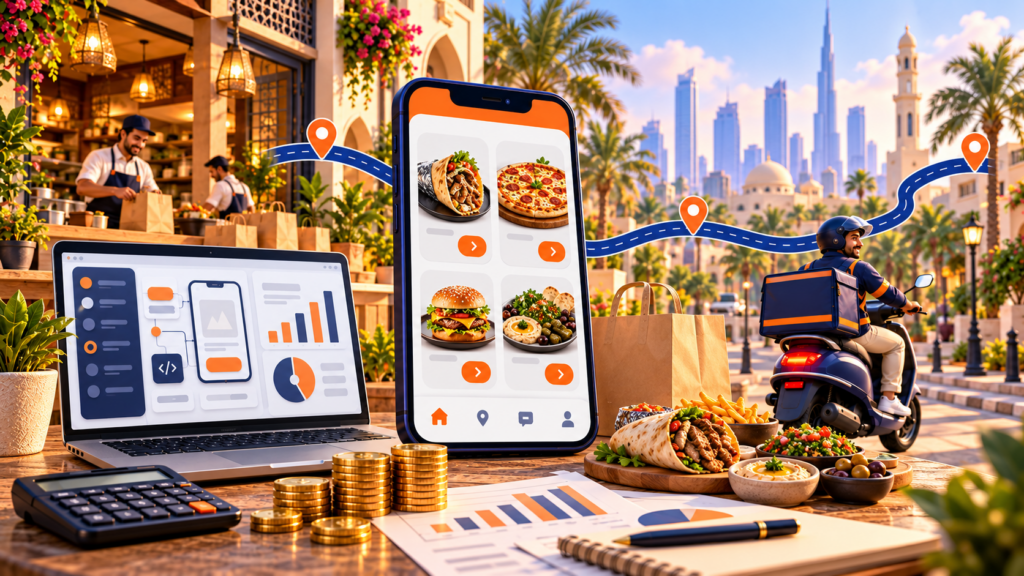
A food delivery app like Talabat is a multi-vendor ordering platform with four connected products: a customer app, a restaurant panel, a driver app and an admin console, all running on a shared dispatch and payments engine. Building that core from scratch typically costs USD 40,000 to 80,000 for a single-city MVP and USD 100,000 to 160,000 for a full marketplace, over 4 to 10 months with an offshore team. Talabat itself is far bigger than its apps: its grocery arm, loyalty subscription and eight-country operations are where its money goes. A white-label platform such as DeliveryStack gives you the same four apps under your brand in 2 to 4 weeks, at a fraction of the upfront cost, with the trade-off that deeply unusual workflows still need custom work.
How much does it cost to build a food delivery app like Talabat?
Building a food delivery app like Talabat costs between USD 40,000 and USD 160,000 for most startups, depending on scope. A single-city MVP sits at the low end. A full multi-vendor marketplace with live tracking, payouts and promotions sits at the high end. A Talabat-scale super app with grocery and subscriptions runs well past USD 250,000 in year one.
The figures below assume a cross-platform build (Flutter or React Native) by an offshore agency at a blended rate of about USD 35 per hour. Rates in the US, UK or Gulf push every number up by two to four times, which we break down later.
Single-city MVP: USD 40,000 to 80,000, 4 to 6 months. You get a customer app, a simple restaurant panel, a driver app and a basic admin console, with one payment gateway and one launch city. This is enough to test whether customers reorder and whether restaurants stay.
Full food marketplace (Talabat core): USD 100,000 to 160,000, 7 to 10 months. Everything in the MVP, plus automatic dispatch, multi-vendor payouts, promotions, ratings, analytics and multi-language support. This is the version most people picture when they say “an app like Talabat”.
Talabat-style super app: USD 250,000 to 500,000+ in year one, 12 months and ongoing. Food plus grocery, dark-store inventory, a paid subscription programme, vendor advertising, and tax and currency handling across several countries. At this level you are funding a permanent product team, not a one-off project.
White-label platform (DeliveryStack): from USD 1,000 for the base platform, 2 to 4 weeks. You get customer, driver, store and admin apps under your own brand, for one vertical in one city to start. Customisation, extra verticals and support plans are quoted separately.
One honest caveat: the build is rarely the largest cost. Driver supply, restaurant acquisition and customer incentives usually cost more than the software within the first year of operation.
What exactly are you copying when you build an app like Talabat?
Talabat is the largest on-demand delivery platform in the Middle East, founded in Kuwait in 2004 and now operating in eight countries. When founders say “an app like Talabat”, they usually mean its food marketplace. The company has since grown into an everyday app covering grocery, retail and a paid loyalty programme, and that wider business is what makes it expensive.
Talabat at a glance
Footprint. Talabat operates in the UAE, Kuwait, Qatar, Bahrain, Oman, Jordan, Iraq and Egypt. Delivery Hero acquired it in 2015, and Talabat Holding listed on the Dubai Financial Market in December 2024.
Scale. In its Q2 and H1 2026 results, Talabat reported first-half 2026 gross merchandise value of USD 5.6 billion. More than one in four active customers paid for talabat pro, its subscription, and those members drove 51% of platform GMV.
Where the money goes. Talabat’s board approved a USD 120 million investment programme for 2026, spent on talabat mart (its own grocery dark stores), the talabat pro loyalty programme and new ventures. None of that is app development in the sense a startup budgets for.
What this means for your budget
You are not competing with Talabat’s engineering team on day one. You are building the core loop it started with: browse a menu, pay, dispatch a rider, track the order, settle with the restaurant. That loop is well understood and repeatable, which is why its cost can be estimated with some confidence. The grocery, subscription and ads layers are add-ons you price later, once the core loop has real orders.
Which apps does a Talabat-like platform need?
A Talabat-like platform needs four apps that share one backend: a customer app, a restaurant panel, a driver app and an admin console. Each has its own users and its own failure points. Founders who budget only for the customer app usually discover the other three around month three, which is where most estimates break.
Customer app
Ordering and tracking. This is the iOS, Android and web experience: sign-up with phone OTP, restaurant search and filters, menus with add-ons, cart, checkout, saved addresses and live order tracking on a map. It also carries ratings, reorders, promo codes and push notifications. In the Gulf, Arabic and English with right-to-left layout is a baseline requirement, not an upgrade.
Restaurant panel
Menus, orders and settlements. Restaurants accept or reject orders, set preparation times, switch items off when they run out and see daily sales. The panel also shows commissions and payout statements. If the prep-time estimate does not feed the dispatch engine, riders arrive too early and wait, which costs you money on every order. See how DeliveryStack handles this on its food delivery page.
Driver app
Assignment, navigation and earnings. Riders go online, receive offers, navigate to pickup and drop-off, confirm delivery and track earnings. Background location tracking is the hard part: Apple and Google review it closely, and battery drain complaints are common if it is built carelessly.
Admin console
Running the business. Your operations team approves vendors and riders, edits delivery zones, sets commission and delivery-fee rules, handles refunds and watches a live order map. This is the panel most often left until after launch, and the one that becomes urgent the first week real orders go wrong.
The shared engine underneath
All four apps sit on a backend that handles dispatch and routing, payments and payouts, geofenced zones and analytics. The dispatch engine, which decides which rider gets which order, is the single most expensive component to get right. It looks simple in a demo and behaves very differently at 500 orders an hour.
What does each part of a Talabat clone cost?
A full Talabat-style food marketplace takes roughly 2,900 to 4,350 development hours, which works out to about USD 101,500 to 152,250 at a blended USD 35 per hour. The backend and customer app take the largest share. The breakdown below shows where the hours go so you can see which modules to trim for an MVP.
The two largest modules. The customer app for iOS, Android and web takes 600 to 900 hours, or USD 21,000 to 31,500. The backend, APIs and dispatch engine take the same: 600 to 900 hours, or USD 21,000 to 31,500. Together they account for roughly 40% of the build.
The supporting apps. The driver app needs 350 to 500 hours (USD 12,250 to 17,500). The admin console needs 300 to 450 hours (USD 10,500 to 15,750), and the restaurant panel needs 250 to 400 hours (USD 8,750 to 14,000).
Design, payments and delivery management. Discovery, UX and UI design take 300 to 450 hours (USD 10,500 to 15,750). Payments, wallet and payouts take 200 to 300 hours (USD 7,000 to 10,500). QA, DevOps and project management add another 300 to 450 hours (USD 10,500 to 15,750).
The total. Added up, a full Talabat-style food marketplace comes to 2,900 to 4,350 hours, or USD 101,500 to 152,250 at USD 35 per hour.
These are planning estimates based on typical scopes, not a quote. A single-city MVP usually cuts the customer web app, multi-language support, advanced promotions and analytics, which brings the hours down to roughly 1,200 to 2,200.
Features that add the most cost
Real-time dispatch and batching. Auto-assigning orders by distance, load and prep time, and batching two orders onto one rider, can add 150 to 300 hours on its own. Multi-vendor payouts. Splitting each payment between restaurant, rider and platform, with refunds and partial cancellations, needs its own ledger logic. Cash on delivery. Still common in Egypt, Iraq and Jordan, it adds rider cash reconciliation to the admin console. Scheduled orders and group orders. Each adds edge cases to checkout and dispatch.
What makes a food delivery app cost more or less?
Five decisions account for most of the gap between a USD 40,000 quote and a USD 160,000 quote: your business model, the number of markets, native versus cross-platform apps, how much dispatch logic you need, and the integrations you require. Settle these before asking for quotes, or every vendor will price a different product.
Business model
Single restaurant, chain or marketplace. A single restaurant with its own riders needs no vendor onboarding, commissions or payouts. A multi-location chain adds per-branch zones and menus. A Talabat-style marketplace needs all of it, plus vendor contracts and settlement reports. The marketplace version costs roughly twice the single-restaurant version.
Markets and languages
Every country adds rules. Each market brings its own currency, VAT treatment, payment gateways and sometimes data-residency requirements. Arabic with right-to-left layout touches every screen. Launching in one city first and adding countries later is cheaper than building for eight markets on day one, as Talabat itself did over two decades.
Native or cross-platform
One codebase or two. Flutter or React Native lets one team ship iOS and Android together, which saves 30 to 40% of mobile effort on a typical scope. Native Swift and Kotlin give finer control over background location and performance, at the cost of two codebases to maintain. For most delivery startups, cross-platform is the sensible default.
Dispatch sophistication
Manual, rules-based or optimised. Manual assignment by an operator is cheap and fine for 50 orders a day. Rules-based auto-assignment by distance and rider load suits most launches. Batching, prep-time prediction and route optimisation are what large platforms run, and they are expensive to build and tune.
Integrations
Payments, maps, POS and messaging. Each payment gateway, POS system, SMS provider or accounting tool is a separate integration to build and keep working. Local gateways in the Gulf and Egypt often have thinner documentation than global ones, which adds testing time.
How does developer location change the cost?
Developer location changes the cost of the same Talabat-like build by up to six times. Using a midpoint scope of 3,600 hours, an Indian agency typically lands between USD 90,000 and 162,000, while a US or UK agency lands between USD 396,000 and 648,000. The scope is identical; only the hourly rate changes.
India. Established Indian agencies typically charge USD 25 to 45 per hour, which puts a 3,600-hour build at USD 90,000 to 162,000.
Eastern Europe. Rates of USD 45 to 75 per hour bring the same build to USD 162,000 to 270,000.
UAE and the wider Gulf. Local agencies usually charge USD 70 to 120 per hour, so the build lands at USD 252,000 to 432,000.
US and UK. At USD 110 to 180 per hour, the same scope costs USD 396,000 to 648,000.
Rates are typical ranges for established agencies in 2026 and vary widely by firm. A lower rate is not automatically cheaper: a team without delivery-platform experience will spend paid hours learning what dispatch and payouts require. Ask any vendor for a delivery or marketplace project it has shipped, and check its reviews on Clutch. Aalpha Information Systems, which builds DeliveryStack, holds a 4.9/5 rating from 215+ reviews on its Clutch profile.
What does it cost to run a food delivery app after launch?
Running a Talabat-like app in one city typically costs USD 1,500 to 7,000 a month in infrastructure and third-party services, plus 15 to 20% of the original build cost each year for maintenance. Map and SMS usage grows with every order, so these costs scale with success rather than staying flat.
Cloud hosting: USD 500 to 3,000 per month. Hosting grows with order volume and with the constant location updates that live tracking generates.
Maps, geocoding and routing APIs: USD 300 to 2,000 per month. These are billed by usage, and every tracked order makes many calls, from address lookup to rider ETAs.
SMS OTP and push notifications: USD 100 to 800 per month. SMS rates in the Gulf are higher than in many other markets, so OTP-heavy sign-up flows cost more there.
Payment gateway fees: about 2 to 3% per transaction. The exact rate depends on the gateway, the card type and the country.
App store accounts: USD 99 a year for Apple and USD 25 once for Google. These are set by the Apple Developer Program and the Google Play Console.
Maintenance and updates: 15 to 20% of the build cost every year. This covers iOS and Android updates, payment gateway changes, bug fixes and small feature requests.
The downside founders underestimate is maintenance. A USD 120,000 build carries roughly USD 18,000 to 24,000 a year just to keep working as iOS, Android and payment providers change. A white-label platform folds most of this into a support plan, which is one reason its total cost over three years is usually lower.
How long does it take to build an app like Talabat?
A custom single-city MVP of a Talabat-like app takes 4 to 6 months, and a full food marketplace takes 7 to 10 months, including design, development, testing and app store approval. A white-label platform shortens this to 2 to 4 weeks because the apps, dispatch and payments already exist and only need configuring.
Custom MVP: 4 to 6 months. Discovery and design take 3 to 5 weeks and development takes 9 to 13 weeks. Testing and fixes add 3 to 4 weeks, data loading and training 1 to 2 weeks, and app store review and launch another 1 to 2 weeks.
Full custom marketplace: 7 to 10 months. Discovery and design stretch to 5 to 8 weeks and development to 18 to 25 weeks. Testing takes 4 to 6 weeks, data loading and training 2 to 3 weeks, and app store review and launch 1 to 2 weeks.
White-label with DeliveryStack: 2 to 4 weeks. Week 1 covers configuration of zones, commissions and payout rules. Branding and order-flow and payment testing run through weeks 1 and 2. Vendors, menus and riders are loaded and your team is trained in weeks 2 and 3, and the apps go live on the App Store and Google Play in weeks 3 and 4.
App store review deserves its own warning. Apps that request background location and handle payments are reviewed more strictly, and a rejection can add one to three weeks. The full white-label sequence is set out on DeliveryStack’s how deployment works page.
Should you build custom or use a white-label platform?
Use a white-label platform if your model is a standard food, grocery or courier marketplace and speed to market matters. Build custom if your workflow has no precedent, or if the software itself is the product you plan to license. Most founders entering Gulf or South Asian markets fit the first case, because the core ordering loop is already proven.
Custom development at a glance. A custom build costs USD 40,000 to 160,000 or more upfront and takes 4 to 10 months to launch. Dispatch and payouts are designed and tuned from zero, and you can specify any workflow you want. Branding is fully yours, but your team or vendor owns every future update. The main downside is the budget and months spent before the first order arrives.
White-label with DeliveryStack at a glance. The base platform starts from USD 1,000, with customisation quoted per scope, and launch takes 2 to 4 weeks. Dispatch and payouts run on a proven engine configured to your rules. Branding is fully yours, and the DeliveryStack name does not appear in the apps. Unusual workflows are built on top of the core and quoted separately, and maintenance is covered under a support plan. The main downside is less freedom if your model departs far from standard delivery.
When custom is the right call
Your model is genuinely new. If orders flow in a way no delivery platform supports, such as a hybrid of catering, subscriptions and B2B invoicing, configuring a white-label core can cost more than building the right thing once. Custom also makes sense when you have an in-house engineering team that will own the code for years.
When white-label is the right call
You need to test demand first. Launching one vertical in one city in weeks lets you prove order volume before committing six figures. The budget you would have spent on rebuilding dispatch goes into rider supply and restaurant acquisition instead. DeliveryStack’s comparison with custom development lists the issues that custom builds usually discover after launch, from rider no-shows to refund reconciliation.
A middle route also exists: start on white-label, and once order volume justifies it, invest in custom features on top of the same core rather than starting over.
How can you reduce the cost of a Talabat-like app?
The fastest way to reduce the cost of a Talabat-like app is to launch narrower: one city, one vertical, one payment gateway and cross-platform mobile apps. Each extra market, language or vertical at launch adds weeks of work that earns nothing until orders arrive. Add them once the first city shows repeat customers.
Cut the customer web app at launch. Most delivery customers order on their phones, so a web ordering site can usually wait. Start with rules-based dispatch. Auto-assign by distance and rider load, and leave batching and route optimisation for later. Use one gateway per market. Each additional gateway is another integration to test and maintain. Skip the subscription programme. Talabat added talabat pro long after its core marketplace worked; a loyalty layer is a growth tool, not a launch requirement. Reuse proven components. A white-label core removes the most expensive and riskiest parts, dispatch and payouts, from your budget entirely.
The downside of cutting scope is that a thin product can lose customers to a polished incumbent. Cut what customers do not see, such as admin reports and advanced analytics, before you cut tracking accuracy or checkout speed.
Frequently asked questions
How much does a Talabat clone app cost?
A Talabat clone app costs USD 40,000 to 80,000 for a single-city MVP and USD 100,000 to 160,000 for a full multi-vendor marketplace when built by an offshore team. Gulf, US or UK agencies charge two to four times more for the same scope. A white-label platform such as DeliveryStack starts from USD 1,000 for the base platform.
How long does it take to build a food delivery app like Talabat?
A custom food delivery app like Talabat takes 4 to 6 months for an MVP and 7 to 10 months for a full marketplace, including app store approval. A white-label platform launches in 2 to 4 weeks, because the customer, driver, restaurant and admin apps are already built and only need configuring.
How does Talabat make money?
Talabat earns commissions from restaurants and stores, delivery fees from customers, subscription fees from talabat pro members, advertising from vendors who pay for visibility, and retail margins from talabat mart, its own grocery dark stores. Its own grocery arm and subscription programme have become a growing share of revenue in 2026.
Can I build a food delivery app for under USD 20,000?
Not as a full custom marketplace. USD 20,000 covers a very limited single-restaurant ordering app at offshore rates, without auto-dispatch or vendor payouts. If you need customer, driver, restaurant and admin apps on that budget, a white-label platform is the realistic route, with custom features added as revenue allows.
What tech stack is used for an app like Talabat?
A typical stack uses Flutter or React Native for the customer and driver apps, Next.js for the web ordering site and admin console, and Node.js for the backend APIs. PostgreSQL stores orders, Redis handles real-time rider locations, and a maps provider handles geocoding and routing. Cloud hosting on AWS, Google Cloud or Azure runs it all.
Do I own the app and customer data with a white-label platform?
With DeliveryStack, yes. The apps are published under your company’s own App Store and Google Play accounts, and customer, order, vendor and driver data belongs to you and can be exported. Source code ownership and licensing terms depend on the engagement and are set out in your proposal.
Does it cost more to build a delivery app for the UAE or Saudi Arabia?
The software scope costs about the same, but Gulf launches add specific work: Arabic with right-to-left layout on every screen, local payment gateways, VAT handling and sometimes data-residency rules. These add roughly 10 to 20% to a build. Hiring a Gulf-based agency, rather than an offshore one, raises the hourly rate far more than the scope does.
What should you do next?
Write down three things before you ask anyone for a price: your launch city, your business model (single restaurant, chain or marketplace) and the one vertical you will start with. Those three answers decide most of the cost. Then compare a custom quote against a white-label proposal on the same scope, including three years of maintenance.
If you want to see what a Talabat-style platform looks like under your own brand before committing a budget, book a DeliveryStack demo. The team will walk through the customer, driver, restaurant and admin apps and send an itemised proposal for your market. Pricing details are on the DeliveryStack pricing page.