ChatGPT
 Claude
 Gemini
 Grok
How Much Does It Cost to Build an On-Demand App?
TLDR
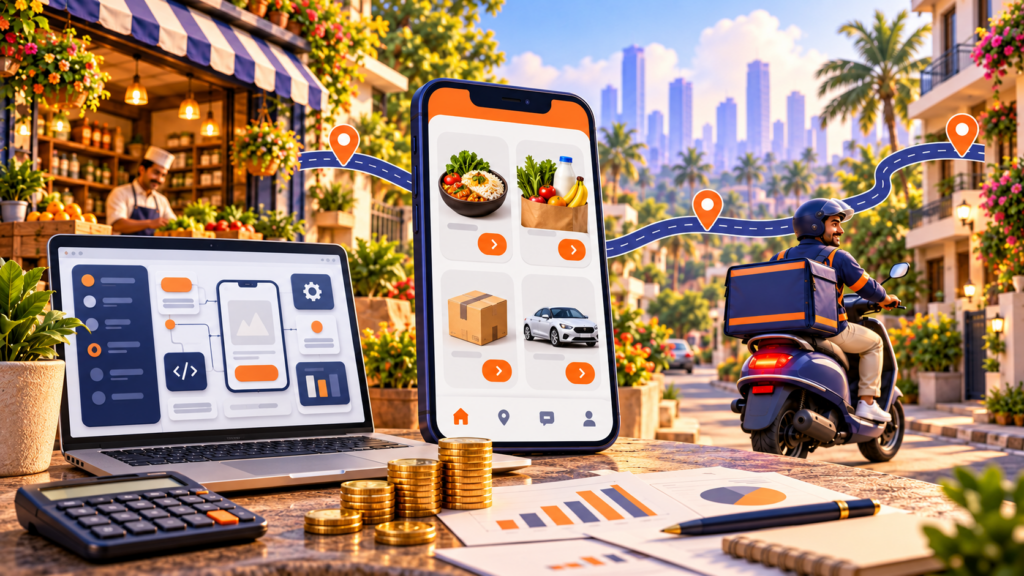
On-demand app development cost is the total price of building the four connected products every on-demand business runs on: a customer app, a driver or provider app, a merchant or store panel, and an admin console, plus the dispatch and payments engine that ties them together. A custom build usually costs US$25,000 to US$60,000 for a lean MVP, US$60,000 to US$150,000 for a market-ready platform, and US$150,000 to US$300,000 or more for a multi-city, multi-vertical system. Budget another 15% to 25% of the build cost every year for maintenance, hosting and third-party fees. A white-label platform such as DeliveryStack starts from US$1,000 for the base platform on one vertical and goes live in 2 to 4 weeks, with customisation quoted separately. Custom development makes sense when your operating model has no precedent. For food, grocery, courier, taxi and bike taxi businesses, buying the core and customising the edges is usually cheaper and faster.
The short answer to how much it costs to build an on-demand app is US$25,000 to US$300,000 or more for a custom build, depending on scope. The number moves with four things: how many apps you need, how smart your dispatch has to be, how many payment and logistics integrations you connect, and where your development team is based.
Most quotes you receive will cover only the first launch. They rarely include the work that surfaces under real order volume, such as failed driver assignments, refund logic and app store rejections. This guide breaks the cost down by tier, app type, module and region, then lists the costs that arrive after launch, so you can compare a custom quote against a white-label platform on equal terms.
How much does an on-demand app cost at each stage of build?
A custom on-demand app costs US$25,000 to US$60,000 as an MVP, US$60,000 to US$150,000 as a market-ready platform, and US$150,000 to US$300,000 or more as an enterprise system. The tier depends on how many apps you ship, how dispatch decides who gets each order, and how many cities, currencies and payment methods you support from day one.
A lean MVP covers one city and one vertical, with cross-platform customer and driver apps, a basic web admin, nearest-driver dispatch and a single payment gateway. It costs US$25,000 to US$60,000 and takes 3 to 5 months to build.
A market-ready platform adds a merchant panel, polished apps, automatic dispatch with order batching, a wallet, a promo engine, ratings and analytics. Expect US$60,000 to US$150,000 and 5 to 9 months.
An enterprise or multi-vertical system runs several verticals on one core across multiple cities and currencies. It adds surge pricing, ERP or POS integrations, compliance controls and high-availability hosting. This tier costs US$150,000 to US$300,000 or more and takes 9 to 15 months.
Assumptions behind these ranges: a blended offshore-plus-senior-review team at US$25 to US$50 per hour, design included, and QA at roughly 15% to 20% of engineering effort. A North American or Western European team will charge two to four times as much for the same scope.
Why the MVP tier is narrower than it looks
A delivery MVP is still three or four apps, not one. Founders often budget for the customer app they picture and forget that drivers need their own app and operations staff need a console to fix things. A US$25,000 MVP is possible only when the admin panel is basic, the driver app is cross-platform and dispatch is simple nearest-available assignment. The downside is that you will rebuild parts of it once order volume exposes the shortcuts.
What pushes a project into the enterprise tier
The jump from mid to enterprise rarely comes from screens. It comes from rules. Batching two orders onto one rider, splitting a payment three ways between customer, store and driver, and handling cash on delivery all need their own logic and testing. Each new country adds tax rules, payment gateways and data residency requirements. Aalpha’s on-demand app development cost guide puts the overall market range at US$15,000 to over US$250,000, which matches what we see in delivery and mobility quotes.
How does the cost change by type of on-demand app?
Courier and single-restaurant apps sit at the low end of the range, food and grocery marketplaces in the middle, and taxi or bike taxi platforms at the high end. The difference comes from dispatch. Moving a parcel tolerates a few minutes of delay. Matching a rider to a passenger needs a decision in seconds, with live fares and surge rules.
Single-restaurant or single-brand delivery apps are the cheapest, at US$25,000 to US$45,000 for an MVP and US$50,000 to US$90,000 for a market-ready version. Courier and parcel apps run US$30,000 to US$50,000 for an MVP and US$60,000 to US$110,000 market-ready.
Food delivery marketplaces cost US$40,000 to US$70,000 as an MVP and US$80,000 to US$160,000 market-ready. Grocery sits slightly higher, at US$45,000 to US$75,000 and US$90,000 to US$170,000. Taxi and ride-hailing apps cost the most, at US$50,000 to US$90,000 for an MVP and US$100,000 to US$200,000 market-ready. Bike and scooter taxi apps follow close behind at US$45,000 to US$80,000 and US$90,000 to US$180,000.
- Food delivery app cost
Food delivery is the most requested vertical and the one with the most hidden logic. The rider should arrive as the food is ready, not before and not after. That means the restaurant’s prep time has to feed the dispatch engine and the customer’s ETA at the same time. Settlement is also three-way, so every refund or partial cancellation touches three balances. See how DeliveryStack handles this on the food delivery page.
- Grocery delivery app cost
Grocery costs more than food because the catalogue is larger and the order changes after it is placed. Out-of-stock items need substitution rules and customer approval. Weighed items such as vegetables need final pricing at packing time, which affects card pre-authorisation. The grocery delivery page covers slots and substitutions.
- Courier and parcel app cost
Courier apps are cheaper to start because there is no menu or catalogue. The cost sits in proof of delivery, address accuracy and multi-stop routing for business clients. Same-city B2B courier work also needs invoicing and credit accounts, which pushes a simple app into the mid tier. Details are on the courier and parcel page.
- Taxi and bike taxi app cost
Ride-hailing is the most expensive to build well. Matching, fare estimation, surge pricing, cancellation fees and in-trip safety all run in real time. A slow match loses the passenger to a competitor within seconds. Bike taxi adds thin margins, so dispatch must keep drivers busy with little dead mileage. See the taxi and ride-hailing and bike and scooter taxi pages.
Which parts of an on-demand app cost the most?
The backend engine costs the most, usually 30% to 40% of the build, because dispatch, payments and real-time tracking all live there. The customer app takes 20% to 25%, the driver app 15% to 20%, the admin console 10% to 15%, and the merchant panel 8% to 12%. Screens are the visible part. The engine is where budgets overrun.
On a US$100,000 build, the core engine takes roughly US$30,000 to US$40,000. That covers dispatch and routing, payments and payouts, zones and geofencing, notifications and APIs. The customer app and website, with sign-up, search, checkout, live tracking, ratings and reorder, take US$20,000 to US$25,000. The driver app, with the online toggle, order acceptance, navigation, proof of delivery and earnings, takes US$15,000 to US$20,000.
The admin console accounts for US$10,000 to US$15,000. It covers vendor and rider approval, the live order map, manual dispatch, refunds, reports and commission rules. The merchant panel, with catalogue, stock toggles, the order queue, prep times and settlement reports, takes US$8,000 to US$12,000.
- Dispatch and routing
Dispatch decides which driver gets which order. A first version that assigns the nearest free driver is quick to build. The cost appears with batching, rejected offers, no-show drivers and peak-hour load balancing, which only show up under real volume. Expect dispatch tuning to continue for months after launch on a custom build.
- Payments and payouts
Taking a card payment is the easy part. Splitting it between the platform commission, the store and the driver, holding it until delivery, then reversing part of it on a refund needs its own ledger. Cash on delivery adds driver cash reconciliation. Every additional gateway or currency adds integration and testing time.
- Real-time tracking
Live GPS on a map looks simple to a customer. Behind it sit location updates every few seconds, battery-aware background tracking on the driver app, and map API calls that are billed per request. Background location also attracts extra review scrutiny from Apple and Google, which can add weeks to approval.
- Admin tooling
Admin features are the most often cut from an MVP budget and the first to become urgent after launch. Support staff need to issue refunds, reassign orders, edit zones and suspend accounts without asking a developer. Without these tools, every operational problem becomes a development ticket.
What factors decide the final price?
Five factors explain most of the difference between two on-demand app quotes: team location, platform choice, feature depth, third-party integrations, and the markets you launch in. Team location alone can change the price by a factor of three or four for identical scope, so compare quotes on hours and seniority, not only the total.
- Team location and hourly rates
Agencies in India and South Asia typically charge US$25 to US$50 an hour, so a 3,000-hour build costs US$75,000 to US$150,000. Eastern European teams charge US$40 to US$75 an hour and Latin American teams US$40 to US$70, which puts the same build at roughly US$120,000 to US$225,000. Western European and UK agencies charge US$70 to US$150 an hour, or US$210,000 to US$450,000 for the build. US and Canadian agencies charge US$100 to US$200 an hour, which takes the same scope to US$300,000 to US$600,000.
These rates are indicative agency ranges, not quotes, and the 3,000-hour figure assumes a market-ready platform with four apps. The lower end of each band usually means a less senior team. A cheaper rate with no senior review on dispatch and payments is the most expensive choice once you count the rework.
- Native or cross-platform apps
Cross-platform frameworks such as Flutter and React Native let one codebase serve iOS and Android, which saves roughly 25% to 35% on the mobile apps. The trade-off is heavier work on background location and battery use for the driver app. Most delivery startups use cross-platform for the customer app and test the driver app hard on low-end Android phones, because that is what most riders carry.
- Feature depth
Every feature has a basic and an advanced version. Promo codes can be a single flat discount or a rules engine with budgets per merchant. Ratings can be stars or a dispute workflow. The advanced version often costs three to five times the basic one, so decide which advanced features are needed at launch and which can wait.
- Third-party integrations
Maps, SMS, push notifications, payment gateways, KYC checks and accounting tools are all paid services with their own setup work. A local payment gateway or a restaurant POS integration can take two to four weeks each. Ask every vendor which connectors already exist and which they will build for you.
- Markets and compliance
Launching in more than one country multiplies languages, currencies, tax rules and payment gateways. Card data handling must follow PCI DSS, and personal data in Europe falls under GDPR. Medical transport or pharmacy delivery may add health-data rules. Compliance work is rarely in a first quote and is expensive to add later.
How long does it take to build an on-demand app?
A custom on-demand app takes 3 to 5 months for an MVP, 5 to 9 months for a market-ready platform, and 9 to 15 months for an enterprise build. A white-label platform shortens this to 2 to 4 weeks because the apps and engine already exist. The work becomes configuration, branding, data loading and app store submission.
A custom build moves through six phases. Discovery and specification take 3 to 6 weeks, UI/UX design 4 to 8 weeks, and development 3 to 9 months. QA and app store review add 3 to 6 weeks, data loading and team training 1 to 2 weeks, and launch about a week.
On DeliveryStack, configuration mapping takes 2 to 3 days, and branding is applied to existing screens in 3 to 5 days. There is no core development phase, because only custom features are built and those are quoted separately. Testing against your business rules takes 3 to 5 days, data loading and training another 3 to 5 days, and launch 2 to 3 days.
What delay costs
Time has a price beyond developer invoices. Every month of build is a month of salaries, office costs and marketing plans on hold with no orders coming in. A competitor or aggregator can also take the market you were preparing for. If your monthly burn is US$15,000, a six-month build adds US$90,000 before the first order, on top of the development fee. The four-step sequence behind a 2 to 4 week launch is set out on how deployment works.
What costs come after launch?
Plan for 15% to 25% of the original build cost every year to keep a custom on-demand app running. That covers maintenance, OS updates, hosting, and the usage-based fees for maps, SMS and payments. On a US$100,000 build, that is US$15,000 to US$25,000 a year before any new features are added.
For a mid-size platform, maintenance and bug fixes typically run US$10,000 to US$25,000 a year, driven by OS releases, library updates and fixes found under load. Cloud hosting for servers, the database, storage, backups and monitoring adds US$3,000 to US$18,000. Maps and location APIs are billed per geocoding, routing and distance request and cost US$1,500 to US$12,000. SMS, OTP and push notifications add another US$1,000 to US$6,000.
Payment gateway fees are a percentage of each transaction, so they rise with order volume rather than sitting as a fixed cost. App store accounts are the smallest line, at under US$200 a year for Apple’s developer membership and Google Play registration.
These ranges assume a single city with a few thousand orders a day at the upper end. Usage fees grow with order volume, so model them per order, not as a fixed line.
Costs nobody quotes up front
Four items catch most founders out. Dispatch edge cases appear only at real volume, such as drivers who accept and then go offline. App store reviews can reject builds over background location, payments or account deletion rules, adding weeks each time. Payment reconciliation needs its own logic for refunds, partial cancellations and cash collected by drivers. Admin tooling for refunds, zone edits and reports is usually deferred, then becomes urgent in the first month. The DeliveryStack vs custom development page lists these side by side.
Who owns the updates
With a custom build, your team or your vendor owns every update for as long as the app runs. Apple and Google change their requirements every year, and payment gateways deprecate API versions. On a white-label platform, core updates are handled by the platform team under a support plan, and you pay for your own customisations only.
Should you build custom, use white-label, or try no-code?
Choose custom development when your operating model has no precedent or the platform itself is the product you will sell. Choose a white-label platform when you run a standard vertical such as food, grocery, courier, taxi or bike taxi and want to test demand quickly. No-code builders suit a prototype or a demo, but they rarely survive real dispatch and payout volume.
On upfront cost, custom development runs US$25,000 to US$300,000 or more. A white-label platform starts from US$1,000 for the base, with customisation quoted separately, and a no-code builder charges a low monthly subscription. On time to launch, custom takes 3 to 15 months, white-label 2 to 4 weeks, and no-code 4 to 8 weeks.
The bigger differences sit in the engine. A custom build designs and tunes dispatch and payouts from zero, a white-label platform brings a proven engine configured per vertical, and no-code tools offer basic dispatch or none. Branding is fully yours with custom or white-label, but often partial with no-code. Each route carries a different main risk. Custom overruns on scope and time. White-label means paying for customisation when your model departs far from the core. No-code means hitting limits and rebuilding.
When custom development is the right call
Custom makes sense when no standard delivery or mobility pattern fits your operation, when you plan to license the software itself, or when you have an in-house engineering team to own it for years. The downside is that you discover dispatch, payment and admin complexity during the build, and each discovery moves the launch date.
When white-label is the right call
White-label suits operators who compete on service, local supply and marketing rather than on software. You start with apps and an engine that already run in production and spend the budget on drivers, merchants and customers. The downside is that workflows far outside the core need paid customisation, and you should check source code and licensing terms before you sign. DeliveryStack, built by Aalpha Information Systems, is one example, with customer, driver, store and admin apps for food, grocery, courier, taxi and bike taxi.
When no-code is enough
No-code is useful to show investors a clickable flow or to run a small pilot by hand. It stops being enough once you need automatic driver assignment, split payouts or thousands of orders a day. Plan for a rebuild if the pilot works. The vs no-code builders page explains where they hit their limits.
How can you reduce the cost of an on-demand app?
The biggest saving comes from not rebuilding what already exists: launch one vertical in one city, buy or license the core engine, and spend custom budget only on what makes you different. After that, cross-platform apps, a phased feature list and a team with prior delivery experience each cut cost further.
Launch narrow, then expand
One vertical in one city exposes your real dispatch and payout problems at low cost. Add a second vertical or city once order data tells you what to build. On a multi-vertical platform, a new vertical is configured rather than coded, so expansion does not restart the budget.
Separate launch features from later features
Write two lists before you ask for quotes: what must work on day one, and what can wait for month three. Loyalty programmes, subscriptions, advanced analytics and scheduled orders usually belong on the second list. This alone can take 20% to 30% off a first build.
Hire a team that has built dispatch before
A team that has shipped delivery or ride-hailing apps knows where the edge cases are. They will price batching, refunds and cash reconciliation into the first quote instead of finding them mid-build. Ask for live apps you can download, not only screenshots. Aalpha’s record is on Clutch, rated 4.9 out of 5 from more than 215 reviews.
How do you estimate the budget for your own app?
Start from five decisions and the right tier follows. Answer them before you request quotes, and every vendor will price the same scope.
- Vertical: food, grocery, courier, taxi, bike taxi, or several on one platform.
- Business model: single brand with its own fleet, multi-vendor marketplace, or fleet operator.
- Apps needed: customer, driver, merchant, admin, plus any corporate or fleet-owner portal.
- Launch market: number of cities and countries, languages, currencies and payment gateways.
- Custom features: workflows no standard platform covers, each listed and described.
If your answers fit one vertical in one city with standard workflows, a white-label platform will almost always be cheaper and faster than a custom MVP. If several answers are unusual, get a custom estimate as well and compare the two over three years, including maintenance, not only the launch price.
What should you do next?
Send your five answers to the DeliveryStack team for an itemised proposal. It shows the base platform price, each customisation as its own line, and a delivery plan. You can request a quote or book a platform demo, and see how pricing is built on the pricing page.
Frequently asked questions
How much does it cost to build an app like Uber or DoorDash?
A close copy of Uber or DoorDash at their current scale would cost millions, because those companies run large engineering teams continuously. A focused app with the same core flows for one city costs US$60,000 to US$200,000 custom. A white-label platform with the same flows starts from US$1,000 for the base on one vertical.
What is the cheapest way to launch an on-demand delivery app?
The cheapest way is to license a white-label platform for one vertical in one city and publish it under your own brand. You avoid paying to build dispatch, payments and four apps from scratch. Customisation is added only where your business needs it, and you can expand once orders prove demand.
How much does an on-demand app cost to maintain each year?
A custom on-demand app costs 15% to 25% of its build price each year to maintain. That covers bug fixes, OS updates, hosting, and usage fees for maps, SMS and payment gateways. Usage fees grow with order volume, so a busy platform pays more than a quiet one with the same code.
How long does it take to launch an on-demand app?
A custom on-demand app takes 3 to 5 months for an MVP and 5 to 9 months for a market-ready platform. A white-label platform such as DeliveryStack goes live in 2 to 4 weeks. That time covers configuration, branding, testing, data loading, team training and app store submission.
Is a white-label delivery app cheaper than custom development?
For standard delivery and mobility models, yes, because the core apps and engine are already built and tested. The saving shrinks as your requirements depart from the standard model, since custom features are quoted on top. If your workflows match no existing platform, custom development may cost less in the long run.
Do I own my app and customer data on a white-label platform?
On DeliveryStack, the apps are published under your company name and developer accounts, and customer, order, vendor and driver data belongs to you. Source code ownership and licensing terms vary by engagement and are set out in the proposal. Check these terms with any white-label vendor before signing.
Can I add grocery or rides to a food delivery app later?
Yes, if the platform shares one core engine across verticals. On a multi-vertical platform, a new vertical such as grocery or bike taxi is configured from the admin panel rather than rebuilt. On a single-purpose custom build, adding a vertical usually means a new development project.