ChatGPT
 Claude
 Gemini
 Grok
How to Build a Grocery Delivery App in Jordan: A Complete Guide
TLDR
A grocery delivery app in Jordan is a mobile platform that lets shoppers order groceries from a supermarket, a chain or a dark store and receive them at home, often within 20 to 60 minutes in Amman. Building one means connecting four parts: a customer app, a store or picker app, a driver app and an admin panel, all working in Arabic and English. The fastest route to market is a white-label platform such as DeliveryStack, which puts your branded apps live in 2 to 4 weeks, while a custom MVP typically costs USD 30,000 to 60,000 and takes 4 to 6 months. You also need to plan for CliQ and cash on delivery payments, Jordan's Personal Data Protection Law and health certificates for delivery staff. Online grocery is still a small slice of total grocery spending in Jordan, which leaves real room for focused local players.
Jordan has almost universal smartphone access, an instant payment system that doubled its volume in a year, and a grocery e-commerce segment that is still early. That mix makes it one of the more interesting delivery markets in the Levant. This guide is for supermarket chains, independent retailers, logistics companies and founders who want to launch a grocery delivery app in Jordan. It covers the market, business models, features, local rules, technology, the build process, costs and how to choose between a custom build and a white-label platform.
What is a grocery delivery app in Jordan and how does it work?
A grocery delivery app in Jordan is a digital ordering and fulfilment system that connects shoppers, stores and drivers. The shopper picks products in the app and pays. The store receives the order, a picker prepares it, and a driver delivers it with live tracking. The admin team controls pricing, zones, promotions and payouts from one dashboard.
How a typical order flows
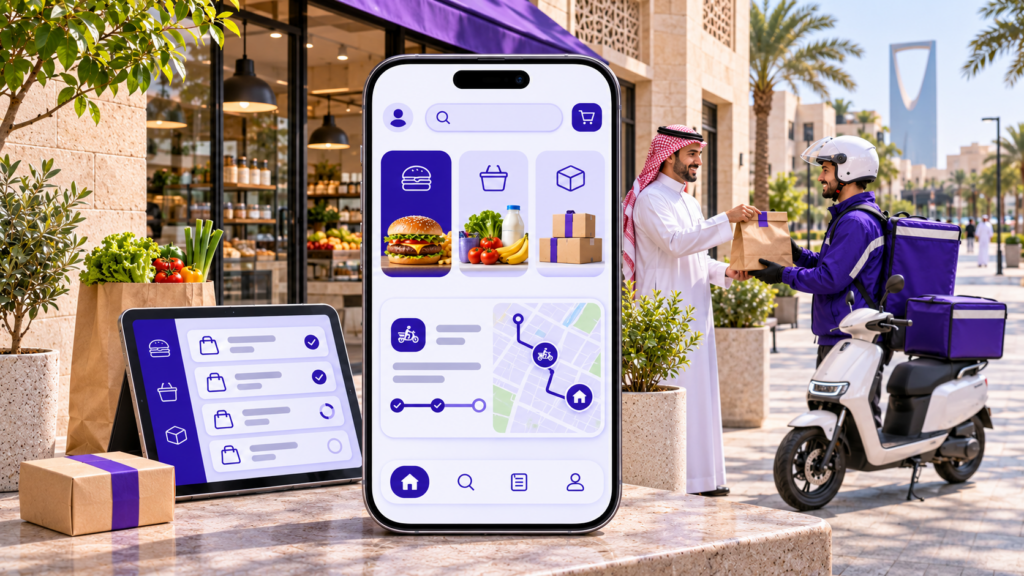
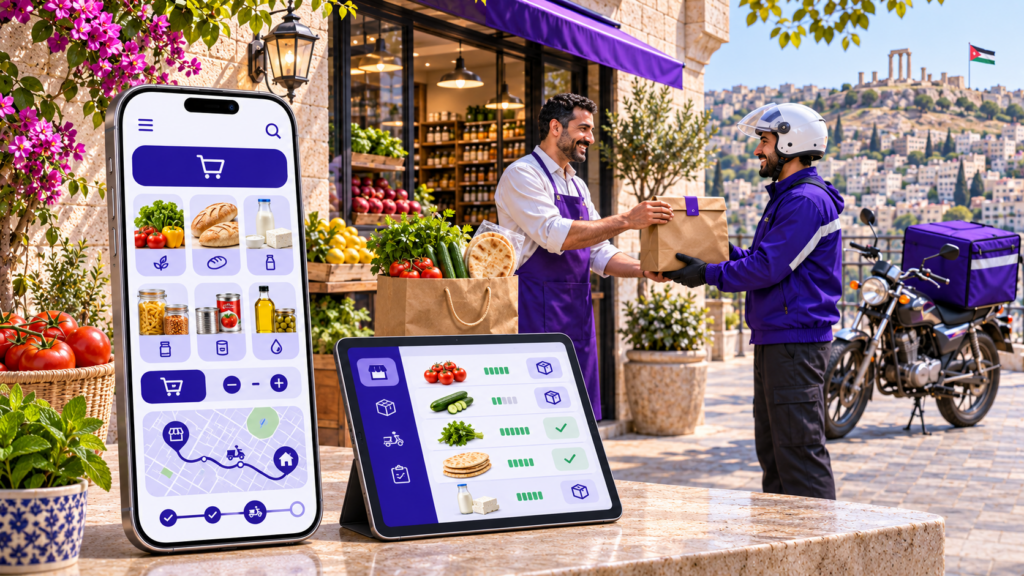
From cart to doorstep. A customer in Abdoun or Irbid opens the app, sets a delivery pin and sees only the stores and products available in that zone. They add items, choose a delivery slot or express delivery, and pay by CliQ, card, wallet or cash on delivery. The order lands on the store tablet, where a picker collects the items and flags anything out of stock. The customer approves or rejects suggested substitutions in the app. Once the bags are sealed, the system assigns the nearest available driver, who collects the order and delivers it while the customer watches the route on a map.
Who uses the platform
Four user groups, four interfaces. Customers use the shopping app. Store staff use a picker or merchant app to accept, prepare and hand over orders. Drivers use a separate app for assignments, navigation and proof of delivery. Operations and finance staff use a web admin panel to manage catalogues, zones, fees, drivers, refunds and reports. A grocery app only works well when all four are designed together, because a delay in any one of them shows up as a late order for the customer.
Is Jordan a good market for a grocery delivery app in 2026?
Yes, for businesses that pick a clear niche or region. Jordan’s population is digitally connected and increasingly pays online, yet online grocery is still a small share of total grocery sales. The main risk is competing head on with large super apps on speed in central Amman, which is expensive. Focused models have more room.
Smartphone and internet reach
Almost every household is reachable on mobile. The Ministry of Digital Economy and Entrepreneurship’s household survey found that 97.5% of Jordanian households owned at least one smartphone in 2024, up from 95.7% in 2023, with Amman at 99%. DataReportal estimates that Jordan had about 11.1 million internet users at the end of 2026, an online penetration of 95.6%, against a population of roughly 11.7 million. In practical terms, your app’s audience is limited by trust and habit, not by access.
Digital payments are scaling fast
CliQ has changed how Jordanians pay. According to the Jordan Payments and Clearing Company (JoPACC), CliQ instant payments roughly doubled in 2025 to 167.92 million transactions worth JOD 19.97 billion, and the instant payments user base grew to 3.93 million. This matters for grocery apps because CliQ lets customers pay straight from their bank app without a card, which lowers checkout friction for shoppers who never used cards online.
Online grocery is still early
Headroom exists, but customers still need convincing. ECDB estimates that food e-commerce in Jordan generated about USD 9 million in 2025, growing 15% to 20% a year, with an online share of total food sales still below 5%. Low penetration means most households still buy groceries in person. Your app has to win on reliability, fresh produce quality and fair pricing, not only on convenience.
Who you are competing with
Two super apps lead, and both focus heavily on Amman. talabat describes itself as Jordan’s largest online grocery and retail platform. As of February 2026, its talabat mart arm ran 13 dark stores around the clock with delivery in as little as 20 minutes, and it lists partners such as the Military Consumer Establishment, Safeway, Hypermax and Centro. Careem launched a Supermarkets service in Jordan in April 2025 and operates in Amman, Irbid and Zarqa. The gaps these players leave are just as clear: supermarket chains that want their own customer relationship and data, cities outside the main Amman delivery zones, scheduled weekly family shops, specialist categories such as organic or imported foods, and B2B supply to restaurants and offices.
Which grocery delivery business model should you choose in Jordan?
Choose the model that matches the assets you already have. A supermarket chain should start with its own branded app. A founder without stock should start with a multi-vendor marketplace in one city. Dark-store quick commerce suits only well-funded teams, because it carries the highest fixed costs and faces the strongest incumbent in Jordan.
Single-store or chain-owned app
Best for existing supermarkets and chains. You sell your own stock under your own brand, keep the full margin and own the customer data. You can tie the app to your loyalty programme and point-of-sale system. The downside is that you must drive every download yourself, because you do not get the traffic a marketplace already has.
Multi-vendor marketplace
Best for founders and logistics companies. You onboard several local supermarkets, butchers, bakeries and fruit shops, and earn a commission or markup on each order plus a delivery fee. You hold no inventory, so capital needs are lower. The downside is the classic marketplace problem: shoppers will not come without enough stores, and stores will not join without shoppers, so you need a tight launch zone and a few anchor partners.
Dark-store quick commerce
Best for teams with capital and a dense target area. You run small fulfilment warehouses close to customers and promise delivery in 15 to 30 minutes. You control stock, picking speed and freshness. The downside is cost: rent, inventory, staff and waste start on day one, and talabat mart already runs 13 dark stores in the Kingdom. Enter this model only with a clear edge, such as a specific neighbourhood cluster or a specialist range.
Scheduled and bulk delivery
Best for family shops and cities outside Amman. Customers book a delivery slot for a weekly or monthly shop, which lets you batch orders by area and cut cost per drop. This works well for large Jordanian households and for governorates where express delivery is hard to sustain. The downside is lower impulse ordering, so you depend on recurring lists, reminders and subscriptions to keep frequency up.
How grocery apps make money
Stack several revenue streams. Most grocery apps in the region combine product margin or vendor commission with delivery fees, small-basket fees and a paid membership that offers free delivery above a minimum order. Sponsored product placements from brands and B2B accounts for restaurants, cafés and offices add income without extra delivery cost per item. Careem’s paid membership in Jordan, which includes free delivery on grocery orders, shows that local customers already understand subscription-based delivery.
What features does a grocery delivery app in Jordan need?
A grocery delivery app in Jordan needs a bilingual customer app, a picker or merchant app, a driver app and a web admin panel. The features that matter most locally are Arabic search, accurate location pinning, substitutions, delivery slots, CliQ and cash on delivery, and real-time tracking. Build these well before adding extras.
Customer app
Built for fast repeat shopping. The customer app needs phone-number sign-in with a one-time password, location-based store and product availability, and a catalogue with clear categories, weights and prices in Jordanian dinars. Search must understand Arabic and English spelling variations. Shoppers expect saved lists, quick reorder, express or scheduled delivery, substitution preferences, promo codes, live order tracking, in-app chat or calling with the driver, ratings and order history. A digital wallet for refunds and loyalty points keeps money inside your platform.
Store and picker app
Built for accuracy under time pressure. Store staff need to accept or reject orders, see a picking list sorted by aisle, scan barcodes to confirm items, enter actual weights for produce and meat, and propose substitutions that the customer approves in real time. Stock availability should sync with the store’s point-of-sale or ERP system so shoppers do not order items that are not on the shelf. A clear handover screen shows when the driver has collected the bags.
Driver app
Built for speed and proof. Drivers need online and offline status, order offers with pickup and drop details, turn-by-turn navigation, one-tap calling, cash collection records and proof of delivery by photo or code. The app should also store each driver’s documents, including vehicle papers and health certificates, with expiry reminders. This supports the driver verification rules described later in this guide.
Admin panel
Built for control. Operations teams use the admin panel to manage stores, catalogues, prices, delivery zones, fees, slots, drivers, promotions, refunds and payouts. Finance needs settlement reports per store and per driver, including cash on delivery reconciliation. Management needs dashboards for order volume, average basket size, fulfilment time, fill rate, cancellations and repeat rate.
Features that set you apart
Small touches that build habit. Ramadan and Eid bundles, family-size packs, recurring weekly baskets and freshness guarantees on fruit, vegetables and meat give customers reasons to choose you over a bigger app. AI-based recommendations that suggest previously bought items and similar alternatives help raise basket size, and large local players already use them, so treat them as an expected feature rather than a bonus.
What Jordan-specific requirements should you plan for?
Plan for six local factors from day one: Arabic right-to-left design, landmark-based addresses, local payment methods, the Personal Data Protection Law, food safety rules from the Jordan Food and Drug Administration, and delivery regulations from the Telecommunications Regulatory Commission. Each one changes your app design, not only your paperwork. This section is a practical guide, not legal advice, so confirm details with a Jordanian lawyer.
Arabic-first, right-to-left design
Design in Arabic first, then English. Most of your shoppers will use the app in Arabic. A layout designed in English and flipped later often breaks: icons point the wrong way, numbers misalign and text gets cut off. Design both languages together, let users switch at any time, and make search tolerant of common Arabic spelling variations such as different forms of alef and taa marbuta. Product names should appear in both languages, because many imported brands are known by their English names.
Addresses and location accuracy
Use pins, landmarks and building details. Many Jordanian customers describe locations by area, nearby landmarks and building names rather than formal street addresses. Your checkout should start with a map pin, then collect building name or number, floor, apartment and a free-text landmark note. Saving multiple addresses per customer and letting drivers call the customer in one tap prevents most failed deliveries.
Payments: CliQ, wallets, cards and cash
Offer more than cards. CliQ, operated by JoPACC under the supervision of the Central Bank of Jordan, supports instant account-to-account transfers, request-to-pay and QR payments, and it is interoperable with JoMoPay mobile wallets. Integrate card payments through a local acquiring bank or gateway, add CliQ for bank-app payments and keep cash on delivery for customers who are not ready to pay online. Remember that the Jordanian dinar divides into 1,000 fils, so prices and totals must support three decimal places throughout your system.
Personal Data Protection Law
Design for consent and data residency. Jordan’s Personal Data Protection Law No. 24 of 2023 came into force on 17 March 2024, and organisations had until March 2025 to comply in full, according to the Ministry of Digital Economy and Entrepreneurship. It covers the personal data of people in Jordan, which includes the names, phone numbers, addresses and order histories your app stores. Build clear consent screens, a privacy policy in Arabic and English, data access and deletion requests, and breach response procedures. The law restricts transfers of personal data outside Jordan unless conditions are met, so decide early where your servers and backups will live.
Food safety and the JFDA
Treat drivers as food handlers. The Jordan Food and Drug Administration (JFDA) is the authority that supervises food safety at every stage. It has required people who work in food delivery to hold health certificates showing they are free of infectious diseases, and it runs inspection campaigns with the Telecommunications Regulatory Commission. Meat, poultry, dairy and frozen items also need cold-chain handling, so plan insulated bags, temperature-aware picking order and maximum delivery times for chilled goods. If you run a dark store, it must be licensed as a food establishment.
Delivery regulations from the TRC
Verify every driver and vehicle. In March 2025 the Telecommunications Regulatory Commission introduced new delivery regulations covering motorbike and vehicle deliveries. They raise the compliance bar for platforms, with checks on drivers before approval, ongoing performance tracking, vehicles that meet updated safety rules and a central driver database. Your driver onboarding flow should collect and verify documents before a driver can go online, and your admin panel should flag expired documents automatically.
What tech stack works best for a grocery delivery app in Jordan?
A reliable stack for a grocery delivery app in Jordan is Flutter or React Native for the mobile apps, Node.js for the backend, Next.js for the admin panel, PostgreSQL and Redis for data, and Google Maps Platform for location. This combination supports Arabic well, scales with demand and keeps one codebase per app for iOS and Android.
Mobile apps
One codebase, two stores. Flutter and React Native both handle right-to-left layouts and let one team ship the customer, picker and driver apps on iOS and Android. This cuts build and maintenance cost compared with fully native apps. The downside is that background location tracking and some device features still need native code, so budget a little time for platform-specific work on the driver app.
Backend, admin panel and real-time updates
Event-driven and API-first. A Node.js backend with a REST or GraphQL API handles orders, stock, pricing, payments and dispatch. WebSockets push live order and driver updates to every app. A Next.js admin panel gives operations teams a fast, secure web interface. PostgreSQL stores orders and catalogues, Redis handles caching and live driver positions, and a search engine such as Elasticsearch or Meilisearch with Arabic text analysis powers product search.
Maps, messaging and integrations
Connect what already works. Google Maps Platform covers geocoding, pin drop, routing and travel-time estimates. Firebase Cloud Messaging sends push notifications, and an SMS provider with good delivery rates on Jordanian networks sends login codes. Payment integrations cover your acquiring bank or gateway for cards and CliQ. For supermarkets, an integration with the existing point-of-sale or ERP system keeps prices and stock in sync.
Hosting
Choose the region with the law in mind. Cloud hosting on AWS, Google Cloud or Azure keeps costs flexible as order volume grows. Because the Personal Data Protection Law limits transfers of personal data outside Jordan, confirm your hosting region and backup locations with legal counsel before launch rather than after.
How do you build a grocery delivery app in Jordan step by step?
Build a grocery delivery app in Jordan in seven steps: validate your area and model, define a lean MVP, design in Arabic first, build and integrate, prepare operations, soft launch in one area, then scale. Most failures come from skipping the operations step, not from the code.
Step 1: Validate your area and model
Start with one city and one promise. Pick a launch zone, such as a cluster of West Amman neighbourhoods, Irbid or Zarqa, and decide what you promise: express delivery, scheduled family shops or a specialist range. Talk to 20 to 30 target customers and three to five potential store partners. Check order frequency, typical basket size and what annoys them about the apps they already use.
Step 2: Define a lean MVP
Ship what the first 1,000 orders need. Your MVP should include the four apps, Arabic and English, zones, slots, substitutions, CliQ, card and cash on delivery, tracking and basic reporting. Leave AI recommendations, complex loyalty tiers and multi-city support for later versions. A tight scope gets you to real customer feedback faster.
Step 3: Design an Arabic-first experience
Prototype before you code. Create clickable prototypes in both languages and test them with real users. Check that a first-time user can find a product, set a location and pay in under three minutes. Fix confusion at this stage, when changes are cheap.
Step 4: Build and integrate
Develop in short sprints with weekly demos. Build the backend and admin panel first, then the customer, picker and driver apps. Import the catalogue with photos, Arabic and English names, weights and prices. Connect payments, maps, SMS and the store’s point-of-sale system. Test cash on delivery reconciliation and refunds as carefully as online payments.
Step 5: Prepare operations
Get people, packaging and paperwork ready. Train pickers on the picking app and substitution rules. Recruit and verify drivers, including health certificates and vehicle documents. Buy insulated bags for chilled and frozen items and set maximum delivery times for them. Write a simple playbook for late orders, missing items and refunds.
Step 6: Soft launch in one area
Learn on a small scale. Open to a limited group of customers in your first zone for two to four weeks. Track fulfilment time, fill rate, substitution acceptance, failed deliveries and support tickets every day. Fix the top issues before you spend on marketing.
Step 7: Launch and scale
Grow zone by zone. Publish the apps, start campaigns and add stores or zones only when your current area hits its targets for delivery time and repeat orders. Add features based on what customers actually ask for, not on what competitors advertise.
How much does it cost to build a grocery delivery app in Jordan?
A custom grocery delivery MVP for Jordan typically costs USD 30,000 to 60,000 and takes 4 to 6 months. A full platform with dark-store inventory, advanced dispatch and loyalty can cost USD 70,000 to 150,000 or more over 6 to 9 months. A white-label platform costs far less upfront and can launch in 2 to 4 weeks.
Assumptions behind these numbers
Know what the estimate includes. These ranges assume an experienced offshore team at a blended rate of USD 25 to 40 per hour, cross-platform customer, picker and driver apps, a web admin panel, Arabic and English, and integrations with one payment gateway, CliQ, maps and SMS. Hiring a local in-house team, adding several ERP integrations or building advanced AI features will push costs higher. These are planning estimates, not quotes.
What drives the cost up or down
Scope and integrations matter most. The biggest cost drivers are the number of apps, the business model, the depth of point-of-sale or ERP integration, dispatch logic such as batching and route optimisation, and the number of payment methods. A multi-vendor marketplace costs more than a single-store app because it needs vendor onboarding, commissions and settlements. A dark-store model adds warehouse inventory, purchasing and expiry tracking.
Running costs after launch
Budget for the months after go-live. Expect cloud hosting of roughly USD 300 to 1,500 per month in the early stage, plus usage-based fees for maps and SMS. Apple charges USD 99 a year for a developer account and Google charges a one-time USD 25 fee. Plan around 15% to 20% of the initial build cost per year for maintenance, updates and security patches.
A quick look at unit economics
Basket size decides profitability. As an illustration, assume an average basket of JOD 20 and a gross margin of 20%, which leaves JOD 4 per order. If a delivery costs you JOD 1.5 to 2.5 in driver pay, packaging and fuel, you keep JOD 1.5 to 2.5 before marketing and overheads. That margin is thin. Minimum order values, delivery fees on small baskets, batching scheduled orders by area and higher-margin categories such as fresh bakery or private-label goods are what make the numbers work.
Should you build a custom app or use a white-label platform like DeliveryStack?
Use a white-label platform when speed to market and lower upfront cost matter most, and you want to validate demand before investing heavily. Choose a custom build when your model is unusual, you need deep integration with complex internal systems, or you plan to own and extend the codebase with your own engineering team.
When a custom build makes sense
Full control, higher commitment. A custom build gives you complete freedom over features, data structure and integrations, and the code becomes your asset. It suits large retail groups with unique workflows and businesses that plan a long product roadmap. The trade-off is time and money: you wait months for launch and carry the full cost of maintenance, hosting and security yourself.
When white-label makes sense
Proven software, your brand, live in weeks. A white-label grocery delivery platform gives you ready customer, store, driver and admin apps that are rebranded and configured for your business. DeliveryStack is a white-label on-demand delivery platform built by Aalpha Information Systems. It launches branded apps on the App Store and Google Play under your name in 2 to 4 weeks, and the team handles hosting, uptime, security patches and platform updates after launch, so you can focus on stores, drivers and customers. Because it is built for on-demand delivery from the ground up, it is a practical fit for supermarket chains and delivery start-ups in Jordan.
The honest trade-off. White-label means less freedom for deep, one-off customisation in the first release, and you usually pay a recurring platform fee instead of owning the full codebase. For most new grocery ventures, that trade-off is worth it, because the first months are about learning what Jordanian customers actually order and how often.
Who builds DeliveryStack
An experienced delivery and marketplace engineering team. Aalpha Information Systems has worked on custom software, mobile apps and on-demand platforms since 2008 and holds a 4.9 out of 5 rating from more than 215 reviews on Clutch. Businesses that outgrow white-label can move to a custom build with the same team.
How do you get your first grocery app customers in Jordan?
Win your first customers by launching in one small zone, partnering with trusted local stores, marketing on the social platforms Jordanians already use, and timing offers around Ramadan and Eid. Delivering consistently in one area builds the word of mouth that paid ads cannot buy.
Start hyperlocal
Own a few neighbourhoods first. Dense residential areas with many families and working professionals give you short delivery distances and repeat orders. Being the most reliable option in five neighbourhoods beats being an average option across the whole of Amman.
Borrow trust from known stores
Let familiar names do the selling. Shoppers are more willing to try a new app when they see stores they already trust in it. Co-marketing with partner supermarkets, such as in-store posters, receipt inserts and QR codes at the checkout, turns walk-in customers into app users at low cost.
Use the channels Jordanians use
Facebook, Instagram, Snapchat and WhatsApp. Facebook’s potential ad reach in Jordan was about 5.55 million users at the end of 2025, according to Meta’s advertising data reported by Jordan News. Instagram and Snapchat each reached around 4 million users in early 2025, according to DataReportal. Short videos showing fresh produce, real delivery times and Ramadan bundles tend to work better than generic discount posts. WhatsApp is useful for order updates and customer support.
Time your offers to the calendar
Plan for Ramadan, Eid and back-to-school. Grocery demand shifts sharply during Ramadan, with larger baskets and evening ordering peaks before iftar and late at night. Prepare stock, drivers and dedicated bundles weeks ahead. First-order discounts, free delivery above a minimum basket and referral credits for both the sender and the new customer give people a reason to try you and to come back.
Frequently asked questions about building a grocery delivery app in Jordan
How long does it take to build a grocery delivery app in Jordan?
A custom grocery delivery MVP usually takes 4 to 6 months, including design, development, testing and app store approval. A full platform with dark-store inventory and advanced dispatch can take 6 to 9 months. A white-label platform such as DeliveryStack can launch branded apps in 2 to 4 weeks.
How much does a grocery delivery app cost in Jordan?
A custom MVP typically costs USD 30,000 to 60,000, assuming an experienced offshore team, cross-platform apps and an Arabic and English interface. A full-featured platform can reach USD 70,000 to 150,000 or more. White-label platforms need far less upfront investment and charge an ongoing platform fee instead.
Which payment methods should a grocery app in Jordan support?
Support card payments through a local acquiring bank or gateway, CliQ instant payments from bank apps, mobile wallets connected through JoMoPay, and cash on delivery. CliQ is growing fast, while cash on delivery still matters for first-time online shoppers. Prices must support three decimal places because the dinar divides into 1,000 fils.
Do I need licences to run a grocery delivery service in Jordan?
You need a registered company and the trade licences that apply to your activity. Dark stores must be licensed food establishments, delivery staff need JFDA health certificates, and delivery operations must follow Telecommunications Regulatory Commission rules. You must also comply with the Personal Data Protection Law. Confirm exact requirements with a Jordanian lawyer.
Can a new app compete with talabat and Careem in Jordan?
Yes, if it avoids a head-on speed race in central Amman. New players win by serving a supermarket chain’s own customers, covering cities outside the main delivery zones, offering scheduled family shops or specialising in categories such as organic, imported or bulk goods. Reliability and fresh quality matter more than raw speed.
Should a grocery app in Jordan be in Arabic or English?
It should be in both, designed Arabic first. Most shoppers prefer Arabic, while many imported brands are known by English names. Build right-to-left layouts from the start, let users switch language at any time, and make search handle Arabic spelling variations as well as English product names.
Can a white-label grocery app carry my own brand?
Yes. A white-label platform such as DeliveryStack publishes the customer, store and driver apps under your brand name, logo and colours on the App Store and Google Play. You control pricing, zones, stores and promotions from your own admin panel, while the platform team handles hosting, updates and security.
What is the next step?
If you want to launch a grocery delivery app in Jordan in weeks rather than months, start with a walkthrough of a ready platform. Visit DeliveryStack to see the customer, store, driver and admin apps, and request a demo configured for your city and business model.