ChatGPT
 Claude
 Gemini
 Grok
How to Build an On-Demand Delivery App Like Snoonu?
TLDR
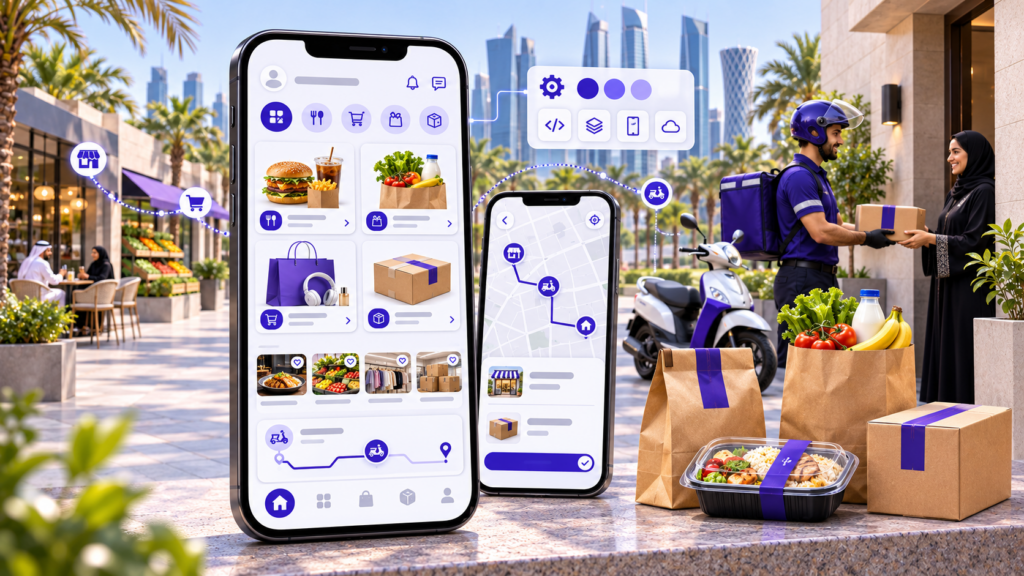
An on-demand delivery app like Snoonu is a multi-vertical platform where customers order food, groceries, parcels and retail goods from one app, and a managed rider fleet delivers them. Building one means launching four connected products: a customer app, a driver app, a merchant panel and an admin console, joined by a dispatch and payments engine. A custom build typically costs USD 40,000 to 210,000 and takes 4 to 12 months, while a white-label platform such as DeliveryStack can go live in 2 to 4 weeks. The proven path is to win one vertical in one city, prove your unit economics, then add services that reuse the same fleet.
What is Snoonu, and why do founders want to build an app like it?
Snoonu is a Qatar-based super app that delivers food, groceries, pharmacy items, gifts, parcels and retail products from a single app. Founders study it because it shows how a local delivery app can grow from one service into a multi-vertical platform with its own fleet, wallet, quick-commerce stores and advertising business.
From startup to regional exit. Snoonu was founded in Doha in 2019 by Hamad Al Hajri. It raised a USD 5 million Series A in 2021, led by Qatar Development Bank. In 2023 it closed a USD 12 million Series B, reported as the first Series B round raised by a Qatari company. In July 2025, Saudi-listed Jahez agreed to buy a 76.56% stake for USD 245 million, valuing Snoonu at about USD 320 million. The deal completed in October 2025, and Snoonu continues to operate under its own brand.
One app, many services. Snoonu’s app store listing describes more than 4,000 shops and services and 11 services in one app. These include restaurant delivery, groceries, a point-to-point courier service called Snoosend, laundry pickup, flowers and gifts, and event tickets. In 2025 it added drive-thru and takeaway ordering alongside delivery, and it runs Snoomart, its own quick-commerce grocery stores.
Expansion through acquisition. In 2022, Snoonu bought Akeed, an Omani food delivery platform, for USD 10 million. It was the company’s first move outside Qatar.
The lesson for founders is not to copy every feature on day one. It is to win one city on speed and reliability, then use the same riders, customers and payment rails to add new verticals. That is how a delivery app becomes a super-app.
Snoonu is a trademark of its owner. DeliveryStack and Aalpha Information Systems are not affiliated with Snoonu. Company facts are drawn from public reports available in November 2026.
How does a delivery app like Snoonu make money?
A Snoonu-style app earns money from several streams at once: commissions on each merchant order, delivery fees from customers, margins on its own quick-commerce stock, in-app advertising, subscriptions and wallet services. A single stream rarely covers rider costs in a competitive market, so mature platforms layer them.
At scale, this mix adds up. Snoonu’s 2024 revenue was reported at SAR 526 million in disclosures around the Jahez deal. Each stream and its main risk are outlined below.
Merchant commission. Restaurants and stores pay a percentage of each order’s value. It is the core stream, but high rates push merchants toward rival apps or their own ordering channels.
Delivery fee. Customers pay a flat or distance-based fee per order. Set it too high and conversion drops; set it too low and you lose money on every delivery.
Small-order or service fee. A fee on baskets below a set minimum protects margin on tiny orders. Show it clearly before checkout, or it will feel unfair.
Quick-commerce margin. With its own dark stores, the platform buys stock and sells it at a margin, as Snoonu does with Snoomart. The trade-off is inventory risk, wastage and warehouse rent.
Advertising. Brands and merchants pay for sponsored listings and banners inside the app. This stream only sells once you have steady daily traffic.
Subscription. Customers pay a monthly fee for free or cheaper delivery. It lifts order frequency, but your heaviest users can make the plan loss-making.
Wallet and payments. Stored value, cashback and partner fees add income and build loyalty. Payment licensing rules differ by country, so this stream usually comes later.
Most new platforms should start with commissions and delivery fees only. Add advertising and subscriptions once order volume is stable. See how DeliveryStack handles commission rules for a multi-vendor marketplace.
What apps make up a delivery platform like Snoonu?
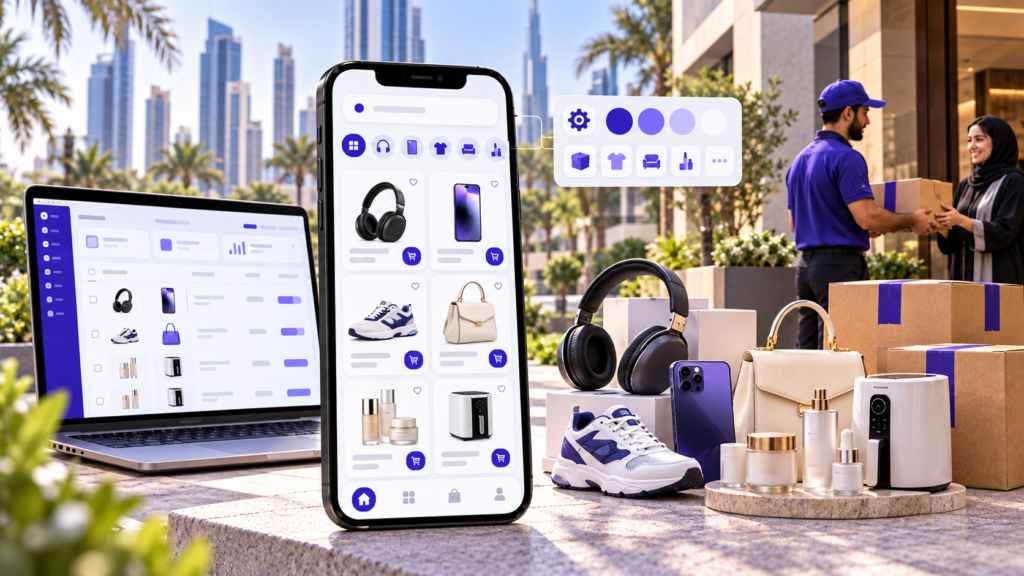
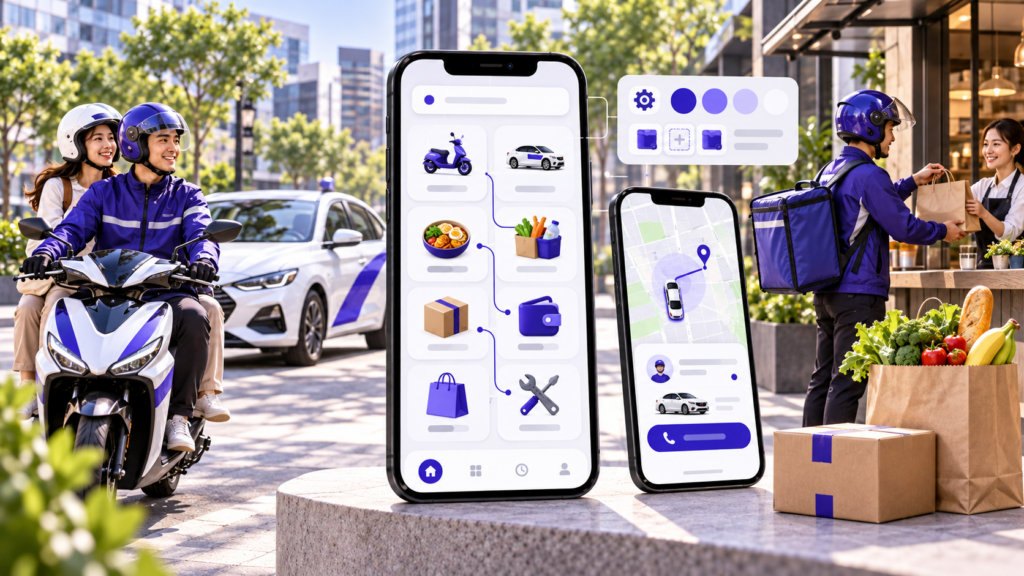
A delivery platform like Snoonu is four apps sharing one backend: a customer app for ordering, a driver app for riders, a merchant panel for restaurants and stores, and an admin console for operations. A dispatch, payments and geofencing engine connects them, so every order status updates in real time across all four.
Shoppers use the customer app on iOS, Android and the web to browse, order, pay and track deliveries. Riders use the driver app to accept jobs, navigate, prove delivery and track earnings. Restaurants and stores use the merchant panel for menus, stock, incoming orders and settlements, while your operations team runs zones, pricing, dispatch, vendors, riders and payouts from the admin console.
Customer app
The customer app is your storefront. It must load fast, show accurate delivery times and make checkout take seconds. In a multi-vertical app, the home screen also has to guide users between food, groceries, courier and other services without clutter. See the customer app module.
Driver app
The driver app decides your delivery speed. Riders go online, receive jobs, follow turn-by-turn routes and confirm drop-off with a photo or OTP. Clear earnings screens matter, because rider churn is one of the biggest hidden costs in delivery. See the driver app module.
Merchant panel
The merchant panel keeps supply accurate. Restaurants and stores accept orders, set preparation times, switch items on or off and download settlement reports. Wrong menus and missing stock are a leading cause of cancelled orders. See the restaurant and store panel.
Admin console
The admin console is where the business is run. Your team approves vendors and riders, sets delivery zones and fees, watches a live order map and fixes late orders. Good admin tools let operations change rules without waiting for a developer. See the admin console.
The core engine underneath
Dispatch, payments and zones do the heavy lifting. The dispatch and routing engine assigns the best rider based on distance, load and preparation time. The payments and payouts layer splits each order between merchant, rider and platform. Zones and geofencing control where you deliver and what you charge.
Which features does an app like Snoonu need?
An app like Snoonu needs multi-service browsing, fast checkout with local payment methods, live order tracking, automatic rider dispatch, merchant menu and stock control, and an admin layer for zones, pricing and payouts. Launch with the features that complete one order end to end, then add loyalty, ads and new verticals.
Customer app features
Multi-service home screen. Users should reach food, groceries, courier and other services in one tap, with the most-used service shown first.
Search, filters and reorder. Search should cover restaurants, stores and individual items. A one-tap reorder button drives repeat orders.
Local payment options. Snoonu supports cards, Apple Pay, a telecom wallet, its own Snoonu Wallet and cash on delivery. Your app should match the payment habits of your market, not a generic list.
Live tracking and notifications. Customers expect to see the rider on a map, with push updates at each stage.
Send-anything courier. A Snoosend-style feature lets users book a pickup and drop between any two addresses. It reuses your existing fleet and adds orders during quiet hours.
Arabic and English with right-to-left layout. In the Gulf, full RTL support is expected, not optional.
Driver app features
Availability and auto-assignment. Riders toggle online or offline and accept jobs that are offered by proximity and load.
Navigation and multi-stop routing. Batching two orders on one trip lowers your cost per delivery.
Proof of delivery. Photo, signature or OTP confirmation reduces disputes.
Earnings and cash handling. Riders see earnings per trip and the cash they hold from cash-on-delivery orders.
Merchant panel features
Order queue with preparation times. Prep time should feed straight into the customer’s estimated delivery time.
Catalogue and stock control. Merchants switch items on or off in real time.
Sales and settlement reports. Clear statements cut merchant support tickets.
Admin console features
Zone, fee and commission rules. Change pricing by area, distance or merchant without code changes.
Live dispatch map with overrides. Ops staff reassign late orders and see exceptions as they happen.
Vendor and rider onboarding. Document checks, approvals and suspensions in one place.
Analytics. Orders, revenue, delivery times and repeat rates, exportable by date.
What belongs in the MVP and what can wait?
Build these in the MVP. Launch with one vertical, such as food, plus card, wallet and cash payments. Add live tracking with push notifications, automatic dispatch with a manual override, and basic promo codes. Together, these complete one order end to end.
Leave these for phase 2 or later. A send-anything courier service, grocery or quick commerce, your own stored-value wallet, subscriptions and loyalty, in-app advertising, and drive-thru or takeaway modes can all wait. Add each one once the core vertical makes money per order.
The downside of a lean MVP is that early users may compare you with a mature app. Offset this with reliability: fast, accurate deliveries matter more than a long feature list.
What technology stack powers a Snoonu-style delivery app?
A Snoonu-style app typically uses cross-platform or native mobile apps, a Node.js or similar backend, PostgreSQL with Redis, a real-time messaging layer for live tracking, a maps platform, push notifications and regional payment gateways, all hosted on a major cloud. The right stack is the one your team can maintain at peak load.
Mobile apps. Flutter or React Native keeps one codebase for iOS and Android, which cuts cost. Native Swift and Kotlin can help when the app leans heavily on maps.
Web ordering and admin. Next.js gives fast, SEO-friendly web ordering and responsive dashboards.
Backend. Node.js handles many concurrent connections, which suits live order and rider updates.
Database and cache. PostgreSQL with PostGIS runs location queries, while Redis caches fast-changing data such as rider positions.
Real-time layer and queues. WebSockets or MQTT push live tracking and status changes. RabbitMQ or Kafka keeps orders flowing during spikes.
Maps and notifications. Google Maps Platform or Mapbox handles geocoding, routing and ETAs. Firebase Cloud Messaging and APNs deliver order and rider alerts.
Payments. Use regional gateways that support cards, Apple Pay and the local wallets your market prefers.
Cloud. AWS, Microsoft Azure or Google Cloud all work at this scale. Snoonu reportedly moved its services to Azure in 2021.
One caution: splitting into many microservices too early adds hosting and engineering cost. A well-structured modular backend is usually enough until you run several verticals across several cities.
How do you build an on-demand delivery app like Snoonu, step by step?
To build an app like Snoonu, pick one city and one vertical, test the unit economics, choose custom or white-label, design for local users, build or configure the four apps, connect payments and maps, run a pilot with real merchants and riders, then launch and add verticals. Each step reduces risk before you spend more.
Step 1: Pick one city and one vertical
Focus beats breadth. Snoonu started in one country before expanding. Choose the vertical with the clearest demand, often food or groceries, and a delivery zone your fleet can cover quickly.
Step 2: Check the unit economics
Every order must make money before you scale. The example below uses illustrative assumptions, not Snoonu’s figures.
Assume an average order value of USD 20.00. An 18% merchant commission earns USD 3.60, and a flat delivery fee adds USD 1.50, giving USD 5.10 of revenue per order.
Now subtract the costs. Rider cost is USD 3.00 per delivery. Payment processing at 2.5% of the USD 21.50 the customer pays is about USD 0.54. Discounts average USD 0.50, and support and refunds another USD 0.30. That leaves a contribution of USD 0.76 per order.
The margin is thin. If rider cost rises to USD 3.80, contribution drops to about zero. This is why batching, rider utilisation and smaller discounts matter more than new features.
Step 3: Choose how you will build
Custom, white-label or hybrid. A custom build gives full control but takes months. A white-label platform launches in weeks with a proven core. A hybrid adds custom modules on top of a white-label base. The comparison section below covers the trade-offs.
Step 4: Design for local users
Local details drive conversion. In Qatar, many addresses use zone, street and building numbers, so address entry should support that format and a map pin. Plan Arabic and English, RTL layouts and local payment methods from the first sprint.
Step 5: Build or configure the four apps and the engine
Ship the full order loop first. Customer order, merchant acceptance, rider assignment, delivery and payout must all work before any extras.
Step 6: Integrate payments, maps and messaging
Third-party services carry hidden work. Payment gateways need merchant accounts and approvals. Maps and SMS are billed per use, so budget for them.
Step 7: Run a pilot
Test with real riders and merchants. Run 2 to 4 weeks in a small zone with a limited set of merchants. Fix dispatch rules, prep times and payout issues before a public launch.
Step 8: Launch, measure and expand
Add verticals that reuse your fleet. Once one vertical is profitable per order, add courier or groceries. DeliveryStack lets you add a vertical by configuration rather than a new build.
How much does it cost to build an app like Snoonu?
Building an app like Snoonu costs about USD 40,000 to 85,000 for a custom single-vertical MVP, and USD 100,000 to 210,000 for a multi-vertical super app. A white-label platform such as DeliveryStack starts at USD 1,000 per month. Custom estimates below assume an offshore blended rate of USD 25 to 35 per hour.
White-label platform (DeliveryStack). You get four branded apps, the core engine and managed hosting. The work is configuration and branding, pricing starts from USD 1,000 per month, and launch takes 2 to 4 weeks.
Custom MVP, one vertical. A team builds the four apps and the core engine from scratch. That takes about 1,600 to 2,400 hours, which works out to USD 40,000 to 84,000 over 4 to 6 months.
Custom multi-vertical super app. This adds quick commerce, a wallet, subscriptions and ads. Expect 4,000 to 6,000 hours, USD 100,000 to 210,000, and 9 to 12 months or more.
DeliveryStack’s final price depends on your verticals, cities, order volume and custom features. Details are on the pricing page.
What drives the cost up?
Number of verticals. Each new vertical adds catalogue rules, checkout flows and dispatch logic.
Payments and wallet. A stored-value wallet adds compliance work, reconciliation and security reviews.
Dispatch complexity. Batching, scheduled orders and multi-stop routing take far longer than simple nearest-rider assignment.
Languages and markets. Arabic RTL, multiple currencies and country-specific tax rules add design and testing time.
Which ongoing costs do founders forget?
Running costs start on launch day. Budget for cloud hosting, maps API usage, SMS and OTP messages, payment processing fees and app store accounts. Maintenance and updates commonly run 15% to 20% of the original build cost per year. Rider onboarding and marketing usually cost more than the software. Compare these numbers in detail on DeliveryStack vs custom development.
How long does it take to build a delivery app like Snoonu?
A custom single-vertical delivery app like Snoonu takes about 19 to 27 weeks, or roughly 4.5 to 6 months, from discovery to app store release. A full multi-vertical super app takes 9 to 12 months or more. A white-label launch on DeliveryStack takes 2 to 4 weeks because the core platform is already built.
For a custom MVP, discovery and scoping take 2 to 3 weeks, followed by 3 to 4 weeks of UX and UI design. Building the four apps and the backend takes 10 to 14 weeks. Testing and pilot fixes add 3 to 4 weeks, and app store submission and release take 1 to 2 weeks, for a total of 19 to 27 weeks.
With DeliveryStack, the sequence is configuration, branding and testing, data loading and team training, then launch. Each step is described on how deployment works.
Should you build custom or use a white-label platform?
Most first-time delivery founders should start on a white-label platform, because it launches in weeks at a predictable monthly cost. Build custom only when your business model needs workflows no platform supports and you have the budget and runway to wait. A hybrid, with custom modules on a white-label core, suits many growing businesses.
Custom build. Launch takes 4 to 12 months and the upfront cost is high. In return, you own all the code, control branding fully and can build any workflow. Maintenance falls on your team or vendor, and the main risk is scope surprises that cause delays.
White-label platform. Launch takes 2 to 4 weeks at a low upfront cost, with full branding. You license the core rather than own it, and unusual workflows are limited to what configuration allows. The provider manages maintenance, so the main risk is dependence on that provider.
Hybrid. A white-label core with custom modules on top launches in 1 to 3 months at a medium cost. You own the custom modules, can support unusual workflows through them, and share maintenance with the provider. The main risk is the integration effort between the core and the add-ons.
The downside of white-label is that you license the core rather than own its source code, and very unusual workflows may still need custom work. The downside of custom is that delivery platforms hide complexity in dispatch, payouts and refunds, and teams often discover it mid-build. No-code tools are a third option, but they tend to stop working at scale. See DeliveryStack vs no-code builders.
What challenges should you plan for when building an app like Snoonu?
The hardest parts of a Snoonu-style business are operational, not technical: keeping enough riders at peak hours, protecting thin per-order margins, reconciling cash on delivery, getting addresses right, and keeping merchant menus accurate. Software can make each one easier, but none disappears on its own.
Rider supply and retention. Too few riders means late orders; too many means idle cost. Use incentives for peak slots and track utilisation daily.
Discount wars. Well-funded regional competitors can outspend a new entrant. Compete on reliability, a strong local merchant mix and services others do not offer.
Cash on delivery. Cash is still common in the Gulf. Your system must track the cash each rider holds and settle it daily.
Address accuracy. Poor addresses cause failed deliveries. Combine map pins, structured address fields and rider notes.
Peak-load spikes. Weekends, holidays and Ramadan iftar hours can multiply order volume. Load-test before these periods.
Regulation and data. Payment, food safety and data protection rules differ by country. Qatar, for example, has its own personal data protection law. Check requirements before launch, especially for wallets.
How should you launch and grow after the app is built?
Launch a delivery app by signing merchants and riders before you market to customers, starting in a tight zone, and tracking a small set of metrics every day. Grow by adding verticals that reuse your fleet, then expand city by city or through acquisition, as Snoonu did in Oman.
Seed supply before demand. An app with few merchants loses first-time users quickly.
Launch in tight zones. Short distances keep delivery times low and rider costs down.
Track the right numbers.
Watch orders per day for demand growth, and average delivery time, the main driver of repeat orders. Track the on-time rate for reliability and the repeat customer rate for product-market fit. Contribution per order shows whether growth makes or loses money, and orders per rider per hour measures fleet efficiency.
Add verticals in a logical order. Snoonu moved from food into groceries, courier, quick commerce and lifestyle services. Each step reused the same riders and customers.
Expand market by market. New countries bring new gateways, taxes and data rules. DeliveryStack supports entering a new country with local gateways and compliance settings.
How can DeliveryStack help you build an app like Snoonu?
DeliveryStack is a white-label delivery and mobility platform built by Aalpha Information Systems. It gives you a branded customer app, driver app, store app and admin dashboard for iOS, Android and web, with dispatch, payments and zones built in. You can launch one vertical in 2 to 4 weeks and add others later.
Built for multi-vertical growth. DeliveryStack supports 25+ verticals, including food, grocery, courier and parcel and ride-hailing, so you can follow a Snoonu-style path without rebuilding.
Your brand and your data. Apps are published under your company’s name and store accounts, and all customer, order, vendor and rider data belongs to you.
Backed by a proven team. Aalpha Information Systems has delivered 5,500+ projects and holds a 4.9/5 rating from 215+ reviews on Clutch.
If your model depends on workflows no delivery platform supports, a custom build may suit you better, and we will tell you that on the first call.
Frequently asked questions
What is an app like Snoonu?
An app like Snoonu is a multi-vertical on-demand delivery app. Customers order food, groceries, parcels and retail products from one app, and a rider fleet delivers them. It runs on four connected apps: customer, driver, merchant and admin.
How much does it cost to build an app like Snoonu?
A custom single-vertical MVP costs about USD 40,000 to 85,000, and a multi-vertical super app about USD 100,000 to 210,000, assuming an offshore rate of USD 25 to 35 per hour. A white-label platform such as DeliveryStack starts at USD 1,000 per month.
How long does it take to build a delivery app like Snoonu?
A custom MVP takes about 4.5 to 6 months. A full multi-vertical super app takes 9 to 12 months or more. A white-label launch on DeliveryStack takes 2 to 4 weeks.
Can I start with only food delivery?
Yes. Starting with one vertical in one city is the lower-risk path. Add groceries, courier or other services once each order makes a positive contribution.
Which features are essential for a delivery app MVP?
An MVP needs ordering and checkout, local payment methods including cash, live tracking, push notifications, automatic dispatch with manual override, a merchant order panel and an admin console for zones, fees and payouts.
Does a delivery app in Qatar or the Gulf need Arabic support?
Yes. Users in Qatar and the wider Gulf expect Arabic and English, with full right-to-left layouts. Address entry should also support local formats, such as Qatar’s zone, street and building numbers.
Should I hire my own riders or use freelancers?
Own or contracted riders give more control over speed and service. Freelance riders lower fixed costs but are harder to manage at peak hours. Many platforms use a mix and adjust it as volume grows.
Do I own the app and data with a white-label platform?
With DeliveryStack, the apps are published under your brand and store accounts, and all customer, order, vendor and rider data belongs to you. You license the core platform rather than owning its source code.
What is the difference between a delivery app and a super app?
A delivery app focuses on one or a few delivery services. A super app combines many daily services, such as delivery, courier, payments, tickets and laundry, in one app with a shared account and wallet.
What is the next step?
If you are planning a Snoonu-style delivery business, the fastest way to see the full platform is a live walkthrough. Book a DeliveryStack demo to see the customer, driver, store and admin apps working together, or request a quote for your city and verticals.