ChatGPT
 Claude
 Gemini
 Grok
How to Build a White Label Marketplace App: A Complete Guide
TLDR
A white label marketplace app is a ready-built, multi-sided platform that you rebrand and launch as your own. It ships with customer, vendor, driver and admin apps already working, so you configure and extend it instead of coding from zero. To build one, pick your marketplace model, choose a vendor that lets you own your brand, app store listings and data, rebrand the apps, set your commission and payout rules, connect local payments, then test and publish. A white label launch usually takes 2 to 6 weeks on a base platform fee plus priced customisation, while a custom build typically runs 6 to 12 months and USD 40,000 to 150,000 or more. DeliveryStack, built by Aalpha Information Systems, is one such platform: it ships branded customer, driver, store and admin apps for food, grocery, courier and ride-hailing, with one vertical live in 2 to 4 weeks. The trade is speed and lower risk for some design freedom. If your model is standard, such as food, grocery, courier, pharmacy or rides, white label is usually the better road. If your core logic is genuinely new, build custom.
What is a white label marketplace app?
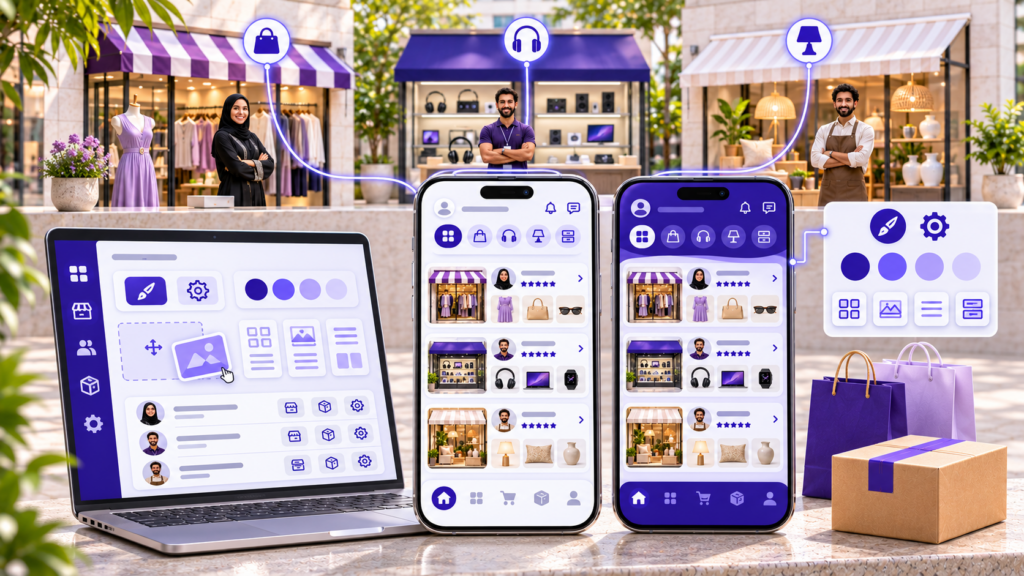
A white label marketplace app is a pre-built platform that connects buyers, sellers and often drivers, which a business licenses and publishes under its own brand. The vendor supplies the working software. You supply the name, logo, colours, domain, app store accounts, pricing rules and local market. Users never see the vendor’s name.
The word “marketplace” matters here. A single-store ordering app has one seller. A marketplace has many sellers, so it needs vendor onboarding, per-vendor catalogues, commission rules, split payments and payouts. That multi-party money flow is the hardest part to build, and it is the main reason founders buy a white label base instead of writing one.
What you get on day one
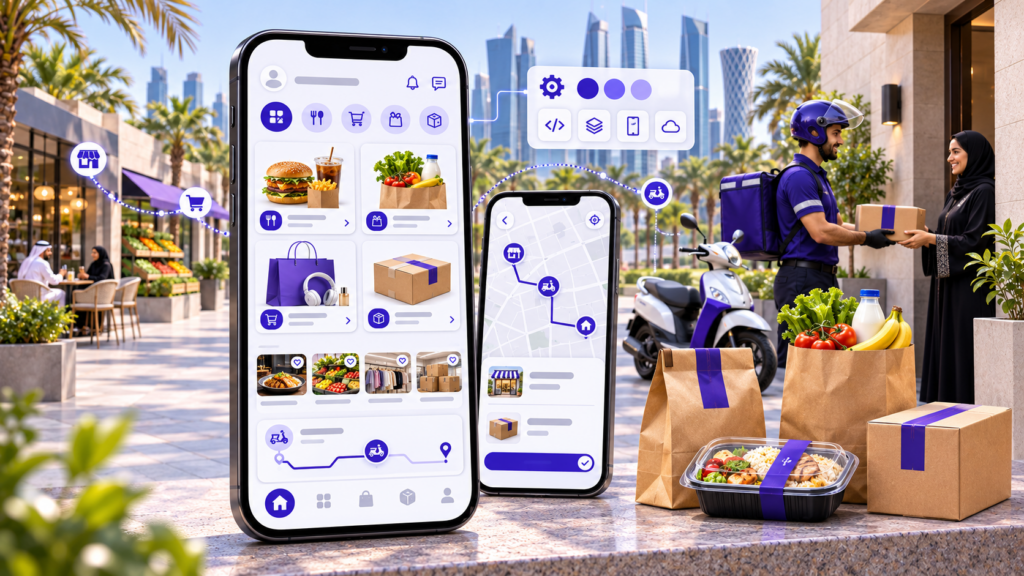
The four connected apps. Most white label marketplaces ship a customer app (iOS, Android and web), a vendor or store panel, a driver app where delivery is involved, and an admin console. All four share one backend, so an order placed in the customer app appears in the store panel, assigns to a driver and shows on the admin map in real time.
The engine underneath. Dispatch and routing, payments and payouts, delivery zones and geofencing, notifications and analytics are already built and tested in production. On a platform such as DeliveryStack, these modules are shared across delivery and mobility verticals, so adding grocery beside food is a configuration change, not a new project.
What white label is not
It is not a no-code builder. A no-code tool gives you blocks to assemble, and you own the assembly problem. A white label marketplace gives you a finished, tested product that you configure. The difference shows up the first time you need multi-stop dispatch or three-way settlement between customer, vendor and driver. DeliveryStack sets out where builders run out of road in its comparison with no-code builders.
It is not a clone script. A clone script is source code sold once, then left to you to host, patch and secure. A managed white label platform keeps receiving core updates, and the vendor can run hosting, security patches, OS updates and app store compliance for you under a support plan.
Should you choose white label, custom development or a no-code builder?
Choose white label when your marketplace follows a known pattern and speed to market decides who wins your city. Choose custom development when your core workflow does not exist in any platform and you have the budget and runway for a long build. No-code builders suit a test of demand, but they rarely survive real order volume.
White label marketplace. A white label platform launches in 2 to 6 weeks on a base platform fee plus customisation. It is tested in production before you sign, and multi-vendor payouts and dispatch come built in. Branding is complete: name, apps, domain and store listings. Unique workflows come through configuration and paid extensions, and the vendor runs hosting and updates under a hosting and support plan. The main downside is that your roadmap depends on the vendor.
Custom development. A custom build takes 6 to 12 months and usually costs USD 40,000 to 150,000 or more. Payouts, dispatch and every other module are built from scratch and first tested on your real users. You get full branding and unlimited freedom over workflows. You or your agency then own hosting and every update, and cost and schedule overruns are the common failure.
No-code builder. A no-code builder launches in 4 to 8 weeks on a low monthly plan. It is only partly production-tested, handles payouts and dispatch through limited features or plugins, and often allows only partial branding. The builder platform runs the hosting. The catch is that it hits its limits as order volume grows.
The custom range matches the figure DeliveryStack gives on its homepage FAQ, and its build versus buy comparison lists the work custom quotes tend to miss, such as dispatch edge cases, app store rejections and payout reconciliation. Custom estimates assume a native customer app, vendor panel, driver app and admin console with payments and dispatch. Your number moves with team location, scope and how many integrations you need.
When custom is the right call
Your logic is the product. If you are inventing a matching rule, a pricing model or a compliance flow that no platform supports, custom is worth the wait. A B2B agro marketplace with credit terms and quality grading, for example, is usually a custom build. Aalpha Information Systems covers that route through its marketplace development services, and its guide to multi-vendor marketplace development cost breaks down the budget.
You need to own every line of code. Some investors and acquirers want full IP ownership. A licensed white label platform gives you your brand and your data, but core code ownership varies by vendor and engagement. Get the terms in writing before you sign, not after your first funding round.
Which marketplace models work best on a white label platform?
White label fits marketplaces where the order flow is well understood: a customer orders, a vendor accepts and prepares, a driver or provider fulfils, and the platform takes a commission. Food, grocery, pharmacy, courier, ride-hailing and home services all follow this shape. Decide your model before you pick a vendor, because it sets your feature list.
Multi-vendor delivery marketplace. Many restaurants or stores sell through one app. The customer pays the platform, and the platform pays the vendor and the driver after taking its commission. This is the core white label use case.
Single brand, multi-location. One brand runs several outlets on a shared catalogue. The customer pays the brand and the outlets settle internally. White label fits this well.
Courier and parcel network. The platform itself is the seller. Customers pay per job and drivers earn per drop. This is also a strong fit.
Ride-hailing or bike taxi. Independent drivers carry riders, who pay a fare from which the platform takes a commission. It fits well, provided the platform was built for mobility as well as delivery.
On-demand services. Plumbers, cleaners and salons take bookings, and providers are paid after the job is done. White label usually works here, but check how deep the scheduling features go.
B2B wholesale marketplace. Distributors and manufacturers sell on invoices, credit terms and bulk pricing. This rarely fits a white label base and is often a custom build.
Product-only e-commerce marketplace. Many sellers ship goods by courier, with returns and escrow to manage. The fit depends on the platform, because delivery platforms are built for same-city fulfilment rather than nationwide shipping.
DeliveryStack’s business model guide maps these models to the platform’s commission, onboarding and payout settings.
Start narrow, then add verticals
One city, one vertical first. The founders who launch fastest pick one vertical in one city and get the unit economics right there. A grocery marketplace in a single metro needs slots, substitutions and weight-based pricing, and that is enough to learn from. Once order density is real, add a second vertical from the admin panel. On a shared engine, a courier service beside food uses the same drivers, zones and wallet.
Watch the hidden model shift. A food marketplace that starts with restaurant-owned riders and later moves to a platform fleet has changed its model. Dispatch, driver pay and liability all change with it. Pick a platform that supports both, so the switch is a setting and not a rebuild.
What features does a white label marketplace app need?
A white label marketplace app needs four connected panels: a customer app to browse, order, pay and track; a vendor panel to manage catalogue, orders and settlements; a driver app for assignment, navigation and earnings; and an admin console to approve vendors, set commissions and watch live operations. Missing any one of them breaks the order loop.
Customer app
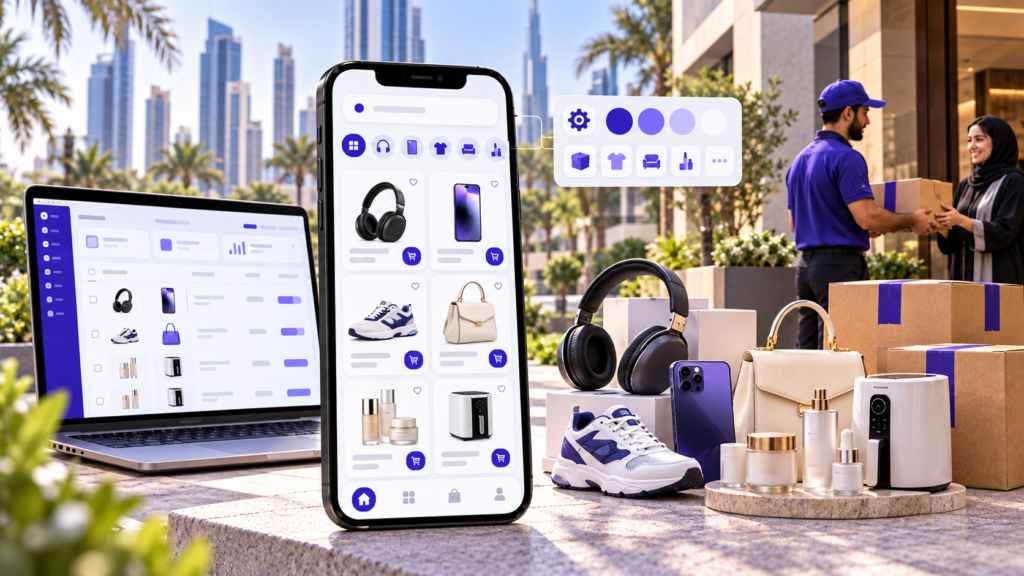
Ordering and checkout. Search with filters, a cart that handles one or several vendors, promo codes, saved addresses and one-tap payment. Multi-cart support matters on grocery and pharmacy marketplaces, where customers often split an order.
Tracking and after-sale. Live GPS tracking, push notifications at each status change, in-app chat with the driver, ratings, tips and quick re-order. Re-order is the feature most founders underrate, because repeat orders carry the unit economics.
Vendor or store panel
Catalogue and order queue. Vendors need to edit menus or products, toggle stock, accept or reject orders and set prep times. Prep times should feed straight into the customer’s ETA, or every order looks late.
Sales and settlements. Daily sales, order history, commission deducted and a downloadable settlement report. Vendors stay on platforms they trust with their money.
Driver app
Assignment and navigation. Online and offline toggle, accept or decline, auto-assignment by distance and load, turn-by-turn navigation and multi-stop routing. Proof of delivery by OTP or photo protects you in disputes.
Earnings and payouts. A clear breakdown per trip, incentives and instant or scheduled payouts. Driver churn is expensive, and an unclear earnings screen is a common cause.
Admin console
Operations control. A live order map, manual dispatch overrides, exception alerts for late orders, and refund and dispute handling.
Business rules without a developer. Commission rates per vendor, delivery zones, distance pricing, surge rules and promotions should all be editable from the console. If each change needs a ticket to the vendor, you have bought a dependency, not a platform.
Onboarding and compliance. Vendor and driver document checks, approvals, suspensions and role-based access for your ops team.
You can see how these panels connect in DeliveryStack’s delivery apps overview.
How do you build a white label marketplace app step by step?
To build a white label marketplace app, validate your model and unit economics, choose a platform vendor, configure zones and commission rules, apply your branding, connect local payments and maps, load vendors and drivers, test every order path, then publish under your own app store accounts. On a production-ready platform this takes 2 to 6 weeks.
Step 1: Prove the numbers before you sign
Work out one order’s margin. Write down average order value, your commission, delivery fee, driver cost per drop, payment gateway fees and refunds. If one order loses money at your target volume, no platform fixes that. Talk to 10 to 20 vendors in your launch zone and confirm the commission they will accept.
Step 2: Choose the platform and the licence terms
Shortlist on proof, not demos. Ask for live apps you can download, the vendor’s production references and the licence terms on data export and exit. The vendor checklist further down covers the full list. This choice sets your ceiling for the next three years.
Step 3: Configure your business rules
Map the operation into settings. Delivery zones, distance pricing, commission per vendor, payout schedules, order flows, tax rules and onboarding requirements go into the platform’s configuration layer. On DeliveryStack this is the first 2 to 3 days of a deployment, as set out in how deployment works.
Step 4: Apply your brand to every touchpoint
Name, logo, colours, domain and store listings. Branding covers the customer app, driver app, vendor panel, emails, SMS templates and push notifications. Check the small screens too: receipts, error messages and empty states often still carry placeholder text.
Step 5: Connect payments, maps and messaging
Use gateways your customers already trust. A UAE launch needs a regional gateway and local card schemes. A European launch needs SCA-ready card flows and GDPR-compliant data handling. An Indian launch needs UPI. Maps, SMS and email providers also go in here. Every integration adds testing time, so start with the few you need on day one.
Step 6: Load data and train your team
Vendors, catalogues, drivers and pricing. Bulk-import menus or product lists, verify driver documents and set up your ops team’s roles. Train them on the console: dispatch overrides, refunds, vendor approvals and payouts. Your first bad night will be an ops problem, not a code problem.
Step 7: Test against your own rules
Run real order paths, not generic test cases. Place orders across zones, cancel mid-delivery, refund partially, split a multi-vendor cart, take a driver offline mid-trip and reconcile a full day’s payouts. Fix configuration, then test again.
Step 8: Publish under your own developer accounts
Your apps, your listings. Apple’s App Store Review Guidelines (section 4.2.6) require apps built from a commercial template to be submitted by the provider of the app’s content. In practice, that means the apps go live under your Apple and Google developer accounts, which is also what keeps your listings, reviews and customers yours.
Step 9: Launch small, measure, then expand
One zone first. Open in a single zone, watch order completion rate, average delivery time, vendor acceptance rate and repeat order rate for two to four weeks, then widen the map. Add a second vertical only when the first one runs without daily firefighting.
What tech stack does a white label marketplace app use?
A modern white label marketplace runs on cross-platform mobile apps, a web front end, a Node.js or similar API layer, a relational database for orders and money, an in-memory store for live driver locations, and WebSockets for real-time tracking. With white label you inherit this stack, so judge it on reliability and how it scales.
Customer and driver apps. These are usually built in React Native or Flutter, with native modules for GPS and payments. One codebase for iOS and Android keeps branding and updates in step.
Web ordering and admin. Next.js or React gives you fast, indexable ordering pages and a responsive admin console.
API and business logic. Node.js services handle the many concurrent connections that drivers and customers keep open during peak hours.
Data and money. PostgreSQL stores orders, ledgers and payouts with relational integrity. Redis and a message queue hold live driver locations and dispatch jobs, so nearest-driver matching stays fast. WebSockets push status and map updates to the apps without a refresh.
Maps and hosting. Google Maps Platform or Mapbox handles geocoding, ETAs and turn-by-turn navigation. AWS, Azure or Google Cloud with auto-scaling absorbs the lunch and dinner peaks.
What to ask about the architecture
Multi-tenant or single-tenant? Some vendors run every client on one shared instance. Others give each client an isolated environment. Isolation costs more but matters for data residency rules, such as in the Gulf or the EU, and for large clients with strict security reviews.
How is money handled? Ask whether the platform keeps a proper ledger of every charge, commission, refund and payout. Marketplaces that calculate payouts on the fly struggle to reconcile disputes. A ledger lets your finance team answer “why did this vendor get paid this amount” in minutes.
What is the uptime commitment? Ask for the SLA in writing, plus how failover works. DeliveryStack, for example, states a 99.95% uptime SLA with automatic failover.
How much does it cost to build a white label marketplace app, and how long does it take?
A white label marketplace app costs a base platform fee plus whatever you customise. DeliveryStack’s base platform starts at US$1,000 for one vertical, with extra verticals, integrations, markets and support plans quoted on top. Launch takes 2 to 4 weeks for one vertical in one city. A custom build usually costs USD 40,000 to 150,000 or more and takes 6 to 12 months.
What goes into the budget
Core apps and engine. On white label, the customer, vendor, driver and admin apps come with the base platform fee, and dispatch, payments and zones are already in the core. On a custom build, every app, panel and module is designed and built from zero, and that is where most of the USD 40,000 to 150,000 goes.
Branding and custom features. White label branding and configuration are part of the deployment. Anything beyond the standard configuration is quoted feature by feature. On a custom build, branding is part of design and every feature is custom.
Integrations and markets. On white label, each ERP, POS or local gateway connector, and each extra language, currency or market, is quoted separately. On a custom build you build and maintain each one yourself.
Hosting and support. White label vendors price hosting, maintenance and support as a separate plan. With custom development, your own team or agency carries that cost for as long as the platform runs.
App store accounts. Both routes pay the same store fees: USD 99 a year for the Apple Developer Program and a one-time USD 25 for a Google Play developer account.
Base platform pricing and what it includes come from DeliveryStack’s pricing page. App store fees are set by Apple and Google and do not change with the build route.
What pushes the number up
More surfaces and verticals. Each extra app, such as a fleet owner console or a corporate booking portal, adds scope. So does a second vertical, though on a shared core it costs far less than a second platform.
Integrations without existing connectors. A connector the vendor already maintains is cheap. A legacy ERP with no API is not. Ask which of your systems already have connectors before you budget.
Multiple countries at launch. Each market brings its own gateway, tax rules, language and sometimes data residency. Launching three countries at once can cost more than the base platform. Launch one, then expand.
Timeline for a white label launch
On DeliveryStack’s published deployment sequence, configuration takes 2 to 3 days in week one, branding and testing 3 to 5 days, data loading and team training 3 to 5 days, and go-live 2 to 3 days in weeks three to four. Custom features you add to the scope extend this, so agree which ones are needed on day one and which can follow in month two.
How does a white label marketplace app make money?
Most white label marketplaces earn from a commission on each order, paid by the vendor, plus a delivery fee paid by the customer. Subscriptions, featured listings, surge pricing and service fees add margin on top. The platform should let you set each of these per vendor or per zone from the admin console, without code changes.
Commission per order. The vendor pays a percentage of each order. Set it too high and strong vendors leave or raise their menu prices on your app.
Delivery fee. The customer pays per delivery. High fees kill small baskets, so many marketplaces offer free delivery above a set basket value.
Service or small-order fee. The customer pays a flat fee on top. Show it before checkout, or you invite complaints and chargebacks.
Customer subscription. Customers pay monthly for free or cheaper delivery. These plans only pay back if members order often.
Vendor subscription or listing fee. Vendors pay to be on the platform. This works once you send them real volume, not on day one.
Featured placement and ads. Vendors pay for visibility in search and on the home screen. Keep paid slots clearly labelled, or customers stop trusting your results.
Surge or peak pricing. Customers pay more at busy times. It needs clear rules and caps to avoid backlash.
Pick two, not seven
Commission plus delivery fee is enough to launch. Every extra stream needs explaining to vendors and customers, and testing in your payout logic. Add subscriptions and ads once order volume is steady and you know which vendors earn the most through your platform.
Model the driver side too. If drivers earn per drop, your delivery fee and any platform subsidy must cover that cost on short and long trips. Distance-based pricing by zone, set in the console, keeps both ends honest.
What are the risks of a white label marketplace, and how do you choose a vendor?
The main risks are vendor lock-in, a roadmap you do not control, shared code that limits deep customisation, and weak support when something breaks at peak time. You reduce all four by choosing a vendor that publishes under your accounts, lets you export all data, prices customisation openly and puts uptime and support terms in writing.
The risks, stated plainly
Lock-in. If the vendor holds your app store listings or your customer data, leaving is painful. Insist that apps publish under your own developer accounts and that you can export customer, order, vendor and driver data at any time.
Roadmap dependency. A feature you need may not be on the vendor’s list. Ask how they price and schedule client-specific features, and whether those features stay yours or join the shared core.
Customisation ceiling. Shared platforms limit how far you can bend the core. If your pitch depends on a workflow no platform has, you may hit that ceiling in month three.
Support at the wrong moment. Friday dinner peak is when dispatch fails. Agree support hours, response times and escalation paths before launch, and know who on your own team handles first-line issues.
Vendor checklist
- Live customer, driver and vendor apps you can download and test today
- Production references in your vertical and, ideally, your region
- Apps published under your Apple and Google developer accounts
- Full data export, plus clear exit terms in the contract
- Source code and IP terms stated in the proposal
- Commission, zones, pricing and promotions editable without a developer
- Payment gateways for your country, and ledger-based payouts
- Written uptime SLA, support hours and response times
- Security and compliance coverage for your market, such as PCI DSS for cards and GDPR in Europe
- An itemised proposal: base platform, each customisation, hosting and support
Check the team behind the platform. A white label product is only as good as the engineers who maintain it. Look for independent reviews. DeliveryStack is built and maintained by Aalpha Information Systems, rated 4.9/5 from 215+ verified reviews on Clutch.
Where does DeliveryStack fit?
DeliveryStack is a white label delivery and mobility marketplace platform built by Aalpha Information Systems. It suits founders and operators launching a multi-vendor marketplace in food, grocery, courier and parcel, or a ride-hailing and bike taxi network. It ships customer, driver, store and admin apps on one shared engine, branded as your own.
Best fit. A first platform in one city and one vertical, a business leaving third-party aggregators to own its customers and margin, or an operator adding grocery beside food, or rides beside courier, on the same drivers and wallet.
Not the best fit. A shipped-goods e-commerce marketplace with nationwide courier logistics, or a B2B marketplace built on credit terms and negotiated pricing. Those usually need a custom build, and Aalpha’s marketplace development team handles that route instead.
Your next step
Write down your vertical, launch city and commission model, then book a DeliveryStack demo. You will see the four apps running end to end and get an itemised proposal for your scope.
Frequently asked questions
What is the difference between a white label marketplace app and SaaS marketplace software?
A white label marketplace app is published under your brand, in your own app store accounts, with no trace of the vendor. Generic SaaS marketplace software usually runs under the provider’s name or a shared app. White label gives you the brand and the customer relationship; plain SaaS gives you software access only.
Can I customise a white label marketplace app?
Yes. Branding, zones, commissions, pricing, promotions and order flows are configured without code. New features, extra apps and integrations are built on top of the core and quoted separately. The limit is the shared core itself: if your model departs from it entirely, a custom build fits better.
Do I own the customer data in a white label marketplace app?
You should. Insist on a contract that names you as owner of all customer, order, vendor and driver data, with export at any time. DeliveryStack publishes apps under the client’s accounts and lets clients export their data whenever they choose.
How long does it take to launch a white label marketplace app?
One vertical in one city usually goes live in 2 to 4 weeks on a production-ready platform. That covers configuration, branding, testing, data loading, team training and app store submission. Custom features, extra markets and new integrations add time on top.
Is a white label marketplace app cheaper than custom development?
For standard models such as food, grocery, courier and rides, yes. The core apps, dispatch and payouts are already built, so you pay a base platform fee plus customisation instead of USD 40,000 to 150,000 or more for a custom build. The gap narrows as your custom feature list grows.
Will Apple approve a white label marketplace app?
Apple’s guideline 4.2.6 requires apps built from commercial templates to be submitted by the provider of the app’s content. Publish under your own Apple developer account, with your own content and branding, and the app goes through normal review like any other.
Can a white label marketplace app grow to more cities and countries?
Yes, if the platform supports multiple zones, currencies, languages and gateways. New cities are usually a configuration task. New countries add local payment, tax and compliance work, so plan them one at a time.