ChatGPT
 Claude
 Gemini
 Grok
How to Start a Delivery App in Saudi Arabia: A Complete Guide
TLDR
To start a delivery app in Saudi Arabia, you need a Saudi company with a Commercial Registration, the right Transport General Authority (TGA) licence for your delivery model, drivers who work through licensed transport companies or as self-employed Saudi nationals, and an Arabic-first app that accepts mada, Apple Pay and STC Pay. You also need to comply with the Personal Data Protection Law (PDPL) and ZATCA e-invoicing. A custom build typically costs USD 40,000 to 150,000 or more and takes several months, while a white-label platform such as DeliveryStack starts from USD 1,000 per month and can go live in 2 to 4 weeks. The hard part in Saudi Arabia is rarely the software. It is licensing, driver supply and competing for orders against HungerStation, Jahez and Keeta, so pick a niche or a city before you pick features.
Saudi Arabia is one of the largest delivery markets in the Gulf, and also one of the most tightly regulated. Founders who treat it like any other app launch usually hit a wall at the licensing stage. This guide walks through what a founder, restaurant group, retailer or logistics company actually has to do, in the order it needs doing.
What does it take to start a delivery app in Saudi Arabia?
Starting a delivery app in Saudi Arabia takes five things: a licensed Saudi legal entity, a TGA licence that matches how your app moves goods, a compliant driver model, a working customer, driver, merchant and admin app suite, and local payment and tax integration. Miss any one of them and the TGA can suspend the app, even if the software is finished.
Most first-time founders assume the build is the long pole. In practice, company setup and TGA approval often take longer than the software, especially if you build on a ready platform. Plan your licensing track and your product track in parallel from week one.
How big is the delivery market in Saudi Arabia?
The Saudi food delivery market alone is estimated in the billions of US dollars a year, and order volumes keep rising. Food delivery orders in the Kingdom passed 200 million in 2023 according to Argaam, with Riyadh taking the largest share, followed by Jeddah. Market research firms disagree on the exact size, so treat any single figure as a range rather than a fact.
The competitive picture changed fast after Keeta, owned by Meituan, launched in Riyadh in October 2024. Argaam reported that Keeta handled more than 150 million orders in Saudi Arabia during 2025. Jahez, a listed Saudi company, recorded about 68.7 million orders in the first nine months of 2025 with an average order value of around SAR 63. HungerStation, owned by Delivery Hero, remains the oldest of the large players.
What this tells you is simple. Demand is proven and large, but the general food aggregator slot in Riyadh and Jeddah is crowded and expensive to contest. The openings are in specific verticals (pharmacy, flowers, B2B supplies, parcel, laundry), secondary cities, and businesses that want their own branded delivery instead of paying aggregator commissions.
Which delivery business model should you choose?
Choose your model before anything else, because it decides your TGA licence, your unit economics and your feature list. The four common models in Saudi Arabia are the multi-vendor food aggregator, grocery and quick commerce, courier and parcel delivery, and single-brand delivery for a restaurant chain or retailer.
Multi-vendor food and restaurant aggregator
This is the HungerStation and Jahez model. You list many restaurants, take a commission on each order and charge customers a delivery fee. It has the highest order frequency, but also the highest customer acquisition cost, because you are competing directly with the three largest players. It works best when you go deep in one city or one cuisine segment that the large apps serve poorly.
Grocery and quick commerce
Grocery apps either partner with supermarkets or run their own dark stores for 15 to 30 minute delivery. Baskets are larger than food orders, which helps margins, but inventory, substitutions and cold-chain handling add operational weight. Arab News has reported that traditional grocery stores are losing ground as online platforms grow, which makes this a strong segment for retailers with existing stock.
Courier and parcel delivery
Courier apps move packages between people and businesses, often same-day within a city. Order frequency per user is lower, but B2B contracts with e-commerce stores can provide steady volume. Expect stricter address and identity checks in this segment.
Single-brand delivery for your own business
A restaurant chain, pharmacy group or retailer can run its own branded delivery app and keep the customer relationship and margin that aggregators would otherwise take. The trade-off is that you must drive your own app downloads, and many brands end up running their own app alongside the aggregators rather than replacing them.
Which licences do you need to run a delivery app in Saudi Arabia?
You need a Saudi company with a Commercial Registration, and then a TGA licence that matches how your app delivers. The TGA separates businesses that sell their own products, platforms that sell products they do not own, and platforms that only connect customers with carriers. Each category has different obligations, and the TGA has blocked apps that operate without the right one.
Company formation and foreign ownership
Foreign founders usually start with an investment registration through the Ministry of Investment (MISA), followed by a Commercial Registration with the Ministry of Commerce, then registration with ZATCA, GOSI and the Chamber of Commerce. Saudi Arabia’s investment rules now allow 100 percent foreign ownership in most sectors, but some trading activities carry higher entry requirements, so confirm your exact activity codes with MISA or a licensed setup consultant before you commit to a structure. Saudi founders can go straight to the Commercial Registration.
The TGA licence for your delivery model
In a circular reported by Okaz and the Saudi Gazette, the TGA set out three cases. A business that delivers products it owns, such as a supermarket or restaurant, does not need a licence for the app itself, but its vehicles must hold light or heavy transport licences, or it must contract a TGA-licensed carrier. A platform that sells products it does not own needs a Delivery of Orders licence plus licences for the vehicles used. A platform that only connects customers or merchants with third-party carriers, without selling products, needs an Electronic Mediation in the Transport of Goods licence.
The TGA has warned that apps using manual dispatching or unlicensed vehicles can face suspension of the app, vehicle impoundment and deportation of drivers. It suspended four food delivery apps for operating without licences in March 2024, so this is enforced, not theoretical. Check the current requirements on the TGA website at tga.gov.sa before you apply, because the delivery rules have changed several times since 2023.
VAT registration and ZATCA e-invoicing
Saudi Arabia charges 15 percent VAT, and every VAT-registered business must issue electronic invoices through ZATCA’s Fatoora system. Phase 2, which requires your system to integrate directly with ZATCA, is rolling out in waves by revenue. Wave 25 covers taxpayers whose VAT-subject revenue exceeded SAR 187,500 in any year from 2022 to 2025, with integration due from 1 February 2027. A delivery platform issues invoices to customers, merchants and sometimes drivers, so build Fatoora-compliant invoicing in from the start rather than adding it later.
How do Saudi driver rules affect your fleet model?
Saudi rules decide who can deliver for your app. Self-employed (freelance) delivery work is reserved for Saudi nationals, and non-Saudi drivers must work through companies licensed for light transport. Your app has to support both routes, and your cost model has to reflect the higher cost of a fully licensed fleet partner.
The TGA introduced these rules in phases. From April 2024, non-Saudi drivers in Al-Baha, Jazan, Najran and the Northern Borders had to join licensed light transport companies, with the change planned to extend nationwide over roughly 14 months. The rules also require approved uniforms for non-Saudi drivers and a face-verification feature for drivers that connects to a TGA system. In October 2024, the TGA paused new motorcycle delivery licences for app-based work pending new regulations, so confirm the current position on motorcycles before planning a two-wheeler fleet.
For parcel delivery, reporting on the TGA’s parcel rules indicates that shipments need a verified national address from January 2026. That means your checkout should capture and validate the Saudi National Address (the short address code) rather than relying on a map pin alone.
In practice, most new delivery apps combine three sources of drivers: Saudi freelancers onboarded directly, one or more licensed fleet companies supplying non-Saudi drivers, and in some cases the merchant’s own staff. Your driver app and admin panel need to track which company each driver belongs to, store licence and vehicle documents with expiry dates, and run identity checks before each shift.
What data protection rules apply to a delivery app in Saudi Arabia?
Delivery apps in Saudi Arabia fall under the Personal Data Protection Law (PDPL), which has been fully enforceable since 14 September 2024 and is overseen by the Saudi Data and Artificial Intelligence Authority (SDAIA). A delivery app collects names, phone numbers, addresses and live location, so it is squarely in scope.
The practical obligations are a clear privacy notice in Arabic and English, a lawful basis or consent for each type of processing, a record of processing activities, registration on SDAIA’s National Data Governance Platform where required, a data protection officer where SDAIA rules call for one, and breach notification to SDAIA. Transfers of personal data outside the Kingdom are restricted, which affects where you host your servers and which third-party tools you use for analytics, support and messaging. Many Saudi delivery operators choose in-Kingdom cloud regions for this reason.
Location data deserves extra care. Keep driver tracking limited to working hours, mask customer phone numbers between drivers and customers, and set retention periods for order and GPS history rather than keeping everything forever.
Which features does a delivery app need for the Saudi market?
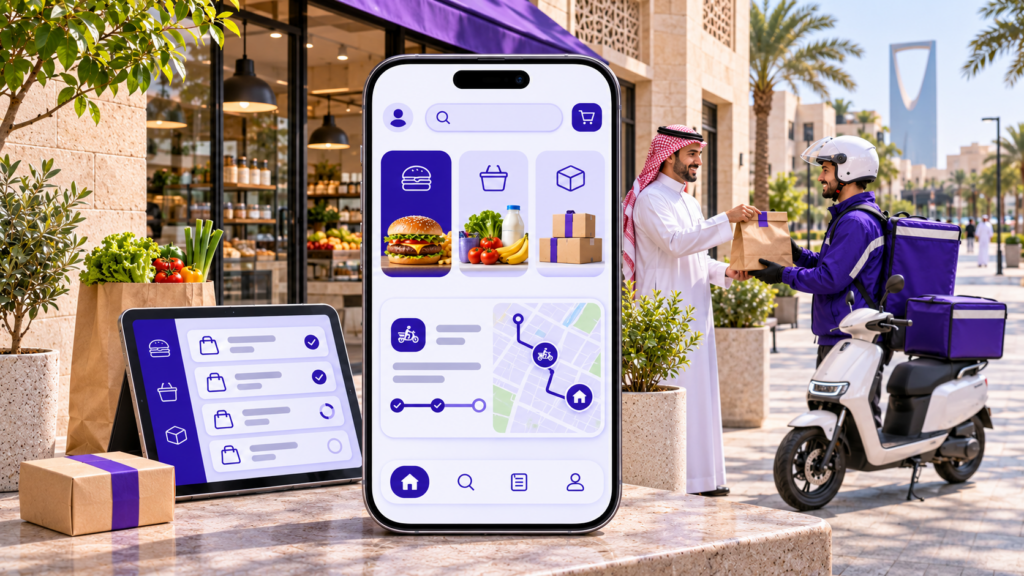
A Saudi delivery app needs four connected products: a customer app, a driver app, a merchant or store panel, and an admin console with dispatch. On top of the standard features, it needs Arabic right-to-left design, Saudi National Address support, local payment methods, TGA-related driver verification and ZATCA invoicing.
Customer app
Customers expect fast browsing, accurate delivery time estimates, live order tracking on a map, saved addresses, reorder, promo codes and in-app support. In Saudi Arabia, the app must be designed Arabic-first, with a full right-to-left layout, not an English app with translated strings. Scheduled orders matter more than in many markets, because demand peaks sharply around iftar and suhoor during Ramadan and around weekend evenings.
Driver app
The driver app handles shift start with identity verification, order offers, navigation, proof of delivery with photo or PIN, cash collection where you allow it, and earnings. It should store driver and vehicle documents, flag expiring licences, and record which licensed company the driver works through.
Merchant or store panel
Restaurants and stores need to accept orders, update menus and stock, set preparation times, pause during rush hours, and see settlements. Arabic and English menu fields, VAT-inclusive pricing and opening hours that change during Ramadan are the details merchants complain about most when they are missing.
Admin console and dispatch
The admin console is where the business is actually run. It needs zone and geofence management, delivery pricing rules, commission settings per merchant, automatic driver assignment, refunds, customer support tools, payouts to merchants and drivers, and reporting. The quality of your dispatch logic decides your delivery times and your cost per order more than any customer-facing feature.
Which payment methods should a delivery app support in Saudi Arabia?
A Saudi delivery app should support mada debit cards, Apple Pay, STC Pay and Visa or Mastercard at launch, with buy now, pay later options such as Tabby or Tamara for larger baskets. Cash on delivery is declining but still expected by some customers, so most apps offer it with limits.
mada is the national debit network and covers most of the banked population. Apple Pay is heavily used for online payments, and STC Pay is popular with younger users. One integration detail catches many foreign teams: some payment gateways route only through Visa and Mastercard rails, and mada cards can fail on them. Choose a gateway licensed in Saudi Arabia that supports mada natively, such as HyperPay, Checkout.com, PayTabs or Moyasar, and test real mada cards before launch.
Cash on delivery raises failed-delivery rates and creates cash-handling work for drivers, so many operators cap the cash order value, charge a small COD fee or restrict cash for new accounts. If your app holds customer money in a wallet or splits payments between merchants and drivers, check whether that activity needs approval from the Saudi Central Bank (SAMA), or keep those flows inside a licensed payment partner.
Should you build a custom delivery app or use a white-label platform?
Use a white-label platform if you want to launch within weeks, test a city or vertical, and spend your budget on drivers and marketing. Build custom if your operating model is genuinely different from existing delivery flows, or if you already have proven volume and need to own every part of the code.
A custom build gives you full control of features and source code, but it costs more, takes months, and leaves you responsible for maintenance, app store updates and security patches. Many custom projects also underestimate the dispatch engine and the admin tools, which are slow to get right.
A white-label platform such as DeliveryStack gives you ready customer, driver, merchant and admin apps under your own brand, with dispatch, payments and payouts already working. The downside is less freedom to change core workflows and an ongoing monthly fee. DeliveryStack, built by Aalpha Information Systems, supports food, grocery, courier and pharmacy delivery from one platform and lets you keep your brand, app store accounts and customer data. If you later need features beyond the standard product, Aalpha’s development team can build them on top.
You can compare both routes in more detail on the DeliveryStack custom development comparison page at https://deliverystack.tech/compare/custom-development.
How much does it cost to start a delivery app in Saudi Arabia?
The software for a delivery app in Saudi Arabia typically costs USD 40,000 to 150,000 or more for a custom build, or from USD 1,000 per month on a white-label platform such as DeliveryStack. Software is usually not the biggest cost. Licensing, driver supply, marketing and working capital for merchant and driver payouts often exceed it in the first year.
The software figures above are based on Aalpha’s own delivery projects and DeliveryStack’s published pricing. The final number depends on how many verticals and cities you launch, your order volume and any custom features. Outside software, budget for company formation and TGA licensing, a licensed fleet partner or driver onboarding costs, payment gateway fees on each transaction, cloud hosting in the Kingdom, Arabic content and support staff, and customer acquisition. Customer acquisition is where most Saudi delivery startups run out of money, because the large apps subsidise delivery fees heavily in Riyadh and Jeddah.
How long does it take to launch a delivery app in Saudi Arabia?
A delivery app in Saudi Arabia can be technically ready in 2 to 4 weeks on a white-label platform, or in roughly 4 to 9 months as a custom build. The full launch, including company setup, TGA licensing, payment gateway approval and app store review, usually takes longer than the software alone.
On DeliveryStack, the deployment runs in four stages: onboarding and configuration, customisation and testing, data loading and team training, then go-live with launch-week monitoring. You can see each stage at https://deliverystack.tech/how-deployment-works. Payment gateway onboarding in Saudi Arabia often needs your Commercial Registration and bank account first, so start it as soon as the company exists.
How can a new delivery app compete with HungerStation, Jahez and Keeta?
A new delivery app competes by being narrower, not bigger. Pick a vertical, a city or a customer group the large apps serve poorly, and build delivery speed, merchant terms or service quality that they cannot match in that slice.
Practical angles that work in Saudi Arabia include a pharmacy or health delivery app with licensed pharmacy partners, B2B delivery for restaurants and offices, a single city outside Riyadh and Jeddah where the large apps have thinner driver coverage, premium or scheduled grocery, flowers and gifts around occasions, and branded apps for restaurant groups that want to cut commission costs. Lower merchant commissions can win you supply, but only if your order volume makes the lower rate worth the merchant’s effort.
The downside of a niche is a smaller ceiling. Plan how you would expand to a second vertical or city once the first one is profitable per order, and choose software that can add verticals without a rebuild.
What are the steps to launch a delivery app in Saudi Arabia?
The launch sequence that causes the fewest delays runs in eight steps. First, pick your delivery model, vertical and launch city, and write down your target cost per delivery. Second, set up the Saudi legal entity, including MISA registration if you are foreign-owned, the Commercial Registration, VAT registration and a local bank account.
Third, apply for the TGA licence that matches your model, and sign at least one licensed light transport company if you plan to use non-Saudi drivers. Fourth, choose between a custom build and a white-label platform, and set up your Arabic and English branding, app store accounts and in-Kingdom hosting. Fifth, integrate a Saudi payment gateway with mada, Apple Pay and STC Pay, and connect ZATCA-compliant e-invoicing.
Sixth, onboard your first merchants and drivers, verify driver documents and run test deliveries across your zones. Seventh, publish your PDPL privacy notice, complete any SDAIA registration that applies, and train your support team. Eighth, launch in a limited area, watch delivery times, failed deliveries and cost per order every day for the first month, then widen your zones.
Frequently asked questions
Do I need a TGA licence to start a delivery app in Saudi Arabia?
It depends on your model. A platform selling products it does not own needs a TGA Delivery of Orders licence, and a platform that only connects customers with carriers needs an Electronic Mediation in the Transport of Goods licence. A business delivering its own products does not need an app licence, but its vehicles must be licensed or it must use a licensed carrier.
Can a foreigner own a delivery app company in Saudi Arabia?
Yes. Saudi investment rules allow 100 percent foreign ownership in most sectors through registration with the Ministry of Investment (MISA) followed by a Commercial Registration. Some trading activities have higher entry requirements, so confirm your activity codes before you set up the company.
Can non-Saudi drivers work for my delivery app?
Yes, but not as freelancers. TGA rules reserve self-employed delivery work for Saudi nationals and require non-Saudi drivers to work through companies licensed for light transport. Your app must record each driver’s employer, documents and identity checks.
Which payment methods must a Saudi delivery app support?
At minimum, mada, Apple Pay, STC Pay and Visa or Mastercard. Buy now, pay later through Tabby or Tamara helps with larger grocery baskets, and many apps still offer cash on delivery with value limits.
Does my delivery app need ZATCA e-invoicing?
Yes, if your business is VAT-registered. Every VAT-registered business must issue electronic invoices, and Phase 2 integration with ZATCA’s Fatoora platform is being rolled out in revenue-based waves, with Wave 25 due from 1 February 2027.
How long does it take to build a delivery app for Saudi Arabia?
A white-label platform such as DeliveryStack can be configured and live in 2 to 4 weeks. A custom build usually takes 4 to 9 months depending on scope. Licensing and payment onboarding can add time to either route.
Does the PDPL apply to delivery apps?
Yes. Delivery apps collect names, phone numbers, addresses and location data, all of which are personal data under the PDPL. You need a privacy notice, a lawful basis for processing, breach notification procedures, and care with transfers of data outside Saudi Arabia.
Start your Saudi delivery app with DeliveryStack
If you want to launch a branded food, grocery, courier or pharmacy delivery app in Saudi Arabia without a long custom build, DeliveryStack gives you the customer, driver, merchant and admin apps ready to configure in Arabic and English. Book a demo to walk through your model, city and licensing plan with the team.