ChatGPT
 Claude
 Gemini
 Grok
Grocery Delivery App Development in Australia: A Complete Guide
TLDR
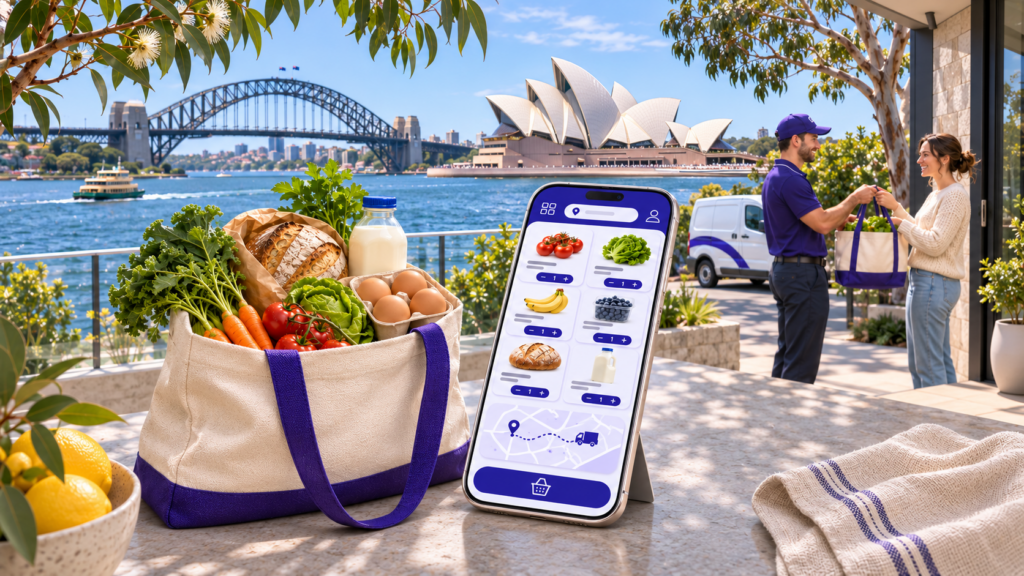
Grocery delivery app development in Australia means building a customer app, a picker or store app, a driver app and an admin console that work within Australian rules on gig worker pay, privacy, GST and alcohol delivery. The market is large and concentrated. Woolworths and Coles together sell well over AUD 7 billion online in a half year, and Amazon began fresh grocery delivery with Harris Farm in 2026. Independent grocers, specialty chains and regional operators still have room, mostly in speed, local range and niche categories. A custom build typically costs USD 40,000 to 150,000 or more (roughly AUD 60,000 to 230,000) and takes four to eight months. A white-label platform such as DeliveryStack gets a branded grocery app live in two to four weeks from USD 1,000 a month. The Australia-specific work that catches teams out is mixed GST baskets, the Fair Work minimum standards for delivery riders that took effect on 17 August 2026, and same-day liquor rules if you sell alcohol.
What does grocery delivery app development in Australia involve?
Grocery delivery app development in Australia is the work of building the software that lets shoppers order groceries online and receive them at home, plus the tools stores and drivers use to fill those orders. A working platform has four parts: a customer app, a store or picker app, a driver app and an admin console. Each has to respect Australian tax, privacy, labour and food safety rules.
Grocery is harder than restaurant delivery. A restaurant order has five items and one kitchen. A grocery order has forty items, a quarter of which may be out of stock, some of which must stay below 5°C, and a few of which (pet food, chocolate, soft drinks) carry GST while the rest do not. The app has to manage substitutions, cold chain timing, weight-based pricing for meat and produce, and delivery windows that make sense for a household doing its weekly shop.
In Australia you also deal with long distances outside the capital cities, high labour costs, and a market where two supermarkets have trained customers to expect same-day delivery. That shapes almost every product decision covered below.
How big is the Australian grocery delivery market, and who competes in it?
Australia’s online grocery market is worth roughly AUD 11 to 12 billion a year and is dominated by Woolworths and Coles. Both supermarkets now report online as their fastest growing channel. Amazon, Uber Eats and DoorDash compete at the edges, which leaves gaps for independent grocers, specialty retailers and regional operators with their own apps.
The two supermarkets set the benchmark. In the first half of FY26 (July to December 2025), Woolworths reported online sales above AUD 5 billion, up 15.3%, and Coles reported AUD 2.8 billion, up 27%. Online now accounts for about 13% of Coles supermarket sales and about 16% at Woolworths. Woolworths runs its quick commerce service under the Milkrun brand from more than 600 stores, and Coles says rapid delivery orders generally arrive within two hours. Any new app is judged against that experience.
Aggregators have moved into grocery. Uber Eats and DoorDash list supermarket and convenience stores, and Coles has partnered with Uber Eats to put hundreds of stores on the app. A 2025 CHOICE price comparison found that a basket ordered through these apps could cost up to 39% more than the same basket in store once marked-up item prices and fees were added. That premium is the opening for retailers who want to sell direct.
Amazon entered fresh in 2026. Amazon Australia launched fresh grocery delivery with Harris Farm Markets in Sydney in January 2026, then expanded to Brisbane, Canberra and Newcastle. It shows a retailer without stores of its own can reach fresh grocery customers through a partner model.
Where the gaps are. Independent supermarkets such as IGA and Foodland stores, Asian, Indian, Middle Eastern and halal grocers, organic and farm-direct sellers, butchers, bulk and wholesale suppliers to cafes, and grocers in regional towns that the national services cover poorly or not at all. These businesses usually have loyal customers and a range the majors do not carry, but lose margin to aggregator commissions. A grocery app of their own lets them keep the customer relationship and the order data.
The lesson from Australia’s first wave of instant delivery startups is worth stating plainly. The original Milkrun stopped trading in April 2023 before Woolworths bought the brand. Pure dark-store models struggled against high labour costs and thin basket margins. The operators doing well today attach delivery to stores or warehouses that already exist.
Which grocery delivery business models work in Australia?
Four models work in Australia: a single grocer selling through its own app, a multi-store chain, a multi-vendor marketplace, and a dark-store quick commerce operation. The first two are the safest starting points because stock, staff and premises already exist. Marketplaces and dark stores need more capital and more volume to break even.
Single-store or independent grocer app. One shop, one catalogue, delivery inside a defined radius. This suits an IGA franchisee, a specialty grocer or a butcher who wants to stop paying aggregator commission. Revenue comes from the basket margin plus a delivery fee. The software can be modest, but stock sync with the point of sale matters from day one, or customers order things that are not on the shelf.
Multi-store chain app. One brand, several stores, each with its own stock and delivery zone. The app routes each order to the nearest store that has the items. This is the model behind most regional chains and the specialty grocers with five to fifty outlets. It needs store-level inventory, zone mapping and an admin view across locations.
Multi-vendor marketplace. Several independent grocers sell through one app, which takes a commission on each order. Ethnic grocery marketplaces and farmers’ market platforms often use this model. It is harder to run because vendors keep their own stock, pricing and opening hours, and you are responsible for the delivery experience you do not fully control. A multi-vendor marketplace setup needs vendor onboarding, split payments and commission reporting built in.
Dark-store quick commerce. A small warehouse close to customers holds 2,000 to 4,000 fast-moving items and promises delivery in 15 to 30 minutes. Australian labour costs and suburban density make this the riskiest model. It works best as an add-on to an existing chain in dense inner-city postcodes, not as a standalone startup.
A fifth option, B2B grocery supply to cafes, restaurants and offices, is often overlooked. These buyers order in bulk on a schedule, pay on account and care more about reliability than speed. The margins are better and the delivery planning is simpler.
What apps and features does a grocery delivery platform need?
A grocery delivery platform needs four connected applications: a customer app for ordering, a store or picker app for preparing orders, a driver app for delivery, and an admin console for running the business. All four share one backend that handles catalogue, stock, payments and dispatch.
Customer app (iOS, Android and web)
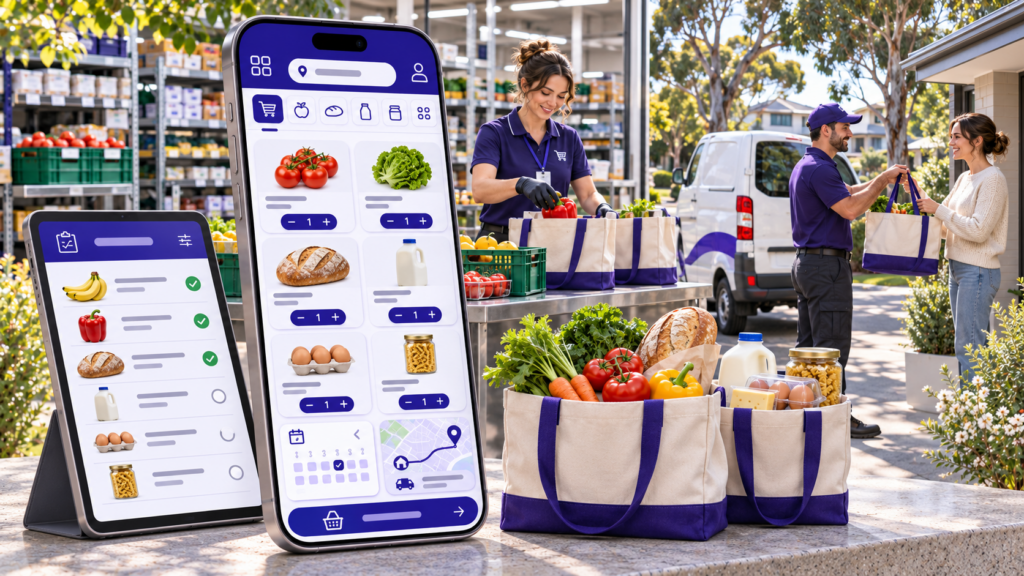
The customer app is where the sale is won or lost. It needs fast search with synonyms (capsicum and bell pepper, coriander and cilantro), category browsing, saved lists and one-tap reorder of a previous shop. Weekly shoppers reorder far more than they browse. It needs clear substitution preferences per item, so the customer can choose “replace with similar”, “replace with a specific product” or “refund if unavailable”. It needs delivery slot selection that shows real capacity, live order tracking, and payment through cards, Apple Pay, Google Pay and, for many Australian shoppers, buy now pay later. Loyalty points and promotions matter because Australian shoppers are used to Everyday Rewards and Flybuys. See the customer app for how this is typically set out.
Store and picker app
The picker app is the part most first-time founders underestimate. Staff walk the aisles with it, scan each item, record weights for produce and meat, and propose substitutions that the customer approves in real time. It needs a pick path ordered by aisle, barcode scanning, temperature zones (ambient, chilled, frozen) and a packing step that keeps cold items together. Without it, picking becomes the bottleneck and error rate climbs. The store panel also manages catalogue, prices and opening hours.
Driver app
Drivers need batched orders, turn-by-turn navigation, proof of delivery with photo and signature, and contactless handover options. If you sell alcohol, the driver app must prompt for ID checks at the door. Because of the new Fair Work minimum standards, the driver app should also record engaged time accurately, since that is what minimum pay is calculated on.
Admin console and dispatch
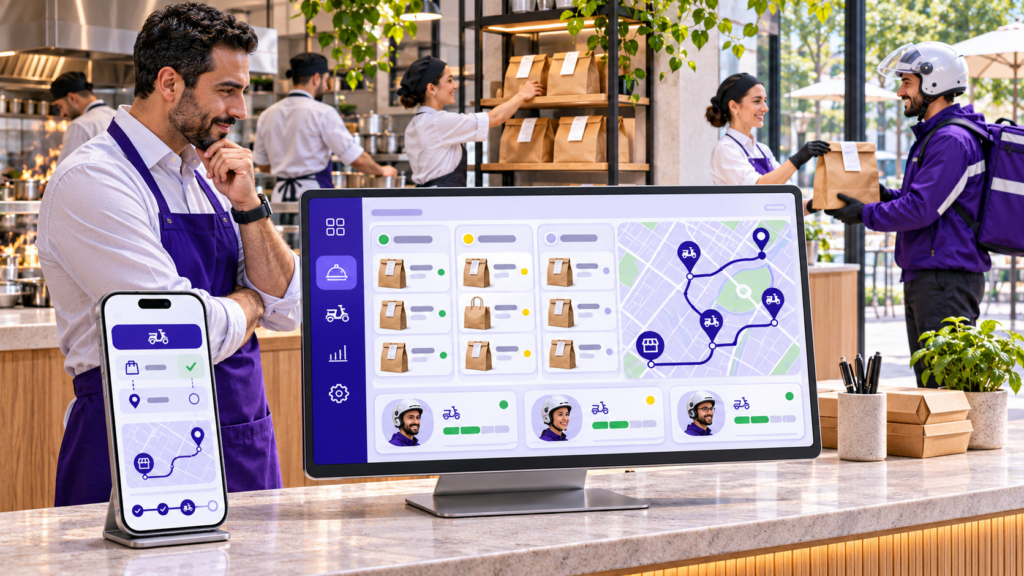
The admin console controls zones, delivery fees, slot capacity, promotions, refunds and reporting. The dispatch and routing engine assigns orders to drivers based on distance, vehicle capacity and time window, and zones and geofencing let you set different fees and minimum orders for inner suburbs and outer areas. For Australian grocery, the reports you will check daily are fill rate, substitution rate, on-time delivery and cost per delivery.
Features worth adding after launch
AI-based substitution suggestions, demand forecasting by suburb and day, subscription delivery passes, recipe-to-cart, and scheduled recurring orders all earn their keep once you have a few thousand orders of data. Building them before launch usually wastes budget.
What Australian rules must a grocery delivery app comply with?
A grocery delivery app in Australia must handle GST correctly on mixed baskets, meet the Fair Work minimum standards for on-demand delivery workers, protect customer data under the Privacy Act 1988, keep chilled food cold under the Food Standards Code, and follow state liquor laws if it sells alcohol. Each of these changes how the software is built, not just the paperwork. This section is general information, not legal or tax advice, so confirm your position with an Australian adviser before launch.
GST on a mixed basket. Most basic food in Australia is GST-free, but confectionery, savoury snacks, soft drinks, prepared meals and pet food are taxable at 10%. A single grocery order usually contains both. Your catalogue needs a GST flag on every product, and invoices must show the taxable and GST-free amounts separately. Product classification is less obvious than it looks, so use the ATO guidance on GST and food and its food search tool when loading your catalogue. Delivery fees follow their own GST treatment, which your accountant should confirm.
Fair Work minimum standards for delivery riders. From 17 August 2026, the Fair Work Commission’s Interim On-Demand Delivery Employee-like Worker Minimum Standards Order applies to independent contractors who deliver food, groceries or alcohol through an app or website run by a digital labour platform operator. It sets minimum pay based on at least AUD 31.30 per hour of engaged time, along with record keeping, insurance and dispute rules. If your app engages its own contractor drivers, you may be the platform operator the order covers. That means the driver app and backend must log engaged time accurately and produce the records the order requires. Read the Fair Work Ombudsman’s guide to the order before you design driver pay. Using employed drivers or a third-party courier changes the obligations, so decide this early.
Privacy Act and customer data. A grocery app collects names, addresses, phone numbers, purchase history and sometimes date of birth. Businesses with annual turnover above AUD 3 million must follow the Australian Privacy Principles, and smaller businesses can be covered if they trade in personal information. The Government released an exposure draft of the second tranche of Privacy Act reforms in August 2026, which would tighten rules on how personal information is collected and used. Build to the stricter standard from the start: collect only what you need, store it in Australian or equivalent-standard data centres, explain clearly what you do with it, and give customers a way to see and delete their data. The OAIC’s guidance is the place to check obligations.
Food safety and cold chain. Under the Food Standards Code, potentially hazardous food such as dairy, meat and prepared salads must be kept at 5°C or below, or 60°C or above. For delivery that means insulated bags or refrigerated vehicles, a maximum time between pick and drop-off for chilled items, and picking frozen and chilled goods last. The software should enforce this by sequencing the pick list and limiting how long a chilled order can wait for a driver.
Alcohol delivery. If you sell liquor, each state has its own licensing and delivery rules. New South Wales has the most detailed framework for same-day delivery. Customers must have their age verified at first purchase, drivers must check ID at the door for anyone who appears under 25, and deliveries can only be made between 9am and midnight (11pm on Sundays). Records of deliveries by postcode go to Liquor & Gaming NSW. Build age verification, ID prompts and time restrictions into the app if alcohol is anywhere on your roadmap, and check the rules in every state you plan to serve.
Australian Consumer Law. Prices shown in the app must be the total price the customer will pay, including GST and any mandatory fees. Substituted items, short-dated stock and refunds for missing items must be handled in a way that meets consumer guarantees. A clear substitution and refund flow in the app protects you here.
Payments. Australian shoppers expect Visa, Mastercard, eftpos, Apple Pay and Google Pay, and many use buy now pay later. Use a gateway that supports Australian dollars and local card schemes natively, and that can split payments if you run a marketplace. Card data should never touch your servers. Use tokenised payments so the gateway carries PCI DSS scope.
How do you build a grocery delivery app for Australia, step by step?
Building a grocery delivery app for Australia takes seven steps: pick one model and one launch area, settle the delivery and driver model, prepare the catalogue, design the four apps, build and integrate, test with real orders, then launch and tune. The steps that decide success happen before any code is written.
- Choose the model and the first delivery area. Start with one city or a handful of postcodes where you already have customers or a store. A suburb cluster in Western Sydney or Melbourne’s south-east is a better first market than “all of Australia”. Delivery cost per order, not app downloads, decides whether the business survives.
- Decide who delivers. Employed drivers, your own contractor fleet, or a third-party courier. The Fair Work minimum standards, insurance and vehicle costs differ for each, and the choice changes what the driver app must record.
- Prepare the catalogue and stock feed. Clean product data with images, GST status, unit or weight pricing and temperature zone. Connect it to your point of sale or inventory system so stock levels update at least every few minutes. A poor catalogue causes more failed orders than any software bug.
- Design the four apps around real tasks. Map how a customer does a weekly shop, how a picker walks your store, and how a driver handles a ten-drop route. Test the designs with your own staff before development starts.
- Build, integrate and set up compliance. Develop the apps and backend, connect payments, maps, SMS and the POS, and add GST handling, privacy notices, engaged-time logging and age checks where needed.
- Run a closed pilot. Take real orders from staff, family and loyal customers for two to four weeks. Measure pick time, substitution rate and delivery time, then fix what breaks.
- Launch and tune. Open to the public in your first area, watch the daily numbers, and expand zone by zone only when cost per delivery is under control.
Aalpha Information Systems, the team behind DeliveryStack, follows the same sequence on custom builds and white-label rollouts. The deployment process shows how steps three to seven compress when the apps already exist.
What technology stack suits a grocery delivery app in Australia?
A sound stack for an Australian grocery delivery app is a cross-platform mobile framework for the customer, picker and driver apps, Next.js for the web store and admin console, Node.js for the backend, PostgreSQL for orders and catalogue, and cloud hosting in the Sydney region. Hosting locally keeps the app fast for Australian users and simplifies privacy questions about where data sits.
Mobile apps. React Native or Flutter lets one team ship iOS and Android from a single codebase. Native development costs more and is rarely justified for grocery unless you need heavy offline scanning on older picker devices.
Web and admin. Next.js gives a fast, search-friendly web store, which matters because many Australians start a grocery shop on a laptop. The same framework can serve the admin console.
Backend and data. Node.js handles real-time order updates well. PostgreSQL suits grocery because catalogue, stock, orders and payments are relational. Redis handles caching and live driver locations. A search engine such as Elasticsearch or Typesense handles product search with synonyms and typos.
Hosting. AWS, Google Cloud and Azure all run data centres in Sydney and Melbourne. Use one of them for production data.
Integrations. A payment gateway with local card and wallet support, Google Maps or Mapbox for addresses and routing, SMS and push notifications, your POS or ERP, and an accredited identity verification provider if you sell alcohol.
The downside of a fully custom stack is that you own every piece of it, including security patches and app store updates, for as long as the business runs.
How much does grocery delivery app development cost in Australia?
A custom grocery delivery app for the Australian market typically costs USD 40,000 to 150,000 or more, which is roughly AUD 60,000 to 230,000, and takes four to eight months to build. The figure depends on the business model, the number of stores, the depth of POS integration and whether you need alcohol, marketplace or quick commerce features. These ranges assume an experienced offshore team; Australian onshore agencies usually quote several times higher for the same scope. AUD figures use an approximate rate of 1.53 Australian dollars to the US dollar.
Single-store grocer app. A customer app, a basic picker and driver app, and an admin console for one store, with POS stock sync and standard payments. Expect around USD 40,000 to 60,000 (about AUD 61,000 to 92,000) and roughly four months.
Multi-store chain platform. Store-level stock, order routing to the nearest store, zone-based fees, loyalty and a cross-store admin view. Expect around USD 60,000 to 100,000 (about AUD 92,000 to 153,000) and five to six months.
Marketplace or quick commerce platform. Vendor onboarding, split payments and commission reporting, or dark-store operations with tight delivery promises and demand forecasting. Expect USD 100,000 to 150,000 or more (about AUD 153,000 to 230,000) and seven to eight months or longer.
What pushes the cost up. Deep integration with an older POS or ERP, alcohol age verification across several states, weighted item pricing, offline picking, custom loyalty, and AI features such as substitution recommendations. Each can add several weeks.
Running costs after launch. Budget for cloud hosting, maps and routing API usage, SMS, payment gateway fees, Apple and Google developer accounts, and ongoing maintenance. A common planning figure for maintenance is 15 to 20% of the original build cost each year, covering OS updates, security patches and small improvements. Aalpha’s breakdown of grocery delivery app development cost and features goes further into line items.
The largest cost in Australian grocery delivery is rarely the software. It is the cost of each delivery: driver pay at or above the Fair Work minimum, vehicle costs, packaging and failed deliveries. Model that before you commit to a build budget.
Should you build a custom grocery app or use a white-label platform?
Use a white-label platform if you want to launch within weeks, run a standard grocery model and keep upfront costs low. Build custom if your operating model is unusual, you need deep integration with in-house systems, or the software itself is what you plan to sell. Many Australian grocers start white-label, prove demand in one area, then extend or replace parts later.
Custom development gives full control of features, data and roadmap. You own the code. The trade-off is time and risk: four to eight months before the first real order, a larger upfront budget, and a team you must keep paying to maintain it. Custom suits a chain with complex ERP links, a marketplace with unusual commission rules, or a startup whose differentiation is the technology. DeliveryStack sets out the trade-offs in its comparison with custom development.
A white-label platform gives you ready-made customer, store, driver and admin apps that carry your brand and run on your app store accounts. DeliveryStack is built for this. Grocers get a branded customer app and website, a store app for catalogue and order handling, a driver app and an admin console with dispatch, zones, payments and analytics. Deployment takes two to four weeks, and pricing starts from USD 1,000 a month depending on order volume and customisation, with hosting, updates and security patches managed for you. The platform lists Australia among its deployment regions. Check current pricing for your volume.
The downside of white-label is less freedom. You work within the platform’s feature set, unusual workflows may need paid customisation, and you pay a monthly fee for as long as you use it. For most independent grocers and regional chains, that is a fair trade for launching this quarter instead of next year. It also helps grocers who want to get off third-party aggregators without a large upfront bet.
DeliveryStack is built and supported by Aalpha Information Systems, a software company operating since 2008 with 5,500+ completed projects and a 4.9/5 rating from 215+ reviews on Clutch.
What mistakes do new grocery delivery apps make in Australia?
The most common mistakes are launching across too wide an area, underpricing delivery, ignoring picking, and treating compliance as a launch-week task. Each one shows up in the first three months as late orders, unhappy customers or losses on every delivery.
Covering too much ground. Australian suburbs are spread out. A driver who completes eight drops an hour in an inner suburb may manage three in an outer one. Start with a tight zone and set higher fees or minimum orders further out.
Matching the majors on price and speed from day one. Woolworths and Coles can absorb delivery losses across billions in sales. An independent grocer cannot. Compete on range, freshness, service or community instead, and offer two-hour or same-day windows rather than 20-minute promises.
Neglecting the picker workflow. If picking a 40-item order takes 35 minutes, the delivery promise is broken before the driver arrives. A proper picker app with aisle ordering and barcode checks often saves more than any routing feature.
Weak substitution handling. Unwanted substitutions are a leading cause of grocery complaints. Let customers set preferences per item and approve changes during picking.
Leaving compliance to the end. GST flags, engaged-time records for drivers, privacy notices and alcohol age checks are much cheaper to build in from the start than to retrofit after a complaint or an audit.
Frequently asked questions
How long does it take to build a grocery delivery app in Australia?
A custom grocery delivery app usually takes four to eight months, from discovery to launch. A single-store app sits at the shorter end and a marketplace or quick commerce platform at the longer end. A white-label platform such as DeliveryStack can be live in two to four weeks because the apps already exist.
How much does it cost to build a grocery app like Woolworths or Coles?
A full platform comparable to the major supermarkets would cost well above USD 150,000 and take a year or more, because it covers hundreds of stores, loyalty, rapid delivery and deep supply chain links. Most businesses do not need that. A focused grocery app for one to fifty stores typically costs USD 40,000 to 100,000 (about AUD 61,000 to 153,000).
Do Fair Work minimum standards apply to my grocery delivery drivers?
They may. From 17 August 2026, the Fair Work Commission’s order sets minimum pay of at least AUD 31.30 per engaged hour for employee-like contractors delivering food, groceries or alcohol through a digital labour platform. If your app engages contractor drivers directly, get workplace law advice on whether the order applies to you.
Do I need to charge GST on groceries sold through my app?
Partly. Most basic food is GST-free in Australia, but confectionery, snacks, soft drinks, prepared meals and pet food attract 10% GST. Your app must flag each product’s GST status and show taxable and GST-free amounts separately on invoices.
Can a grocery delivery app sell alcohol in Australia?
Yes, with the right state liquor licence. Rules differ by state. In New South Wales, same-day delivery requires age verification at first purchase, ID checks at the door for anyone appearing under 25, and delivery only between 9am and midnight (11pm on Sundays).
Is a white-label grocery app good enough for an Australian grocer?
For most independent grocers and regional chains, yes. A white-label platform covers the customer, store, driver and admin apps under your brand. The trade-off is less control over unusual features and an ongoing monthly fee. Businesses with complex ERP links or unusual models may need custom work.
Which cities should a new grocery delivery app launch in first?
Launch where you already have stores or customers, not where the population is largest. A tight cluster of postcodes around an existing store keeps delivery costs low and lets you prove the model before expanding.
What is the next step?
Write down three things before you speak to any developer: your first delivery area, who will deliver, and the number of stores you will run from. Those answers decide whether a white-label launch or a custom build makes sense, and they make every quote you receive comparable.
If you want to see a grocery delivery platform running under your own brand, book a DeliveryStack demo or schedule a call with the team to talk through your Australian rollout.