ChatGPT
 Claude
 Gemini
 Grok
How to Build a Grocery Delivery App like Coles: A Complete Guide
TLDR
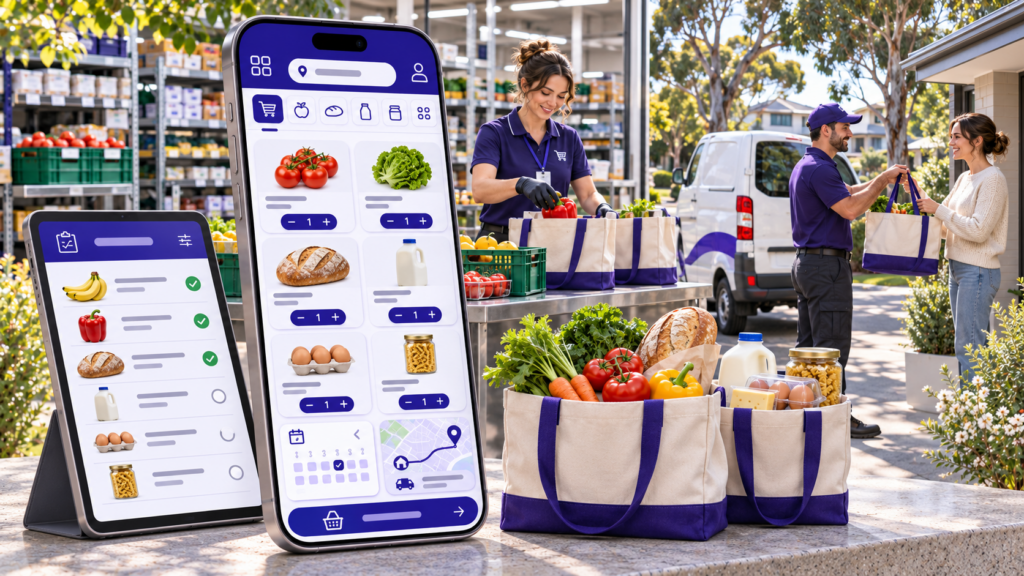
A grocery delivery app like Coles is not one app. It is a connected system of a customer app and website, a store picking app, a driver app and an admin console, held together by live inventory, delivery slot management, product substitutions and loyalty. Coles grew its supermarket eCommerce sales by 26.4% in FY26 by running several fulfilment modes at once: store picking, two automated fulfilment centres, Click & Collect, and under-one-hour delivery through Uber Eats. A custom build of a launch-ready grocery platform typically costs USD 60,000 to 150,000 and takes five to nine months, while a white-label platform such as DeliveryStack gives regional grocers the same core apps from about USD 1,000 per month with go-live in two to four weeks. The difficult parts are rarely the screens. They are inventory accuracy, weighted items, substitutions and slot capacity, and those deserve most of your planning time.
What Coles actually runs, and why it matters for your build
Coles has been selling groceries online for longer than most people assume. It first launched home delivery in 1999, and today it runs that service across a network of more than 800 supermarkets in Australia. The app most shoppers see is the visible layer of a fulfilment operation that took over two decades to assemble.
The numbers explain why grocers everywhere study it. In Q1 FY26, Coles reported online sales growth of 27.9% with online penetration reaching 13.3%, narrowing the gap with Woolworths. For the full FY26 year, supermarket eCommerce sales grew 26.4%, and Coles said its two customer fulfilment centres turned EBITDA positive in only their second year of operation.
How Coles fulfils an order
Coles does not rely on a single fulfilment method, and that is the first lesson for anyone planning a similar app.
Store picking. Outside metropolitan Melbourne and Sydney, online orders are picked from existing supermarkets. Staff walk the aisles with a picking device, much like a shopper with a list, and orders go out in scheduled delivery windows.
Automated customer fulfilment centres. In September 2024 Coles opened an automated centre at Truganina, west of Melbourne, followed by a second at Wetherill Park in greater Sydney in October 2024. Both run on Ocado’s Smart Platform, which combines eCommerce, robotic fulfilment and route planning, and next-day home delivery orders in those cities moved from stores to the centres.
Click & Collect and Click & Collect Rapid. Customers order online and pick up from a store. The Rapid version promises groceries ready in under 90 minutes. In Australia, collection is unusually popular and accounts for roughly 40% of online sales at the two largest grocers, which tells you that a pickup flow is not an afterthought.
On-demand delivery through a partner. From 26 December 2025, Uber Eats became Coles’ exclusive on-demand delivery partner, with up to 17,000 products delivered in under an hour. Coles keeps the weekly shop in its own channel and uses a partner fleet for urgent top-ups.
Subscriptions and loyalty. Coles launched its Coles Plus membership in February 2021, tying free delivery to a minimum basket, and links every account to Flybuys points. Both exist to make online shoppers order more often.
The takeaway is simple. If you copy the Coles app screen by screen but run a single delivery mode with manual inventory, you will have the look of Coles without the economics. Plan the fulfilment model first, then design the app around it.
Choose your grocery business model before you list features
The feature list, the cost and the timeline all depend on which of three models you are building.
Single grocer or supermarket chain. You own the stock, the stores and the brand. This is the Coles model. Your app must sync with your point-of-sale or ERP system, support picking from one or many stores, and handle delivery slots and collection. Most regional chains in the Gulf, Africa and South Asia fall here.
Multi-vendor grocery marketplace. You list many independent stores and take a commission on each order, similar to Instacart. The hard problem shifts from picking to vendor onboarding, catalogue quality across hundreds of sellers, and payouts. Inventory accuracy is worse because you do not control the shelves.
Dark store or quick commerce. You run small, closed warehouses that stock a few thousand fast-moving items and promise delivery in 10 to 30 minutes. Picking is fast because the layout is designed for it, but the unit economics depend on order density in a small radius. This model punishes you if you launch in a thinly populated area.
Many grocers end up running a hybrid. Coles itself combines a chain model with automated warehouses and a marketplace partner for on-demand orders. Start with one model, prove it works in one city, and add the second once the first is profitable.
Core features of a grocery delivery app like Coles
A Coles-style platform has four user-facing products. Each one needs to work for the others to work.
Customer app and website
Search and catalogue. A supermarket carries tens of thousands of products, so search does most of the work. Shoppers type “milk” and expect full cream, skim and lactose-free in the top results, with spelling mistakes forgiven. Filters for brand, dietary needs and price per unit are expected. A proper search engine such as OpenSearch or Algolia is worth the cost here.
Bought before and shopping lists. Weekly grocery shopping is repetitive. The fastest way to raise conversion is to let customers rebuild last week’s basket in a few taps. Reviews of the Coles app show how much customers care about this, with shoppers complaining when their bought-before items did not carry across from web to app.
Delivery slot booking. Customers choose a delivery window or a collection time before or during checkout. Slots must reflect real capacity: picker hours, vehicle count and zone limits. Coles also prices slots differently, for example offering free delivery on larger baskets when a customer picks a wider three or six hour window, which lets it spread demand across the day.
Substitution preferences. When an item is out of stock, the customer decides whether to accept a replacement. Good apps let them set this per item and leave a note. This single feature drives more complaints than any other in grocery, so design it with care.
Weighted and variable-price items. Fruit, vegetables, meat and deli items are sold by weight. Coles shows an approximate weight per item, a price per kilogram and a note that the final price is based on weight. Your payment flow has to authorise a slightly higher amount and capture the actual total after picking.
Specials, catalogue and loyalty. A weekly digital catalogue, personalised offers and points tracking keep customers coming back. Coles has been personalising its weekly digital catalogue inside the app.
Checkout, payments and tracking. Cards, wallets, local payment methods, saved addresses, promo codes and live order tracking with push notifications for each status change complete the customer side.
Picker and store app
This is the app most founders forget to budget for, and it decides whether orders arrive correct. The picker app groups orders into batches, sorts items by aisle sequence, scans barcodes to confirm the right product, records actual weights for loose items, and prompts the picker through substitutions based on the customer’s preferences. It also handles bagging, temperature zones for chilled and frozen goods, and handover to the driver or the collection bay. Store managers need a view of the day’s orders, staff allocation and items frequently out of stock.
Driver app
The driver app covers availability, order assignment, multi-drop route optimisation, turn-by-turn navigation, proof of delivery with photo or signature, cash collection where relevant, and earnings. Grocery deliveries are heavier and bulkier than food orders, so route planning by van capacity matters more than in restaurant delivery. If you use partner fleets for on-demand orders, the admin side needs to hand those jobs to an external API instead of your own drivers.
Admin console
The operations team runs the business from here: catalogue and pricing management, store and zone setup, delivery slot capacity, promotions and coupons, customer support tools including refunds for missing items, driver and picker management, and reporting on order accuracy, substitution rates, on-time delivery and basket size. If you run a marketplace, it also handles vendor onboarding, commissions and payouts.
Advanced features that separate a Coles-grade app from a basic one
Once the core works, a few capabilities make a measurable difference to repeat orders and margin.
Personalised baskets and AI suggestions. Australian grocers are already competing here. Woolworths is beta testing a Smart Basket that builds a basket from previous purchases, on top of its conversational assistant Olive, which plans meals and adds items to the online basket. For a new grocer, a simple “your usual basket” built from order history delivers most of the value at a fraction of the effort.
Omnichannel store tools. Coles has rolled out smart trolleys built on Instacart’s Caper Carts, which let shoppers bag as they go, see a running total and pay from the trolley. You do not need hardware to borrow the idea. Shared lists, in-store aisle locations and scan-and-go in the same app connect online and offline shopping.
Subscriptions. A monthly delivery pass encourages weekly ordering and gives you predictable revenue. It works only once delivery operations are efficient enough that frequent small orders do not lose money.
Dynamic slot pricing. Charging less for wider or off-peak windows moves demand to times when pickers and drivers are idle. It is one of the cheapest levers you have for improving delivery cost per order.
Retail media. Sponsored product placements in search and category pages are a growing revenue line for large grocers. They need enough traffic to matter, so treat them as a phase-two feature.
Recommended technology stack
For the customer and driver apps, Flutter or React Native lets one team ship iOS and Android from a single codebase, which suits most grocery projects. Native Swift and Kotlin are worth considering only for heavy offline use in the picker app or very large user bases. The customer website should be built in Next.js for fast, indexable product and category pages, since grocery SEO drives a meaningful share of new customers.
On the backend, Node.js with PostgreSQL handles orders, inventory and customers well, with Redis used to hold delivery slots and carts during checkout so two customers cannot book the last slot at the same time. Search runs on OpenSearch, Elasticsearch or Algolia. Maps and routing come from Google Maps Platform or Mapbox, with a route optimisation service for multi-drop runs. Payments go through Stripe, Adyen or regional gateways such as Razorpay, Paystack or PayTabs depending on your market, and push notifications through Firebase. Host on AWS, Google Cloud or Azure in a region close to your customers.
The integration layer is where most grocery projects run late. Your platform needs a reliable connection to the point-of-sale or ERP system for prices and stock, ideally updated every few minutes rather than once a night. Budget time for it, and test it with real store data early.
Step-by-step process to build a grocery delivery app like Coles
Step 1: Validate the market and the delivery economics
Before any design work, calculate your cost per order: picking time, packaging, driver cost and payment fees, against your average basket and margin. Grocery margins are thin, so if a typical order loses money at your planned delivery fee, no app feature will fix it. Pick one city and a small set of postcodes with dense demand for launch.
Step 2: Fix the fulfilment model and scope
Decide whether orders will be picked in stores, from a dark store or from a warehouse, and whether you will offer home delivery, collection, on-demand or all three. Write down the minimum feature set for each app. Keep the first release narrow: catalogue, search, slots, substitutions, payments, picking, delivery and basic admin.
Step 3: Design for repeat shopping
UX design for grocery is different from fashion or food delivery. Customers buy 30 to 60 items at a time, so the speed of adding items, editing quantities and reordering matters more than visual flair. Prototype the bought-before flow, the substitution flow and the slot selector first, and test them with real shoppers.
Step 4: Build the backend, integrations and apps
Development usually runs in two-week sprints, with the backend and integrations started first because every app depends on them. Product data migration, including images, categories and weights, takes longer than teams expect, so assign someone to it from day one.
Step 5: Test with real stores and real orders
Run a closed pilot with staff and friendly customers for two to four weeks. Measure order accuracy, substitution rate, picking time per item and on-time delivery. Fix inventory sync problems here, before they reach paying customers.
Step 6: Launch in one zone and scale gradually
Open to the public in your first zone, watch slot capacity daily and add zones only when the existing ones are hitting their targets. Marketing spend should follow operational capacity, not run ahead of it.
Step 7: Improve continuously
After launch, the roadmap is driven by data: which searches return nothing, which items are most often substituted, where drivers lose time. Loyalty, subscriptions and personalisation come in once the basics are reliable.
How much does it cost to build a grocery delivery app like Coles?
Cost depends on the business model, the number of apps, the depth of integrations and where your development team is based. The figures below are typical ranges from projects with offshore development teams in India and are estimates, not quotes.
A focused MVP for a single grocer, with customer app, simple picker flow, driver app and admin panel, typically costs USD 35,000 to 60,000 and takes four to five months. A launch-ready platform with slot management, substitutions, weighted items, POS integration, loyalty and a web storefront usually lands between USD 60,000 and 150,000 over five to nine months. A multi-store, multi-city platform with advanced routing, personalisation, marketplace features and several third-party integrations can pass USD 200,000 and take a year or more. Automated fulfilment hardware of the kind Coles uses sits in another category altogether, since Coles agreed to spend up to AUD 150 million over four years with Ocado to double its home delivery capacity.
The main cost drivers are the number of platforms, the quality of your existing product data, the ERP or POS integration, the complexity of slot and zone rules, and support for multiple languages and currencies. Ongoing costs include cloud hosting, maps and SMS usage, payment fees, app store accounts and maintenance, which commonly runs at 15% to 20% of the initial build cost each year.
Custom development or a white-label platform?
A custom build makes sense when your fulfilment process is unusual, when you need deep integration with legacy systems, or when the platform itself is your long-term product. You own the code and can change anything, but you pay for every feature and wait months before your first order.
A white-label platform suits grocers and startups that want to launch quickly and spend their budget on stock, drivers and marketing instead. DeliveryStack is one such option. It provides the customer app and website, driver app, store panel and admin console on a shared core for dispatch, payments, zones and analytics, with grocery delivery available as a ready vertical. Pricing starts at about USD 1,000 per month depending on volume and customisation, and launch typically takes two to four weeks, covering configuration, branding, data loading and staff training. The trade-off is that you work within the platform’s structure, although branding, pricing rules, zones and commissions are configurable.
A practical path for many grocers is to launch on a white-label platform, prove demand in one city, and then fund custom features once the business has real order data to justify them. DeliveryStack is built by Aalpha Information Systems, a software development company founded in 2008 that has delivered more than 5,500 projects across 55+ countries and holds a 4.9 out of 5 rating from more than 215 reviews on Clutch. That means a grocer can start with the white-label product and extend it with custom development from the same team. You can see what is included on the DeliveryStack grocery delivery page.
How grocery delivery apps make money
Grocery apps earn from product margin first and fees second. Delivery fees, often waived above a minimum basket, cover part of the fulfilment cost. Service fees and small-basket fees discourage tiny orders that lose money. Subscriptions such as delivery passes lock in frequent shoppers. Marketplaces add vendor commissions, and larger players add sponsored listings and supplier-funded promotions.
Pricing on partner channels is a separate decision. Coles, for example, stopped matching its in-store special prices on Uber Eats and DoorDash, adjusting prices on those on-demand platforms instead. A CHOICE investigation found that some Coles items cost up to 42% more through those apps than in store. If you use partner fleets for rapid delivery, decide early whether the channel will carry its own pricing, and be transparent with customers about it.
Mistakes that sink grocery delivery apps
The most common failure is inaccurate stock. If the app shows items the store does not have, every order ends with substitutions or refunds, and customers stop ordering within a few weeks. Fix inventory sync before you spend on marketing.
The second is launching across too wide an area. Delivery cost per order falls only when drops are close together, so a city-wide launch with thin demand guarantees losses.
The third is treating the picker app as a minor tool. Pickers handle every item in every order. A slow or confusing picking flow adds minutes to each order and errors to many of them.
The fourth is copying the scale of Coles on day one. Coles built automated fulfilment centres after more than 20 years of online grocery and a very large order base. A new grocer should start with store or dark store picking and add automation only when volume justifies it.
Frequently asked questions
How long does it take to build a grocery delivery app like Coles?
A custom MVP usually takes four to five months, and a full launch-ready platform with integrations takes five to nine months. A white-label platform such as DeliveryStack can be configured and launched in two to four weeks because the core apps already exist.
What apps are needed for a grocery delivery business?
You need a customer app and website for ordering, a picker or store app for preparing orders, a driver app for delivery, and an admin console for operations. Marketplaces also need a vendor panel for each store.
How does Coles handle out-of-stock items in online orders?
Customers set substitution preferences when ordering, and the picker follows those preferences when an item is unavailable. Your app should let customers allow or block substitutions for each item and add notes for the picker.
Can a small grocery chain compete with an app like Coles?
Yes, on a local scale. Smaller grocers win on faster delivery in a tight area, local products, personal service and lower fees. They do not need to match Coles’ national network, only to serve their own neighbourhoods better.
Is it better to build a custom grocery app or use a white-label solution?
White-label is faster and cheaper to start, which suits most new and regional grocers. Custom development makes sense when your processes are unusual or the software itself is a long-term asset. Many businesses start white-label and add custom work later.
Which payment features does a grocery app need?
It needs card and wallet payments, local payment methods for your market, saved cards, promo codes, refunds for missing items, and pre-authorisation that can capture a different final amount for items sold by weight.
How can a grocery delivery app make a profit?
Profit comes from keeping cost per order below the margin on each basket. That means dense delivery zones, minimum basket sizes, efficient picking, slot pricing that spreads demand, and subscriptions or loyalty that raise how often customers order.