ChatGPT
 Claude
 Gemini
 Grok
Delivery App Development in Kenya: A Complete Guide
TLDR
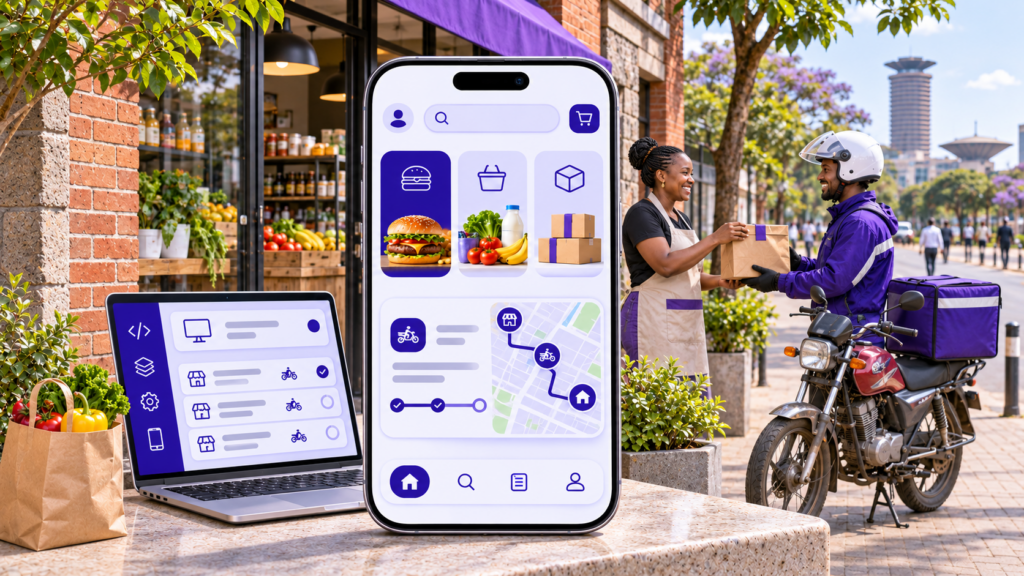
Delivery app development in Kenya means building a customer app, a rider app, a merchant panel and an admin dashboard that run well on mid-range Android phones, take payments through M-Pesa, and cope with addresses that are often landmarks rather than street numbers. The market is concentrated. Glovo, Uber Eats and Bolt Food lead food delivery, and a July 2026 deal will put Glovo Kenya under Uber once it closes. That leaves room for brand-owned delivery apps, secondary towns and verticals such as pharmacy, gas, groceries and parcels. A custom multi-vendor build usually costs about $32,000 to $53,000 and takes four to six months, while DeliveryStack, a white-label delivery platform, puts a branded app live in two to four weeks from $1,000 a month. Whichever route you take, register with Kenya's Office of the Data Protection Commissioner before launch.
What does delivery app development in Kenya involve?
Building a delivery app in Kenya means shipping four connected products: a customer app, a rider app, a merchant panel and an admin dashboard. All four share one backend for orders, dispatch, payments and payouts. The Kenyan version differs from a US or European build in three places: payments run on mobile money, addresses are informal, and riders work mostly on motorbikes.
Most of the engineering effort sits behind the screens. Dispatch logic, rider tracking, M-Pesa callbacks, refunds and settlement reports take more time than the customer-facing design. A founder who budgets mainly for “the app” usually underestimates the backend by half.
The product also has to fit the phones people actually carry. Many customers and nearly all riders use entry-level Android devices on prepaid data. An app that loads slowly or eats data loses orders before the menu even appears.
What does Kenya’s delivery market look like in 2026?
Kenya’s online delivery market is large, mobile-first and dominated by three foreign platforms. The Competition Authority of Kenya valued online food delivery at KSh 13.3 billion in 2023 and projected about 19% annual growth. Its 2024 market study put Glovo first in consumer preference at roughly 33%, ahead of Uber Eats at 21% and Bolt Food at 16%.
The market has consolidated
Jumia Food shut down across its African markets, Kenya included, in December 2023. In July 2026, Uber agreed to acquire Glovo’s Kenyan operations as part of a larger deal with Delivery Hero. Until that deal closes, Glovo, Uber Eats and Bolt Food keep operating as separate apps. Once it closes, one company will control two of the three largest food delivery apps in the country.
For restaurants and retailers, that concentration matters. Fewer platforms means less room to negotiate commissions and less control over customer data. This is the main reason Kenyan chains, supermarkets and pharmacies are looking at their own delivery apps.
Payments are already digital
The Communications Authority of Kenya counted about 54 million active mobile money subscriptions at the end of June 2026, slightly more than one per person. M-Pesa held 88.8% of them and Airtel Money 11.1%. A delivery app that cannot take M-Pesa in two taps will struggle in Kenya.
Where the openings are
The big platforms focus on Nairobi first. Secondary towns such as Mombasa, Kisumu, Nakuru and Eldoret have fewer options and lower rider costs. Verticals outside restaurant food are also thinner: LPG gas refills, drinking water, pharmacy orders, hardware, B2B restocking for dukas, and same-day parcels. A focused operator in one of these niches can reach order density faster than a general marketplace.
Which delivery business models work in Kenya?
Four models work in Kenya today, and the right one depends on who owns the customer and who owns the riders. Pick the model before you write a feature list, because it changes the payment flows, the commission logic and the admin tools.
Multi-vendor marketplace. You list many restaurants or shops, take a commission per order and run a shared rider fleet. This is the Glovo model. It needs heavy marketing spend and enough vendors to make the app worth opening. The downside is that you compete head-on with well-funded incumbents.
Single-brand delivery app. A restaurant chain, supermarket or pharmacy runs its own app and its own riders, or contracts riders from a courier. KFC already runs in-house delivery in Kenya alongside the aggregators. The brand keeps the customer data and the margin. The downside is that you must drive downloads yourself.
Hyperlocal vertical service. One category, such as gas, water or medicines, served in a few neighbourhoods with fast delivery. Order values are predictable and repeat rates are high. Growth is limited by the size of the category.
Courier and parcel platform. Businesses and individuals book pickups and drops, priced by distance and parcel size. This model suits e-commerce sellers on Instagram and WhatsApp who have no delivery partner. Margins per trip are thin, so dispatch efficiency decides profitability.
Aalpha’s guide to pickup and delivery app development covers the courier model in more depth.
Which apps and features does a Kenyan delivery platform need?
A working delivery platform needs four apps sharing one backend. Each has a short list of features that matter on day one and a longer list that can wait for version two. Kenyan conditions add a few features that global templates leave out.
Customer app
The customer app handles sign-up by phone number with SMS OTP, browsing, cart, checkout, live tracking and order history. In Kenya, sign-up by phone number beats email, because the phone number is also the M-Pesa account. Checkout should send an M-Pesa STK Push prompt straight to the customer’s phone. Address entry needs a map pin plus a free-text field for landmarks, gate colour or building name.
Add a one-tap button to call or WhatsApp the rider. Kenyan customers expect a call when the rider is close, and many deliveries depend on it. Support for English and Swahili is worth adding early, especially outside Nairobi.
Rider app
The rider app shows new jobs, pickup and drop locations, turn-by-turn navigation, proof of delivery and earnings. Most riders work on boda boda motorbikes and keep the phone mounted on the handlebar, so buttons must be large and flows short. Location tracking has to survive weak signal and must not drain the battery during a full shift.
Riders care most about payout speed. Daily or on-demand payouts to M-Pesa, sent through the B2C API, help with rider retention more than any app feature. Show each rider exactly how every payout was calculated.
Merchant panel
The merchant panel lets restaurants and shops manage menus or catalogues, accept orders, mark items out of stock and see settlements. Many Kenyan merchants run it on a cheap tablet or a phone at the counter. A loud new-order alert and a one-tap accept button matter more than analytics charts.
Admin dashboard
The admin dashboard runs the business: vendor onboarding, rider management, delivery zones, pricing rules, promotions, refunds, M-Pesa reconciliation and reports. Build the reconciliation view early. Mismatches between orders and M-Pesa callbacks are the most common operational headache in Kenyan delivery businesses.
How do you integrate M-Pesa and other payments?
M-Pesa integration runs through Safaricom’s Daraja API, the official interface for taking and sending M-Pesa payments from software. A delivery app usually needs three Daraja products: STK Push for checkout, C2B for Paybill or Till confirmations, and B2C for rider and merchant payouts.
STK Push for checkout. Your server asks Daraja to send a payment prompt to the customer’s phone. The customer enters their M-Pesa PIN, and Daraja posts the result to your callback URL. The order should only move to the merchant after a successful callback, never on the initial request.
C2B for manual payments. Some customers prefer to pay to a Paybill or Till number from the M-Pesa menu. Registering C2B URLs lets your backend receive and match those payments to orders using the account reference.
B2C for payouts. B2C sends money from your business shortcode to riders and merchants. It needs a verified B2C shortcode and an encrypted initiator credential, so start the Safaricom approval process weeks before launch.
Plan for failure cases. Customers cancel prompts, enter the wrong PIN or run out of balance. Callbacks arrive late or twice. Your backend must handle idempotent callbacks, timed-out prompts and transaction status queries, or your support team will spend its days matching receipts by hand.
Airtel Money holds a growing share of subscriptions and is worth adding once M-Pesa is stable. Card payments serve corporate customers and expats. Cash on delivery still has a place in some towns, but it creates rider cash-handling risk, so many operators limit it to trusted repeat customers.
How do you solve addressing and last-mile routing in Kenya?
Kenyan addressing is the problem foreign templates miss most often. Many homes and offices have no usable street address, so customers describe locations by estate, building, landmark or gate. The app must capture a map pin, a landmark note and a phone number, and the rider must be able to call.
Save addresses with context. Store each saved address with its pin, a nickname such as “Home” or “Office”, and the customer’s own directions. Repeat orders then go to the right gate without a phone call.
Correct pins over time. When a rider completes a delivery, record the actual drop location. If it differs from the customer’s pin, offer to update the saved address. This one feature cuts failed deliveries noticeably over a few months.
Zone the city. Define delivery zones and fees by area rather than straight-line distance. Nairobi traffic makes a 4 km trip across Waiyaki Way at 6 pm slower than an 8 km trip at 2 pm. Zone-based pricing with time-of-day surcharges is easier for customers to understand and safer for margins.
Batch where you can. For groceries and parcels, batching several drops into one rider trip lowers cost per order. Food delivery tolerates batching less, because food goes cold.
What legal and compliance rules apply to delivery apps in Kenya?
The main legal requirement is Kenya’s Data Protection Act, 2019. It requires data controllers and data processors that handle the personal data of people in Kenya to register with the Office of the Data Protection Commissioner (ODPC), subject to thresholds the ODPC sets. A delivery app collects names, phone numbers, locations and payment data, so plan on registering.
Data protection in practice
Registration is done online, and the ODPC issues a certificate within 14 days of a complete application. Beyond registration, the Act expects a lawful basis for processing, clear consent screens, a data protection policy, and breach notification to the ODPC within 72 hours. Location history is personal data. Keep only what you need for delivery, support and fraud checks, and set retention limits. If you host outside Kenya, document the safeguards for cross-border transfer.
Consumer protection and complaints
In 2024, the Competition Authority of Kenya ordered Glovo and Uber Eats to open local offices so Kenyan consumer complaints could be resolved locally. The lesson for new entrants is simple: build in-app complaint handling, clear refund rules and a local support contact from the first release.
Tax, licences and riders
You will need a Kenyan company registration, a KRA PIN, county business permits for each county you operate in, and compliant electronic invoicing under KRA’s eTIMS system. Food vendors need their own health licences, and pharmacy delivery needs a licensed pharmacy partner. Rules on how platform riders are classified and insured are still being debated in Kenya. Take advice from a Kenyan lawyer and accountant before you sign rider agreements. This guide is general information, not legal or tax advice.
Which tech stack suits a Kenyan delivery app?
A good stack for Kenya is cross-platform on mobile, light on data, and simple to run. Aalpha Information Systems builds delivery platforms with Flutter or React Native for the customer and rider apps, Node.js for the backend, Next.js for the admin dashboard and merchant web panel, and PostgreSQL with Redis for data and real-time state.
Mobile. Flutter and React Native both ship to Android and iOS from one codebase. Android matters far more in Kenya, so test on entry-level devices first, not the newest flagships. Keep the install size small and compress images aggressively.
Backend. A Node.js service handles orders, dispatch, M-Pesa callbacks and notifications. WebSockets carry live rider locations to the customer app. A queue processes payment callbacks and payouts so a slow Daraja response never blocks an order.
Maps and messaging. Google Maps Platform covers geocoding, routing and map display, billed per request. SMS goes through a Kenyan SMS gateway for OTP and order updates. Push notifications use Firebase Cloud Messaging.
Hosting. Cloud hosting in a nearby region keeps latency low. Whichever region you pick, record it in your data protection documentation.
The trade-off with any custom stack is ownership. You control every line, but you also maintain every line, including Daraja changes, OS updates and map API price changes.
How much does it cost to build a delivery app in Kenya?
A custom delivery platform with customer, rider, merchant and admin apps typically costs about $32,000 to $53,000 at Aalpha Information Systems. That figure comes from Aalpha’s on-demand app development cost calculator, which prices an Uber-like build with customer and driver apps at $15 to $25 an hour. A white-label platform costs far less up front.
What changes the price
The main cost drivers are the number of apps, the business model and the integrations. A single-brand app for one restaurant chain sits at the lower end, because it skips vendor onboarding and commission logic. A multi-vendor marketplace with scheduled orders, promotions, rider batching and wallet features sits at the upper end. A super app that combines food, groceries, parcels and rides can reach $64,000 to $106,000 or more on the same calculator.
Agency location changes the number most. The same scope priced at North American agency rates costs several times more. Kenyan development teams are another option, with rates usually between Indian and Western levels.
Running costs after launch
Budget for monthly costs that continue after the build: cloud hosting, Google Maps API calls, SMS for OTPs, M-Pesa transaction charges on your Paybill or Till, app store fees, and maintenance. Maps and SMS costs grow with order volume, so model them per order rather than per month. A maintenance budget of 15% to 20% of the build cost per year is a sensible starting assumption.
White-label cost
DeliveryStack licenses a ready platform with customer, rider, store and admin apps under your brand. Pricing starts at $1,000 a month and depends on order volume, cities, verticals and custom work. See the DeliveryStack pricing page for current plans. The trade-off is that you rent the core platform rather than own the source code.
How long does it take to launch a delivery app in Kenya?
A lean custom delivery platform usually takes four to six months from kickoff to first release. A white-label platform such as DeliveryStack goes live in two to four weeks, with onboarding typically taking 14 to 21 days. Safaricom go-live approval for Daraja, app store review and ODPC registration run alongside development, so start them early.
A typical custom timeline runs like this. Discovery and design take three to four weeks. Backend, apps and admin development take ten to fourteen weeks. Testing on real Kenyan devices and networks, M-Pesa sandbox and live tests, and a soft launch with a small group of merchants take another four weeks.
The soft launch is the step founders skip and regret. Run two to four weeks in a single zone with a handful of merchants and riders. Address issues, payment edge cases and rider behaviour show up here, not in testing.
The DeliveryStack deployment process follows four steps: configuration, customisation and testing, data loading and team training, and go-live.
Should you build a custom delivery app or use a white-label platform?
Choose a white-label platform if you want to test a market quickly, your model is standard, and your budget is under about $30,000. Choose a custom build if delivery is your core product, you need workflows no platform supports, or investors expect you to own the technology.
When white-label wins. A supermarket adding delivery, a pharmacy chain, a gas distributor or a founder testing one town gains most from speed. You spend your money on riders and marketing instead of code. The downside is less control over the roadmap and a recurring licence fee that grows with you.
When custom wins. A funded startup building a new category, or an operator with unusual flows such as cold-chain pharmacy or B2B credit terms, needs full control. The downside is a larger upfront bill, a longer wait for revenue, and a permanent maintenance responsibility.
Many operators take a middle path. They launch on white-label, prove demand in one or two towns, and move to a custom build once order volume justifies it. DeliveryStack compares both routes on its custom development comparison page.
How do you win your first customers in Kenya?
Start with density, not coverage. A delivery app that serves three estates well beats one that serves all of Nairobi badly. Pick one zone, sign up the merchants people in that zone already buy from, and keep delivery times short and predictable.
WhatsApp is the strongest early channel. Share order links in estate and office WhatsApp groups, and let customers reorder from a link. Rider quality matters as much as marketing, because a rude rider or a late order spreads through the same groups.
Track three numbers from week one: order completion rate, average delivery time and repeat rate after 30 days. If the repeat rate is weak, more marketing will not fix it.
Frequently asked questions
How much does it cost to build a delivery app in Kenya?
A custom delivery platform with customer, rider, merchant and admin apps costs about $32,000 to $53,000 at Aalpha Information Systems’ rates. A super app with several verticals can exceed $64,000. White-label platforms such as DeliveryStack start at $1,000 a month with no large upfront build cost.
Can a delivery app in Kenya accept M-Pesa payments?
Yes. Apps accept M-Pesa through Safaricom’s Daraja API. STK Push sends a payment prompt to the customer’s phone at checkout, C2B confirms Paybill and Till payments, and B2C pays riders and merchants. B2C needs a verified shortcode, which takes time to approve.
Do delivery apps in Kenya need to register with the ODPC?
In most cases, yes. The Data Protection Act, 2019 requires data controllers and processors handling personal data of people in Kenya to register with the Office of the Data Protection Commissioner, subject to its thresholds. Delivery apps process names, phone numbers and locations.
Is a white-label delivery app better than a custom build?
It depends on your goal. White-label suits fast market tests and standard delivery models, with launch in weeks. Custom suits founders who need unique workflows or must own the code. Many operators start with white-label and move to custom after proving demand.
Which Kenyan cities should a new delivery app start in?
Nairobi has the most demand and the most competition. Mombasa, Kisumu, Nakuru and Eldoret have fewer delivery options and lower operating costs. Starting in one zone of one city and reaching order density there works better than launching nationwide.
How do Kenyan delivery apps handle addresses without street numbers?
They combine a map pin, a landmark note and the customer’s phone number. Riders call when they are close. Good apps save corrected drop locations after each delivery, so repeat orders reach the right gate without a call.
Can one app handle food, groceries and parcels?
Yes. A multi-vertical platform uses one customer app with separate catalogues and pricing rules per category, and one rider fleet. It costs more to build and run, so most operators launch one vertical first and add others once the first is profitable.
Next step
If you want a branded delivery app live in Kenya within weeks, book a DeliveryStack demo and see the customer, rider, store and admin apps working with your own branding. If your project needs a custom build, the same team at Aalpha Information Systems, rated 4.9 out of 5 from more than 215 reviews on Clutch, can scope it with you.