ChatGPT
 Claude
 Gemini
 Grok
How to Build a Food Delivery Platform in Germany: A Complete Guide
TLDR
Building a food delivery platform in Germany means launching a customer app, a restaurant dashboard, a courier app and an admin and dispatch system that fit German payment habits, GDPR, the EU Platform Work Directive and local food labelling rules. The market is large and still growing, but Lieferando, Uber Eats and Wolt dominate the big cities, so new entrants usually win by focusing on a region, a niche or lower commissions for restaurants. A white-label platform such as DeliveryStack can bring a branded launch down to roughly USD 15,000 to 40,000 and 6 to 10 weeks, while a fully custom build typically runs from USD 60,000 to well above USD 200,000 over 5 to 9 months. Whichever route you take, plan early for German-language UX, PayPal and SEPA payments, allergen disclosure, courier employment status and EU data hosting, because these decide whether the platform can operate legally and earn trust.
Why Germany Is Worth Building For
Germany is the largest consumer economy in the EU and one of Europe’s most important food delivery markets. IMARC Group estimates the German online food delivery market at USD 14.7 billion in 2025 and expects it to reach USD 31.3 billion by 2034, a compound growth rate of about 8.7 percent. Demand is broad rather than limited to young city dwellers: Mintel reports that 46 percent of German consumers order takeaway or delivery several times a month, the highest level since 2021.
Who you will compete with
Lieferando remains the default choice. A Statista Consumer Insights survey from November 2026 found that three quarters of respondents use Lieferando to order restaurant food, far ahead of Domino’s at 27 percent and Uber Eats at 22 percent. Lieferando’s parent, Just Eat Takeaway.com, has been owned by Prosus since late 2025.
The market is consolidating fast. In July 2026 Uber agreed to buy Berlin-based Delivery Hero in a deal valued at USD 14.8 billion, with completion expected in the second half of 2027. Wolt, owned by DoorDash, keeps expanding city by city. For a new operator, this concentration is both the risk and the opening: restaurants increasingly look for alternatives to high commissions and limited control over their customer data, and many mid-sized cities and rural districts are thinly served.
Where the opportunity actually is
Regional and niche platforms win on focus. The realistic entry points in Germany are a single city or region, a vertical such as groceries, bakeries, halal, vegan or office catering, a restaurant group that wants its own branded ordering, or a cooperative model where local restaurants share a platform. Each of these needs the same technical core, which is why the build decisions below matter regardless of which niche you choose.
Choosing the Right Business Model
Your business model decides who delivers the food, who owns the customer relationship and how you earn money. Settle it before writing a single specification, because it changes the feature set, the legal exposure and the cost structure.
Order-only marketplace
The platform takes orders, restaurants deliver. You list restaurants, process orders and payments, and pass each order to the restaurant, which uses its own drivers. This is the lightest model to run because you carry no courier workforce, and you earn through a commission or a monthly subscription. It works well in towns where many pizzerias, kebab shops and Asian restaurants already have their own delivery staff.
Full-service delivery marketplace
The platform handles both ordering and logistics. You recruit and manage couriers, dispatch every order and charge restaurants a higher commission plus a delivery fee to customers. This model gives you control over speed and quality but brings the heaviest operational and legal load in Germany, since courier wages, working time and employment status all become your responsibility.
Hybrid model
Restaurants choose per order or per location. Some partners deliver themselves while others use your fleet. Most growing regional platforms end up here because it lets you onboard restaurants quickly and add your own fleet only where order density justifies it.
Branded ordering for chains and restaurant groups
One brand, its own apps, no marketplace. A restaurant group or franchise runs its own customer app and website, keeps its customer data and pays no per-order commission to a third-party marketplace. Delivery can be in-house or outsourced to courier partners through an integration.
Grocery and quick commerce
Food delivery logic applied to shopping baskets. Supermarkets, specialty stores and dark stores need larger catalogues, substitution handling, age checks and slotted delivery windows. The core platform is similar, but catalogue management and picking workflows add real scope.
The Core Components of a Food Delivery Platform
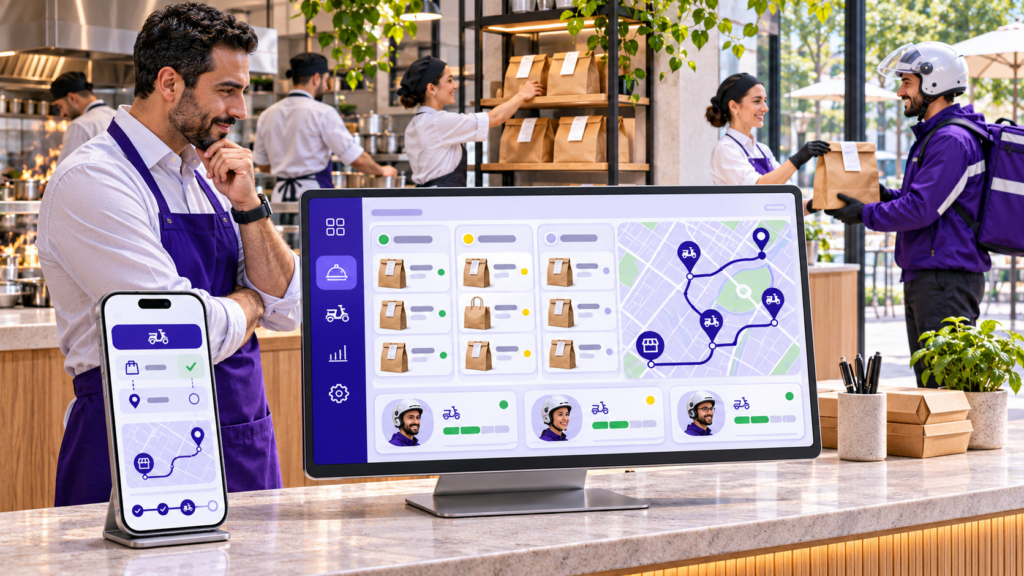
Every serious food delivery platform is really four connected products sharing one backend. Treating them as one system from the start avoids the most common failure, where the customer app looks polished but restaurants and couriers struggle with tools that were added as an afterthought.
Customer app and website
This is where orders start. Customers need fast restaurant discovery by address, clear menus with photos, prices and allergen information, a simple cart, scheduled orders, delivery or pickup selection, multiple payment methods, live order tracking, ratings, reorder and loyalty features. In Germany, a full web ordering experience matters as much as the app, because a large share of orders still come from desktop and mobile browsers, often through search.
Restaurant dashboard and tablet app
Restaurants must be able to run service without friction. Partners need to accept or reject orders with a preparation time, pause the store when the kitchen is overloaded, edit menus, options and prices, mark items out of stock, see payouts and commission invoices, and download VAT-ready reports. Integration with the restaurant’s point-of-sale system saves staff from typing orders twice and is often the deciding factor for larger partners.
Courier app
Couriers need clarity, not complexity. The app should handle shift sign-up, order offers or assignments, pickup and drop-off navigation, contactless delivery with photo proof, cash handling where offered, earnings, and working-time records. Bike and e-bike routing matters in German cities where many couriers ride rather than drive.
Admin panel and dispatch engine
This is the control room. Operators manage restaurants, customers, couriers, delivery zones, fees, promotions, refunds and support tickets. The dispatch engine assigns orders based on distance, courier load and kitchen readiness, and batches orders where it saves time without letting food go cold. Analytics on order volume, delivery time, cancellations and unit economics per zone guide every expansion decision.
Features German Customers and Restaurants Expect
A platform built for another market will feel foreign in Germany unless it is adapted in a few specific places. These are the details German users notice immediately.
Payments that match German habits
PayPal and SEPA come first, cards second. German shoppers rely heavily on PayPal, SEPA direct debit and invoice or instalment options such as Klarna, alongside Visa, Mastercard, Apple Pay and Google Pay. Cash on delivery is still expected by many customers and many smaller restaurants, so the platform should support it with clear courier cash reconciliation. All card payments must meet PSD2 Strong Customer Authentication. Because a marketplace collects money on behalf of restaurants, use a licensed payment provider with marketplace capabilities, such as Stripe Connect, Adyen or Mollie, rather than holding funds yourself, which can trigger licensing requirements under the German Payment Services Supervision Act.
Language, tone and address details
German first, English as an option. The interface, emails, push messages and legal texts should be written in natural German, not machine-translated copy. Address capture needs the German format of street followed by house number, five-digit postcodes, and fields for floor, building wing and the name on the doorbell, because many apartment buildings have dozens of bells and no visible unit numbers. Getting this right reduces failed deliveries more than almost any other change.
Allergen and food information
Allergens must be visible before checkout. Under the EU Food Information Regulation, information on the 14 major allergens must be available to the customer before the purchase is completed in distance selling. The menu builder in the restaurant dashboard should make allergen and additive tagging part of adding a dish, not an optional extra, so the platform can display it consistently.
Reusable packaging options
Sustainability is a purchase factor in Germany. Since 2023 the German Packaging Act has required many takeaway businesses to offer a reusable packaging alternative to single-use containers. Letting customers choose reusable packaging at checkout, and letting restaurants connect to reusable deposit systems, helps partners comply and appeals to environmentally conscious customers.
Trust signals
Transparency builds conversion. Show delivery fees, minimum order values and service charges before checkout, display realistic delivery times, and offer an easy path to support and refunds. German consumers tend to be cautious about hidden costs, and unclear pricing is one of the fastest ways to lose them.
Legal and Compliance Requirements in Germany
Compliance is not a launch-day checklist in Germany. It shapes the data model, the courier app and the payment flow, so it belongs in the specification from day one. The points below are a practical overview for planning purposes and do not replace advice from a German lawyer or tax adviser.
Data protection under GDPR
Privacy by design is expected, and enforced. The platform must follow the GDPR and the German Federal Data Protection Act. In practice this means a clear legal basis for every data use, data processing agreements with every vendor, hosting in the EU or with adequate safeguards, data minimisation in courier tracking, retention rules, and simple tools for users to access, export and delete their data. Location tracking of couriers is a sensitive area, so track only during active shifts and only as precisely as dispatch requires.
Cookies, imprint and legal pages
German websites have specific legal page requirements. Cookie and tracking consent falls under the Telecommunications Digital Services Data Protection Act, so non-essential tracking needs prior opt-in consent. Every commercial website and app needs an Impressum with the operator’s legal details under the Digital Services Act, plus terms and conditions, a privacy policy, withdrawal information where relevant, and platform terms for restaurants and couriers.
Courier employment, minimum wage and platform work
This is the area with the highest financial risk. Germany’s statutory minimum wage rose to EUR 13.90 per hour on 1 January 2026 and is set to rise to EUR 14.60 on 1 January 2027, and it applies to couriers who are employees, including mini-jobbers. Treating couriers as freelancers when they work like employees carries a serious risk of reclassification as false self-employment, with back payments of social security contributions. On top of this, EU member states must transpose the EU Platform Work Directive into national law by 2 December 2026. The directive introduces a presumption of employment where a platform controls how work is performed and adds transparency and human oversight rules for algorithmic management. Your courier app should therefore record working time accurately, explain how orders are assigned and how pay is calculated, and give couriers a human contact for decisions that affect them.
VAT and invoicing
Food and drinks are taxed differently. Since 1 January 2026, food supplied by restaurants is permanently taxed at the reduced VAT rate of 7 percent, whether it is eaten in, taken away or delivered, while most beverages remain at 19 percent. The platform must handle mixed-rate baskets correctly, split VAT on receipts, and produce clean commission invoices and payout statements for restaurants. Germany is also phasing in mandatory B2B e-invoicing, so commission invoices to restaurants should be designed to support structured formats such as XRechnung or ZUGFeRD.
Age-restricted products and accessibility
Alcohol and accessibility need explicit handling. If partners sell alcohol, the courier app needs an age verification step at handover, in line with the Youth Protection Act. Since June 2025, the Accessibility Strengthening Act has required many consumer e-commerce services in Germany to meet accessibility standards, so build the customer app and website to WCAG guidelines from the start rather than retrofitting later.
Recommended Technology Stack
The right stack keeps the platform fast at dinner-time peaks, easy to extend and compliant with EU data rules. A proven combination for a German food delivery platform looks like this.
Web and admin layer. Next.js works well for the customer website, restaurant dashboard and admin panel, because server-side rendering helps restaurant and city pages rank in search and load quickly on mobile networks.
Backend and APIs. Node.js with a modular or service-based architecture handles orders, payments, dispatch and notifications, with WebSockets or a similar real-time layer for live order status and courier tracking.
Mobile apps. React Native or Flutter let you ship the customer, restaurant and courier apps for iOS and Android from one codebase each, which keeps cost and release cycles manageable.
Data and caching. PostgreSQL suits orders, payments and accounting data that must stay consistent, while Redis handles caching, sessions and dispatch queues during peak hours.
Maps and routing. Google Maps Platform, HERE or Mapbox provide geocoding, delivery zones and routing. HERE, which is headquartered in Germany, and Mapbox both offer strong bicycle and European address coverage.
Payments and messaging. A marketplace payment provider such as Stripe Connect, Adyen or Mollie handles split payments and payouts. Firebase Cloud Messaging and email or SMS services handle notifications.
Hosting. Use EU data centre regions, such as AWS Frankfurt, Google Cloud Frankfurt or a German provider like Hetzner, to simplify GDPR compliance and keep latency low for German users.
How to Build the Platform, Step by Step
The sequence below reflects how successful delivery platforms are typically planned and delivered. Skipping the early steps is the most common reason projects run over budget.
Step 1: Validate the city, niche and unit economics
Start with numbers, not screens. Pick a launch city or district and estimate how many restaurants you can sign, the realistic orders per day, average basket size, commission rate, delivery fee and courier cost per order. If the margin per order does not work on paper at your target volume, no app will fix it. Talking to twenty local restaurant owners about their current commissions and frustrations is the cheapest research you will ever do.
Step 2: Choose build route and business model
Decide between white-label, custom or a mix. A white-label platform gets you to market quickly with proven workflows, while a custom build gives full control over every feature. Many operators launch on white-label software, prove demand, and then invest in custom features where they differentiate.
Step 3: Write a clear specification
Turn decisions into a scope everyone can sign off. Document user roles, every screen, order states, payment and refund flows, dispatch rules, delivery zones and fees, integrations, and the compliance requirements described above. A good specification also lists what is out of scope for the first release.
Step 4: Design the user experience in German
Design with real German content. Use real German menu names, addresses and legal texts in the prototypes, because German words are long and break layouts that were designed in English. Test the ordering flow with local users before development starts.
Step 5: Build the backend, apps and integrations
Develop in short sprints with working releases. Build the order engine, payment integration and restaurant dashboard first, because these carry the business. Then add the customer apps, courier app, dispatch logic, POS integrations and analytics. Weekly or fortnightly demos keep the product aligned with operations.
Step 6: Test under real conditions
Test the Friday-night peak, not just the happy path. Run load tests that simulate dinner rush volumes, test payments with real German payment methods, check GDPR flows such as data export and deletion, and run a pilot with a handful of friendly restaurants and couriers before opening to the public.
Step 7: Launch, measure and iterate
Go live in one area and expand by data. Launch in a defined zone, track delivery times, cancellation reasons, repeat order rates and contribution margin per order, then expand zone by zone once the numbers are healthy.
How Much Does It Cost to Build a Food Delivery Platform in Germany?
Cost depends mainly on the build route, the number of apps, the depth of the dispatch logic and the integrations you need. The ranges below are typical market estimates for planning and assume an experienced development partner.
White-label platform
Fastest and most predictable route. A branded white-label food delivery platform with customer, restaurant, courier and admin apps typically costs around USD 15,000 to 40,000 to set up, including German localisation, payment integration and branding, and can go live in about 6 to 10 weeks. Ongoing hosting, maintenance and support are usually charged monthly.
Custom MVP
Your own codebase with a focused feature set. A custom minimum viable product covering ordering, payments, restaurant management, basic dispatch and an admin panel generally ranges from USD 60,000 to 120,000 and takes roughly 5 to 7 months.
Full-scale custom platform
Built for multi-city growth. A platform with advanced dispatch and batching, POS and ERP integrations, loyalty, subscriptions, grocery features, deep analytics and a mature courier management system often costs USD 150,000 to 250,000 or more and takes 8 months or longer, with continuous development after launch.
Costs beyond development
Budget for operations, not just code. Plan for payment processing fees, map and SMS usage, cloud hosting, app store accounts, legal review of terms and courier contracts, data protection consulting, insurance, courier equipment, customer support staff and, above all, marketing to acquire both restaurants and customers. In a market dominated by well-funded players, customer acquisition often costs more than the software.
Go-to-Market Strategy for German Cities
Technology is only half the work. The platforms that survive in Germany win a local market before they try to win a national one.
Start with supply
Restaurants first, then customers. Customers will not stay on a platform with few choices, so sign a strong base of popular local restaurants before you spend on consumer marketing. A lower commission than the incumbents, faster payouts, free onboarding, and giving restaurants access to their own customer data are proven arguments.
Pick the right first market
Density beats size. A compact university town or a single district in a large city often gives better early economics than a citywide launch in Berlin or Munich, because shorter delivery distances lower courier cost per order. Mid-sized cities with fewer competing platforms can also be easier to win.
Local marketing that works in Germany
Search, local partnerships and offline presence. Optimise city and restaurant pages for local search, use flyers in restaurant bags, partner with universities and employers for office lunch delivery, and run referral codes. German customers respond well to clear value and reliability rather than aggressive discounting, so make service quality part of the message.
Build retention early
Repeat orders make the business. Loyalty points, a delivery-fee subscription, reorder shortcuts and responsive German-language support turn first orders into habits. Track repeat rate from the first week, because it tells you faster than any other metric whether the platform will be profitable.
Common Challenges and How to Handle Them
Competing with dominant platforms. You will not outspend Lieferando, Uber Eats or Wolt, so compete on focus: a region, a cuisine, a customer segment or a fairer restaurant model. Restaurants are often the most motivated allies of a new local platform.
Courier costs and legal status. Rising minimum wages and the Platform Work Directive make courier cost the biggest line in your unit economics. Decide early whether couriers are employees, work through a licensed staffing partner or whether restaurants deliver themselves, and build the courier app to document working time and pay transparently.
Thin margins per order. Low basket values and high delivery costs can make every order unprofitable. Minimum order values, distance-based delivery fees, order batching, pickup options and subscription fees help bring each order into positive territory.
Peak-time reliability. Most orders arrive in a few evening hours and on weekends. Load-tested infrastructure, smart restaurant throttling and enough couriers on shift at peak times matter more than any extra feature.
Regulatory change. German and EU rules on platform work, e-invoicing, packaging and accessibility are all evolving. Choose a technology partner that can adapt the platform quickly when the rules change, rather than a fixed product you cannot modify.
How DeliveryStack Helps You Launch in Germany
DeliveryStack is a white-label on-demand delivery platform built for operators who want their own brand in the market without spending a year on development. It includes a customer app and website, a restaurant dashboard, a courier app and an admin panel with dispatch, all connected to one backend and ready to be configured for German language, payments and delivery zones.
Launch fast, then customise. You can go live on a proven platform in weeks and add custom features, integrations and workflows as your business grows, instead of choosing between speed and control.
Built for local compliance. The platform can be configured for EU hosting, GDPR workflows, allergen display, mixed VAT rates, German payment methods and transparent courier working-time records.
Backed by an experienced engineering team. DeliveryStack is developed by Aalpha Information Systems, a software development company working since 2008, with more than 5,500 completed projects across 55+ countries, ISO 9001:2015 certification and a 4.9 out of 5 rating from 215+ reviews on Clutch. You can see how other operators have launched on the platform on the DeliveryStack case studies page.
Frequently Asked Questions
How much does it cost to build a food delivery app in Germany?
A white-label food delivery platform typically costs around USD 15,000 to 40,000 to launch, a custom MVP around USD 60,000 to 120,000, and a full-scale custom platform USD 150,000 or more. Marketing, courier operations, legal review and payment fees come on top of development.
How long does it take to launch a food delivery platform in Germany?
A white-label platform can usually launch in about 6 to 10 weeks. A custom MVP takes roughly 5 to 7 months, and a full-scale platform 8 months or longer, depending on scope and integrations.
Can a new platform compete with Lieferando, Uber Eats and Wolt?
Yes, but rarely head-on. New platforms succeed by focusing on a specific city or region, a niche such as groceries or halal food, office catering, or by offering restaurants lower commissions and ownership of their customer data.
Do delivery couriers in Germany have to be employees?
Not necessarily, but platforms carry a real risk if couriers who work like employees are treated as freelancers. The minimum wage of EUR 13.90 per hour in 2026 applies to employed couriers, and the EU Platform Work Directive, due to be transposed by 2 December 2026, introduces a presumption of employment where a platform controls the work. Get legal advice on your courier model before launch.
Which payment methods should a German food delivery app support?
At minimum, PayPal, credit and debit cards, Apple Pay, Google Pay and SEPA direct debit. Many platforms also offer Klarna and cash on delivery, since cash remains common in German food delivery.
What VAT applies to food delivery in Germany?
Since 1 January 2026, restaurant food is taxed at 7 percent VAT whether it is eaten in, taken away or delivered, while most drinks remain at 19 percent. The platform must calculate and display mixed rates correctly.
Do I need to host the platform in Germany?
Germany does not strictly require local hosting, but hosting in EU regions such as Frankfurt makes GDPR compliance simpler, reassures restaurants and customers, and reduces latency for German users.
Conclusion
Building a food delivery platform in Germany is a serious undertaking, but the opportunity is real. The market keeps growing, restaurants want alternatives to high marketplace commissions, and many cities and niches are still underserved. The operators who succeed choose a focused market, get the unit economics right before writing code, design for German payment habits and legal requirements from day one, and launch with technology that can adapt as regulation changes.
If you are planning a food delivery platform for Germany, the quickest way to test your idea is to see it running under your own brand. Explore DeliveryStack or book a call with our team to discuss your city, business model and launch timeline.