ChatGPT
 Claude
 Gemini
 Grok
Last Mile Food Delivery App for Restaurants: A Complete Guide
TLDR
A last mile food delivery app for restaurants is the software that gets a cooked order from the kitchen pass to the customer's door under the restaurant's own brand. It is four connected apps: a customer ordering app, a rider app, a restaurant panel and an admin console. Restaurants use it to take direct orders, run their own riders or a partner fleet, and keep the customer data and margin that marketplaces hold back. That margin is real money, since marketplace commissions on delivery orders run from 15% to 30% of the order subtotal on DoorDash's US plans. Building the platform from scratch usually costs USD 40,000 to 150,000 and takes 6 to 12 months. A white-label platform such as DeliveryStack, built by Aalpha Information Systems, goes live in 2 to 4 weeks with prep-time-aware dispatch, live menus and automated restaurant and rider settlement already working. The right setup depends on your order volume, your delivery radius and whether you can staff riders at lunch and dinner peaks.
What is a last mile food delivery app for restaurants?
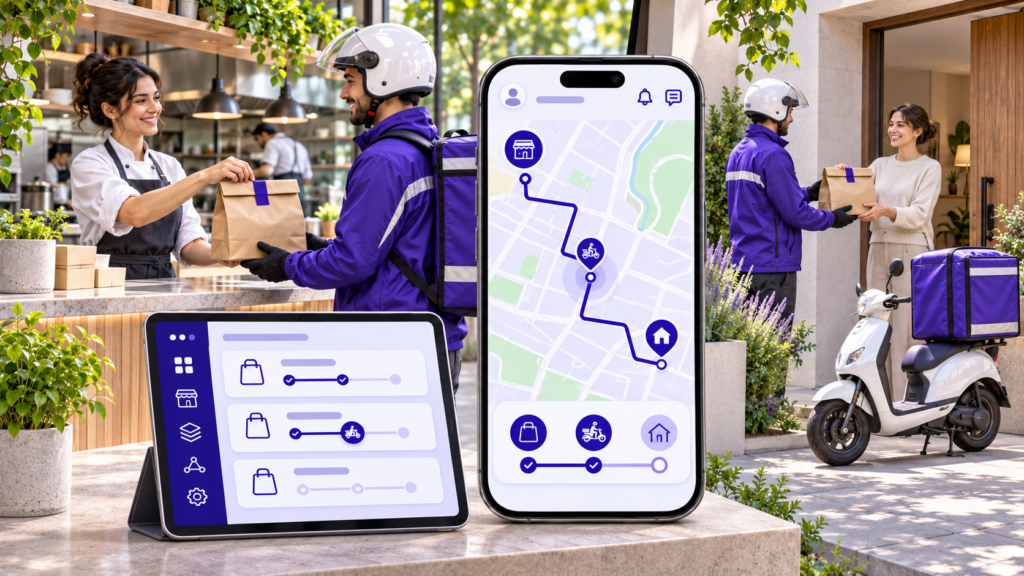
A last mile food delivery app is a branded system that takes a customer’s order, tells the kitchen when to cook, assigns a rider at the right moment, tracks the food to the door and settles the money between the restaurant, the rider and the platform. The restaurant owns the app, the customer and the order data.
The term comes from logistics, where the last mile is the final leg from a local hub to the end customer. In food, that hub is the kitchen and the leg is usually under 8 km. It is also the leg where most delivery problems show up. Food goes cold, riders wait at the counter, and a 20-minute promise becomes 45 minutes during the Friday rush.
How is it different from an online ordering page?
An ordering page only takes the order and the payment. What happens after checkout is left to the restaurant: someone phones a rider, someone answers “where is my food?” calls, someone works out who gets paid what at the end of the week. A last mile delivery app covers that second half. It dispatches riders automatically, shows live GPS to the customer and keeps a settlement ledger for every order.
How is it different from listing on an aggregator?
On a marketplace such as DoorDash or Uber Eats, the restaurant rents access to the platform’s customers and riders and pays a commission on every order. The marketplace keeps the customer relationship, controls the delivery experience and sets the rules. With your own app, you set the delivery fee, the radius and the service level, and the customer’s order history stays with you. The trade-off is that you also own the work of bringing customers in.
How does last mile food delivery work, step by step?
Every order moves through six states, and each one should be visible to the customer, the kitchen, the rider and the operations team at the same time. If any party loses sight of the order, the phone starts ringing.
Order placed. The customer checks out in the app or on the website. The payment is authorised, not captured, and the restaurant gets an alert with the items, modifiers and any notes.
Restaurant accepts and sets a prep time. The kitchen confirms it can make the order and enters how long it will take, for example 15 minutes. This single number drives everything that follows, so a good restaurant panel makes it a one-tap action with sensible defaults per item.
Rider assigned. Dispatch picks a rider whose travel time to the restaurant matches the prep time. Assign too early and the rider stands at the counter unpaid. Assign too late and the food sits under a heat lamp.
Picked up. The rider confirms the handover in the app, often with an item count and a packaging check. The customer sees the status change immediately.
En route. The customer follows the rider on a live map, and the ETA is recalculated as traffic changes rather than fixed at checkout.
Delivered. The rider captures proof of delivery with a photo, a signature or a one-time PIN. Payment is captured, and the restaurant’s share, the rider’s earnings and the platform fee are queued for payout.
Why are restaurants running their own delivery instead of relying on aggregators?
Restaurants run their own delivery to stop paying a percentage of every order to a marketplace and to keep the customer relationship. Aggregators are good at finding new customers. They are expensive at serving repeat ones, and repeat customers are most of a successful restaurant’s delivery volume.
The commission is the visible cost. DoorDash’s published US merchant plans charge 15%, 25% or 30% of the order subtotal on delivery orders, depending on the plan. Take a restaurant doing 1,500 delivery orders a month at a USD 30 average ticket, on a 25% plan. That is USD 45,000 in monthly delivery sales and USD 11,250 a month in commission, before promotions.
The hidden cost is the data. The marketplace decides who sees your menu, owns the customer’s email and phone number, and can show a competitor’s dish on the same screen as yours. You cannot send a regular a loyalty offer, and you cannot see why someone stopped ordering.
Running your own channel is not free either. You pay riders or a delivery partner, a platform fee, payment processing and the marketing that brings customers to your app. For most restaurants the answer is a hybrid. Keep the marketplace for discovery, and move regulars to the direct app with a lower delivery fee or a loyalty reward. DeliveryStack’s guide to getting off third-party aggregators covers that transition in more detail.
What apps does a restaurant delivery platform need?
A complete restaurant delivery platform has four apps that share one backend: a customer app and website for ordering, a rider app for pickups and drops, a restaurant panel for the kitchen, and an admin console for the operations team. Remove any one of them and a person ends up doing that job on the phone.
Customer app and website
This is the ordering surface on iOS, Android and the web. It needs menus with modifiers and combos, delivery-radius awareness so customers outside the zone see it before checkout, saved cards and wallets, scheduled orders, live tracking and one-tap reorder. Reorder matters more than it looks. It is the single feature that turns a first order into a habit.
Rider app
The rider app shows incoming offers with the distance, payout and prep time up front, so riders can accept or decline with full information. After acceptance it handles navigation to the restaurant and the customer, a pickup checklist at the counter, proof of delivery and a per-trip earnings breakdown with tips and incentives.
Restaurant panel
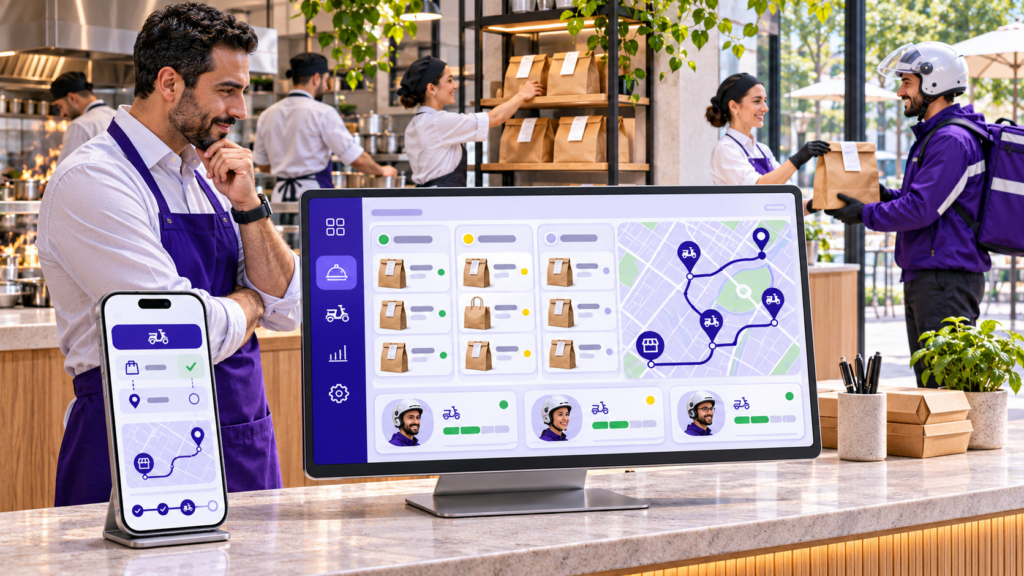
The kitchen uses this on a tablet or the POS screen. It takes incoming orders, sets prep times, marks items sold out mid-service, pauses the store when the kitchen is overwhelmed and shows daily sales and payout statements. If your POS has a connector, accepted orders should go straight into the kitchen display rather than being re-keyed.
Admin console
The operations team runs the business from here. It covers restaurant and rider onboarding with document checks, delivery zones and fees, commission rules, promotions, refunds with reason codes, a live order map with manual dispatch overrides and an exception queue for late or failed orders.
Which features matter most for food delivery specifically?
The features that decide whether food arrives hot are prep-time-aware dispatch, controlled batching, live menu availability and peak-hour rider supply. Payment settlement between restaurant, rider and platform decides whether the business can scale past a few hundred orders a day. Generic courier software usually lacks all of these.
Prep-time-aware dispatch assigns the rider based on when the food will be ready, not only on who is closest. The goal is for the rider to walk in as the bag is sealed. Good systems also flag restaurants whose prep estimates are consistently wrong so ops can fix the defaults.
Batching with detour limits lets one rider carry two or three compatible orders from the same area. It lowers cost per delivery at peak, but every extra drop adds minutes to the first customer’s wait. Set a maximum detour per zone, and switch batching off for premium or long-distance orders.
Live menu and sold-out control keeps the app in step with the kitchen. Items run out at 8 pm on a Saturday, prices differ by outlet, and modifiers multiply. If staff cannot mark an item unavailable in one tap, you will refund it later.
Zones and distance-based pricing let you draw a geofence around each outlet and charge more for longer trips. A tight radius at launch, often 3 to 5 km, protects food quality while you learn your real delivery times.
Peak-hour surge and rider incentives pull rider supply into the lunch and dinner windows, where most of a restaurant’s delivery volume lands. Without them, peak orders wait for riders and off-peak riders wait for orders.
Three-way settlement splits each order between the platform, the restaurant and the rider, including refunds and adjustments that arrive after the fact. If this is done in a spreadsheet, it breaks at around the point you add a second outlet.
Proof of delivery with a photo, signature or one-time PIN settles “I never got it” disputes. Many operators make the PIN mandatory above a set order value.
Exception handling puts late orders, rejected pickups and failed payments into one queue with one-click reassign, refund or notify actions. This is what keeps a small ops team from spending the dinner rush on the phone.
Which last mile delivery model fits your restaurant?
Restaurants have three ways to staff the last mile: their own riders, an on-demand partner fleet paid per delivery, or a hybrid of both. Own riders give the most control and the lowest cost per drop at steady volume. A partner fleet suits low or unpredictable volume. Most growing restaurants end up hybrid.
Own fleet. You hire or contract riders, set shifts around your peaks and control the handover, the uniform and the service. It pays off once you have enough orders per rider-hour to keep riders busy. The downside is fixed cost during quiet afternoons and the work of recruiting, scheduling and managing riders.
On-demand partner fleet. Your app takes the order, and a delivery network’s courier carries it for a flat fee per delivery. DoorDash, for example, charges a flat per-order fee rather than a commission when its couriers deliver orders placed on a restaurant’s own website or app. You keep the customer and the data but give up control of the rider experience.
Hybrid. Your riders cover the core zone and the peak hours, and overflow or far-zone orders go to a partner fleet. This needs dispatch software that can route an order to either pool without staff stepping in.
The business model matters as much as the fleet. A single restaurant needs one zone, one menu and a small rider pool. A multi-location brand needs a shared catalogue with per-outlet pricing, availability and delivery zones. A cloud kitchen running several virtual brands from one kitchen needs combined orders and one pickup per rider. A multi-vendor marketplace, where you deliver for many restaurants in a city, adds restaurant onboarding, per-restaurant commission and payouts. DeliveryStack sets these up as configurations of the same platform, so a single restaurant can later open the app to partner kitchens without a rebuild.
Should you build a custom app, use a no-code builder or choose a white-label platform?
Choose white-label if you want to be live in weeks with dispatch, payments and settlement already proven in production. Choose custom development only when your model needs workflows no delivery platform supports and you have 6 to 12 months of runway. No-code builders suit a test or a single small outlet, not a delivery operation.
Custom development gives you full control of the code and the roadmap. It also makes you rediscover every hard problem in delivery: dispatch timing, real-time GPS, multi-party payouts, refunds and disputes, rider onboarding and surge pricing. Each one looks like a small feature until it moves the launch date. You then own maintenance, app store updates and security patches for as long as the platform runs. Aalpha’s guide to food delivery app maintenance explains what that ongoing work involves.
No-code builders get an ordering app online quickly and cheaply. They tend to stop at the point where food delivery gets specific: prep-time-aware dispatch, batching rules, rider payouts and fully branded apps under your own App Store and Google Play accounts. DeliveryStack sets out where no-code builders stop being enough.
White-label platforms give you a working customer app, rider app, restaurant panel and admin console under your brand, configured to your zones, fees and commission rules. The trade-offs are a recurring platform fee and working within the platform’s data model. Unusual features cost extra. Check that the apps are published under your own developer accounts and that you can export all customer and order data at any time. If either answer is no, keep looking.
For most single restaurants, restaurant groups and regional delivery marketplaces, white-label is the better first move. You can still commission custom features on top once real order data shows which ones matter. DeliveryStack’s comparison with custom development walks through the cost and timeline side by side.
How much does a last mile food delivery app for restaurants cost?
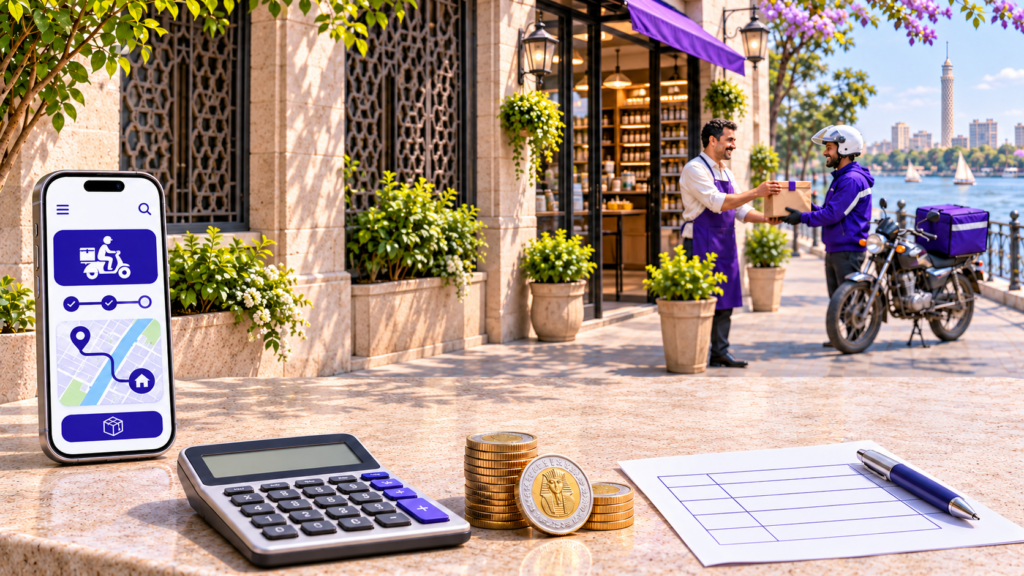
A custom-built food delivery platform with customer, rider, restaurant and admin apps typically costs USD 40,000 to 150,000 or more before launch, depending on scope and team location. A white-label platform replaces most of that with a one-time setup fee and a monthly licence. Riders, payment processing and marketing are extra in both cases.
Team location moves the custom figure more than anything else. Aalpha’s on-demand app development cost calculator shows one sample on-demand scope of 2,109 hours costing USD 31,500 to 52,500 at Aalpha’s India rates. The same hours cost USD 211,000 to 380,000 at typical US agency rates. Those figures cover the build only.
On DeliveryStack, a single-city, single-vertical food delivery launch starts at a one-time setup of USD 10,000 to 20,000, with managed hosting and updates included and monthly plans from USD 1,000. The final price depends on order volume, the number of cities and any custom features.
Budget separately for the running costs that no quote includes. Apple charges USD 99 a year for a developer account and Google Play charges a one-time USD 25. Payment gateways take a percentage of each transaction. Maps, geocoding and SMS are billed by usage, which grows with orders. Rider pay or partner-fleet fees are usually the largest line of all, so model them per delivery before you set your delivery fee.
How long does it take to launch a restaurant delivery app?
A white-label restaurant delivery app goes live in 2 to 4 weeks, including branding, configuration, testing, data loading, staff training and app store approval. A custom-built app usually takes 6 to 12 months, because dispatch, payments and payouts all have to be designed, built and tested from scratch before the first real order.
The DeliveryStack deployment sequence shows where those weeks go. Configuration of zones, commission, payout rules and order flow takes 2 to 3 days. Branding the apps and testing order, payment and dispatch flows against your rules takes 3 to 5 days. Loading menus, riders and pricing and training your team on the admin console takes another 3 to 5 days. Store submission and go-live take 2 to 3 days.
The usual cause of delay is not software. It is a menu that is not ready, rider contracts still being signed or a payment gateway account still in review. Start those three on day one.
What should restaurants measure after launching delivery?
The numbers that matter most are order-to-doorstep time, rider wait time at the counter, prep-time accuracy, cost per delivery and the share of repeat customers ordering direct. Revenue tells you the channel is growing. These five tell you whether it is profitable and whether customers will come back.
Order-to-doorstep time is what the customer actually experiences, from checkout to handover. Across live DeliveryStack food deployments the median is 24 minutes. Track the median and the slowest 10% of orders separately, because the slow tail is where complaints and one-star ratings come from.
Rider wait at the counter shows whether dispatch and the kitchen are in step. If riders routinely wait more than five minutes, either prep times are understated or riders are being assigned too early. Both cost money.
Prep-time accuracy compares the time the kitchen entered with the time the order was actually ready. Review it per outlet and per item. A burger that always takes 18 minutes against a 12-minute default will throw off every ETA at dinner.
Cost per delivery adds rider pay, incentives, partner-fleet fees and packaging, then divides by delivered orders. Compare it with the delivery fee you charge and with the commission you would have paid a marketplace for the same order.
Repeat rate and direct share tell you whether the app is doing its job. If customers order once and go back to the marketplace, look at reorder flow, delivery fee and loyalty offers before spending more on acquisition.
What mistakes do restaurants make when launching their own delivery app?
The most common mistakes are drawing the delivery radius too wide, launching without enough riders at peak, skipping prep-time setup and leaving the marketplaces on day one. Each one damages early reviews, and early reviews decide whether the direct channel grows.
A wide radius looks like more customers on paper. In practice, a 10 km trip in evening traffic delivers lukewarm food and ties up a rider for a full cycle. Start tight and widen zone by zone as your delivery times hold.
Thin rider supply at 8 pm on a Friday is the fastest way to lose a new customer. Plan rider shifts or a partner-fleet overflow around your known peaks before launch, not after the first bad weekend.
Packaging gets ignored until the reviews mention soggy fries. Vented boxes, sealed soup containers and tamper-evident bags cost little compared with a refund.
Cutting the marketplaces too early removes your discovery channel before the direct app has customers. Run both, price the direct channel slightly better and use in-bag inserts with a first-order code to move regulars across.
Underpricing delivery is the last trap. If the delivery fee does not cover cost per delivery at your average order value, every direct order loses money. Set a minimum order value or distance-based fees from the start.
How do you launch a restaurant delivery app in 30 days?
A 30-day launch works when the restaurant prepares its menu, riders and payment account while the platform is being configured. Software is rarely the slow part on a white-label platform. The work splits into setup in week one, testing in week two, a soft launch in week three and a public launch in week four.
In week one, finalise the menu with photos, modifiers and prep times per item. Open the payment gateway account, sign rider contracts or a partner-fleet agreement, and decide your zones, delivery fees and minimum order values. Your platform team configures the apps in parallel.
In week two, test real orders end to end with staff as customers. Time every handover, check the receipts and settlement statements, and fix prep-time defaults that come out wrong.
In week three, soft launch to a small group such as loyalty members or regular dine-in guests. Keep the radius tight and watch the exception queue closely during each peak.
In week four, open to the public. Put first-order codes in every marketplace bag, add the app link to your Google Business Profile and website, and review order-to-doorstep time and rider wait daily for the first month.
What is the next step?
If you are paying marketplace commission on a steady base of repeat orders, the next step is to price your own channel against it. Book a DeliveryStack demo to see the customer, rider, restaurant and admin apps working with prep-time-aware dispatch, and get a quote based on your outlets, cities and order volume.
Frequently asked questions
What is last mile delivery in the food industry?
Last mile delivery in food is the final leg of an order, from the restaurant kitchen to the customer’s door. It covers rider assignment, pickup, travel, handover and proof of delivery. It is the most time-sensitive part of food delivery because cooked food loses quality within minutes.
Is running your own delivery cheaper than using DoorDash or Uber Eats?
It is usually cheaper per order once you have steady repeat volume, because you stop paying a 15% to 30% commission. You take on rider costs, a platform fee and marketing instead. Most restaurants keep marketplaces for discovery and move regular customers to their own app.
Do I need my own riders to launch a restaurant delivery app?
No. You can launch with an on-demand partner fleet that charges a flat fee per delivery, then add your own riders for peak hours or your core zone as volume grows. Hybrid dispatch sends each order to whichever rider pool fits it best.
Can a restaurant delivery app connect to my POS?
Yes, where a connector exists for your POS or kitchen display system. Accepted orders then go straight to the kitchen without re-keying, which removes a common source of errors at peak. Check POS compatibility before you sign with any platform.
How do restaurants keep food hot during last mile delivery?
They time rider assignment to the kitchen’s prep estimate, keep the delivery radius tight, limit batching detours and use insulated bags with vented packaging. Prep-time-aware dispatch matters most, because it stops food waiting at the counter for a rider who is still several minutes away.
Will the app be published under my own brand?
On a true white-label platform, yes. Your name, logo, colours and domain appear on every screen, and the apps are listed under your own App Store and Google Play developer accounts. Customers, riders and restaurant staff never see the platform provider’s name.
Can I start with one outlet and add more locations later?
Yes. On a configurable platform, each new outlet gets its own delivery zone, menu availability and pricing, and a new city is a setup task rather than a new development project. Starting small also lets you set accurate prep times before you scale.