ChatGPT
 Claude
 Gemini
 Grok
Pizza Delivery App Development: A Complete Guide
TLDR
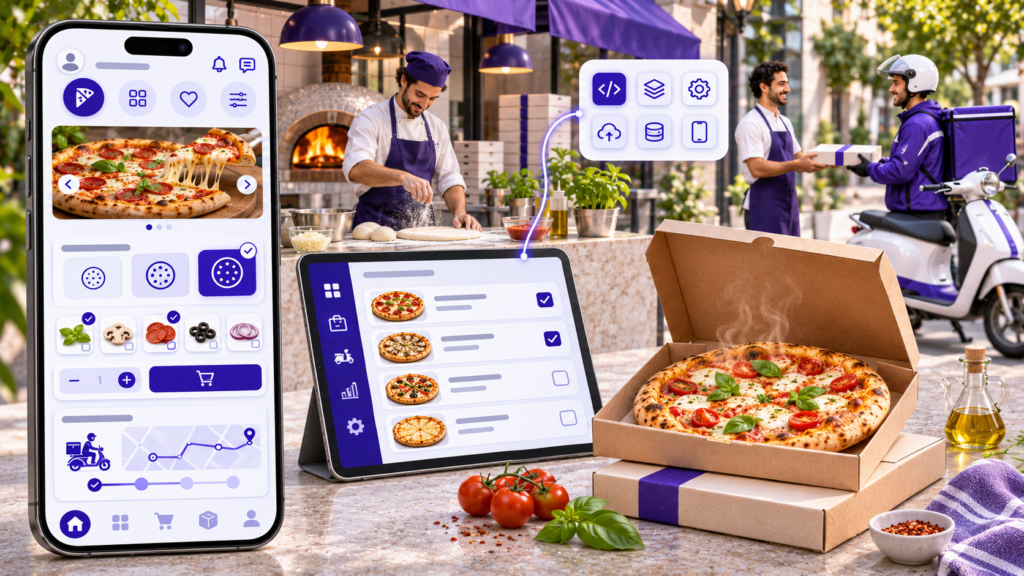
Pizza delivery app development is the process of building the customer app, store panel, driver app and admin dashboard a pizza business needs to take orders and deliver them under its own brand. The pizza-specific parts are a topping builder with half-and-half pricing, deal bundles, an order tracker tied to oven stages and tight delivery zones that keep pizza hot. A custom build usually costs USD 25,000 to 150,000 and takes 3 to 9 months, depending on whether you run one store, a chain or a marketplace. A white-label platform such as DeliveryStack launches in 2 to 4 weeks from USD 1,000 per month. Most single-brand pizza businesses should start white-label and go custom only when their workflow has no standard equivalent.
What is a pizza delivery app and how does it work?
A pizza delivery app is a branded ordering system that lets customers build a pizza, pay and track it to their door. It runs on four connected parts: a customer app, a store or kitchen panel, a driver app and an admin dashboard. Orders, payments and driver locations sync between them in real time, so the kitchen, the driver and the customer see the same order status.
The category matters because pizza is already a digital-first product. Domino’s reported that more than 85% of its US retail sales in 2025 came through digital channels. Domino’s Pizza Group, the UK and Ireland franchisee, reported about 8 million app customers in its FY2025 results, accounting for roughly 75% of its digital orders. Independent pizzerias compete for the same customers, on the same phones.
The order flow, step by step
- The customer opens the app, which detects their address and picks the nearest store that delivers to it.
- They build a pizza (size, crust, sauce, toppings), add a deal or sides and pay by card, wallet or cash on delivery.
- The store panel or kitchen display receives the order with a prep-time estimate, and the customer sees the order confirmed.
- The tracker moves through prep, oven, quality check and out for delivery as staff update each stage.
- The dispatch engine assigns the nearest available driver, or batches two orders heading the same way.
- The driver navigates to the address, the customer follows the driver on a live map, and the order closes with a delivery photo or OTP.
- The customer rates the order and gets a reorder button and loyalty points for next time.
Each step generates data the business owns: order history, favourite pizzas, delivery times by zone and repeat rates. That data is the main reason pizza brands build their own app instead of relying only on marketplaces.
What types of pizza delivery apps can you build?
There are three types of pizza delivery app: a single-store ordering app, a multi-location chain app and a multi-vendor pizza marketplace. The type sets your feature list, cost and timeline more than any other decision. A single pizzeria needs simple ordering and its own drivers. A chain needs store routing by zone. A marketplace needs vendor onboarding, commissions and payouts.
Single-store app. A single-store app suits one pizzeria with its own delivery staff. It covers ordering, the pizza builder, payments and simple driver assignment. It is the cheapest type to run but the hardest to grow, because low order volume makes every paid download expensive. Most of the work is getting regulars to install it, usually with a first-order discount and app-only deals.
Multi-location chain app. A chain app suits franchises and chains with anywhere from 2 to 500 stores. It adds a shared menu, per-store zones and prices, store routing and central reporting. It carries the best economics: one app, one marketing budget and one loyalty programme serve every store, and the routing logic sends each order to the store that can deliver it fastest. The downside is internal. Franchisees often resist a central system unless it shows them their own numbers.
Multi-vendor marketplace. A pizza marketplace suits founders aggregating local pizzerias in one city. It adds vendor onboarding, commission rules, settlements and ratings. It carries the most risk, because it needs pizzerias and customers at the same time in each city, and it competes head-on with DoorDash, Uber Eats and Deliveroo, which already have both.
Why do pizza businesses build their own app instead of relying on aggregators?
Pizza businesses build their own app to keep the margin and the customer data that marketplaces take. Aggregator commissions on delivery orders run from 15% to 30% of the order subtotal in the US. On your own app, a repeat customer costs a payment fee and your delivery cost, not a quarter of the bill.
What the commission costs in practice
DoorDash’s published US merchant pricing charges 15% on Basic, 25% on Plus and 30% on Premier for marketplace delivery orders. Take a pizzeria doing 1,000 delivery orders a month at a USD 35 average order. On Basic it pays USD 5.25 per order, or USD 5,250 a month. On Plus it pays USD 8.75 per order, or USD 8,750 a month. On Premier it pays USD 10.50 per order, or USD 10,500 a month.
Shifting even half of those orders to your own app recovers USD 2,600 to 5,250 a month on these assumptions. That is the budget that pays for the app.
Where the argument stops
Your own app does not replace what the commission buys. Aggregators bring discovery, a driver network and customers who would never search for your name. With your own app you pay for drivers, insurance and marketing yourself. The commission saving only holds if your delivery cost per order stays below the commission rate.
The working model for most pizza brands is hybrid. Use marketplaces to acquire new customers, then move repeat customers to your app with app-only deals and loyalty points. Domino’s Pizza Group follows this pattern: its FY2025 results show it began its Just Eat rollout in 2022 and Uber Eats in 2024, while its own app carries about three quarters of digital orders. For a full walkthrough of the switch, see getting off third-party aggregators.
What features does a pizza delivery app need?
A pizza delivery app needs features in four places: the customer app for ordering and tracking, the store panel for accepting and preparing orders, the driver app for deliveries and earnings, and the admin dashboard for zones, pricing and reports. Leaving out any one of the four pushes that work back onto phone calls and spreadsheets.
Customer app (iOS, Android and web)
Ordering basics cover sign-up by phone or social login, saved addresses and a store finder that respects delivery zones. The menu should load fast on a poor connection, because many orders are placed from sofas with weak Wi-Fi.
Checkout and payments need cards, Apple Pay and Google Pay, local wallets such as UPI in India, and cash on delivery where it is still common, including much of the Gulf. Promo codes, tips and a scheduled-order option belong here too.
Tracking and retention cover live order status, a driver map, push notifications, ratings, one-tap reorder and a loyalty wallet. Reorder matters more for pizza than most food, because customers tend to order the same pizza again.
Store panel and kitchen display
The store panel receives orders with an audible alert, shows prep-time targets and lets staff mark items out of stock in seconds. A kitchen display screen should show the full topping build for each pizza, including each half. Staff also need daily sales, item reports and a way to pause delivery when the kitchen is overloaded.
Driver app
The driver app handles shift check-in, order assignment, turn-by-turn navigation and proof of delivery by photo or OTP. It also tracks cash collected, tips and earnings per shift. Background location tracking drains batteries, so the app should switch to low-frequency updates when the driver is idle.
Admin dashboard
The admin console is where the business runs. It holds menu and pricing per store, delivery zones and fees, promotions, driver and store management, refunds, and reports on orders, revenue and delivery times. Every setting the operations team changes weekly should be editable without a developer.
Which features make a pizza app different from a generic food delivery app?
Five features separate a pizza delivery app from a generic food app: a visual pizza builder with half-and-half pricing, a deal engine for bundles, a tracker tied to kitchen stages, delivery zones sized for hot food, and peak-hour order throttling. Generic restaurant apps treat a pizza as one menu item with add-ons. That breaks as soon as a customer orders two halves with different toppings.
Pizza builder with half-and-half pricing
The builder lets customers choose size, crust, sauce, cheese and toppings, with a live preview and a running price. The hard part is pricing rules. A topping on one half might cost 50% of a full topping, or full price, or be free up to three. Extra cheese might count as a topping or not. These rules differ by brand, so they must be configurable, not hard-coded.
Deal and bundle engine
Pizza sales run on deals: two large for a fixed price, a meal box with sides and a drink, or a midweek discount. The engine has to pick the cheapest valid deal for the basket automatically. Customers abandon carts when they find out after paying that a better deal applied.
Order tracker tied to kitchen stages
Customers check the app several times while waiting. A tracker that moves through prep, oven, quality check and out for delivery answers the “where is my pizza” call before it happens. The stages should update from the kitchen display or POS, not from a timer, or the tracker will lie during a rush.
Delivery zones built around hot food
Pizza loses quality fast. Domino’s Pizza Group reported an average UK delivery time of 24.3 minutes in 2025, and customers judge everyone else against that. Set zones by drive time rather than by radius, cap driver batching at two orders, and route each address to the store that can deliver it fastest.
Peak-hour throttling
Friday evenings and big sports nights flood a kitchen with orders it cannot bake in time. Throttling caps orders per 15-minute slot per store, then offers the next available time or switches the customer to carryout. Without it, a successful promotion produces late, cold pizza and one-star reviews.
Other pizza-relevant features worth planning for are carryout and curbside pickup, group orders for offices and parties, saved favourite pizzas, and integration with the POS your stores already run.
How much does it cost to build a pizza delivery app?
A custom pizza delivery app costs between USD 25,000 and USD 150,000 or more to build. A single-store ordering app sits at the low end. A chain app with its own driver fleet and dispatch sits in the middle. A multi-vendor marketplace sits at the top. A white-label platform replaces the upfront build with a monthly fee, starting from USD 1,000 on DeliveryStack.
Single-store ordering app. Expect USD 25,000 to 45,000 and 3 to 4 months. That covers a customer app for iOS, Android and web, the pizza builder, payments, a store panel and basic driver assignment.
Multi-location chain app. Expect USD 45,000 to 90,000 and 4 to 6 months. On top of the single-store scope, it adds a driver app, automated dispatch, per-store zones and pricing, POS integration and loyalty.
Multi-vendor pizza marketplace. Expect USD 80,000 to 150,000 or more and 6 to 9 months. It adds vendor onboarding, commissions, settlements, vendor apps and marketplace search to everything above.
White-label platform. On DeliveryStack, the customer, driver, store and admin apps are already built, so you pay from USD 1,000 per month and launch in 2 to 4 weeks after configuration and branding.
These ranges assume a full-stack agency team in India or Eastern Europe, native-feel cross-platform apps, one launch country and one payment gateway. US and Western European agencies typically quote two to three times higher for the same scope. Each extra country, language or payment gateway adds cost.
What the build price leaves out
Running costs continue after launch. Budget for cloud hosting, maps and routing APIs billed per request, SMS and push notifications, payment gateway fees per transaction, and app store developer accounts. Maintenance usually runs 15% to 20% of the build cost each year, covering OS updates, security patches and store policy changes. The DeliveryStack vs custom development comparison lists the costs that tend to surface only after launch, such as payment reconciliation and admin tooling.
The cheapest option is not always the right one. A white-label fee runs for as long as you use the platform. A custom build costs more on day one but gives you code you can change without anyone’s roadmap.
How long does it take to build a pizza delivery app, and what are the steps?
A custom pizza delivery app takes 3 to 9 months from discovery to app store launch, depending on scope. A single-store MVP can ship in about 3 months. A chain or marketplace takes 6 to 9. A white-label deployment takes 2 to 4 weeks because the apps already exist and only need configuration, branding and data.
The custom build process
- Discovery (1 to 2 weeks). Map the business model, delivery zones, menu structure, deal rules, payment methods and POS. The output is a written scope with a fixed feature list.
- UX and UI design (2 to 4 weeks). Wireframes, then branded screens for the customer app, store panel, driver app and admin. Test the pizza builder with real customers before any code is written.
- Backend and API (6 to 12 weeks). Orders, menu and pricing rules, dispatch, payments, notifications and reporting. This runs in parallel with app development.
- App development (6 to 12 weeks). Customer apps for iOS, Android and web, plus the driver app and panels.
- Integrations (2 to 4 weeks). POS, payment gateways, maps, SMS and loyalty.
- QA and pilot (3 to 4 weeks). Functional testing, load testing for Friday peaks, then a pilot in one store with real orders.
- Launch (1 to 2 weeks). App Store and Google Play submission. Apple review can reject apps over location permissions or payment flows, so leave buffer.
The pilot step is the one teams most want to skip, and the one that most often saves the launch. One store, two weeks, real customers: it shows you the dispatch and kitchen problems that test cases do not.
The white-label process
On DeliveryStack, deployment runs in four steps: configuration of zones, fees and order flow; branding and testing; loading menus, stores and drivers with team training; then app store launch under your own name. The trade-off is that features outside the platform are quoted and built on top, which adds time.
What tech stack and integrations does a pizza delivery app use?
A typical pizza delivery app uses a cross-platform mobile framework for the customer and driver apps, Next.js for the web ordering site and admin, a Node.js backend, PostgreSQL for orders and Redis for live locations. WebSockets carry real-time status. Google Maps or Mapbox handle routing. Stripe, Razorpay or a regional gateway handle payments.
Apps and web front end. React Native or Flutter builds the customer and driver apps from one codebase for iOS and Android, which cuts build and maintenance cost. Next.js runs the web ordering site and the admin, giving fast menu pages that search engines can index.
Backend and data. Node.js handles the many open connections that tracking and notifications need. PostgreSQL stores orders, payments and reports, which are relational and need strict consistency. WebSockets backed by Redis push order stages and driver positions to every screen without polling.
Maps, payments and messaging. Google Maps Platform or Mapbox handle geocoding, drive-time zones, ETAs and navigation. Stripe, Adyen, Razorpay or a regional gateway handle cards, wallets, refunds and payouts. Firebase Cloud Messaging, Apple Push and SMS carry order updates and offers.
Hosting. AWS, Google Cloud or Azure provide the autoscaling a pizza app needs for Friday nights and big match nights, when order volume spikes well above the weekday baseline.
Cross-platform frameworks have one downside worth knowing: background location in the driver app needs native modules on both platforms. Budget a few extra days for it rather than assuming the framework handles it.
Integrations that decide whether stores adopt the app
POS integration matters most. If orders do not drop straight into the POS your stores already use, such as Square, Toast or Petpooja, staff retype them and errors follow. Check the POS vendor’s API access early, because some charge partner fees or limit write access.
Payment gateways must match the market. US customers expect Apple Pay. Indian customers expect UPI. In the UAE and Saudi Arabia, cash on delivery and local cards still matter. Regulated markets add compliance work, so plan for PCI DSS from the start.
Loyalty and marketing tools close the loop. Connecting the app to your CRM or email platform turns order history into targeted offers, which is where the margin from owning the customer actually shows up.
Should you build a custom pizza app, use white-label, or stay on aggregators?
Choose a custom build when your operating model has no standard equivalent or the app itself is the product you plan to sell. Choose white-label when you run a standard pizza delivery model and want to launch in weeks. Stay on aggregators only while you test demand, because you never own the customer there.
Cost. A custom build costs USD 25,000 to 150,000 or more upfront, then 15% to 20% of that each year for maintenance, plus hosting. White-label replaces the upfront build with a setup fee and a monthly fee from USD 1,000 that includes managed hosting and updates. Aggregators cost nothing upfront but take 15% to 30% of every US delivery order.
Speed. Aggregators can list you in days. White-label launches in 2 to 4 weeks. A custom build takes 3 to 9 months before the first order.
Ownership. With custom or white-label, the brand, the app store listing and the customer data are yours, and white-label data can be exported. On aggregators, the marketplace owns the listing and holds most of the customer data.
Flexibility. Custom builds pizza features exactly to spec. White-label configures them, with custom work quoted on top, and the platform’s roadmap limits deep changes. Aggregators fix the features for everyone.
Custom fits an established chain with unusual operations, such as a hub-and-spoke kitchen model, or a funded startup whose platform is the asset it will license to others. It also suits teams with in-house engineers to maintain it.
White-label fits most independents, small chains and franchisees. You get your brand on the App Store and Google Play, and your budget goes to drivers and marketing instead of building dispatch from zero.
Aggregators fit a test phase or a top-of-funnel role. Keep them for discovery even after your app launches, as Domino’s does.
What mistakes do pizza businesses make when building a delivery app?
The most common mistakes are hard-coding pizza pricing rules, launching without a driver plan, skipping POS integration, and treating the app launch as the finish line. Each one is cheap to avoid at the scoping stage and expensive to fix after customers have installed the app and left reviews.
Hard-coded pricing. If half-and-half rules, deal logic and store-level prices live in code, every menu change needs a developer. Make them admin settings from day one.
No driver plan. An app that takes 300 orders on a Friday needs drivers to deliver them. Decide early whether you run your own fleet, use a third-party courier for overflow, or both, and build dispatch for that model.
Ignoring the kitchen. Most apps are designed from the customer screen backwards. If the kitchen display is slow or unclear, prep times slip and the tracker becomes wrong. Test with your kitchen staff, not only with customers.
Underestimating app store review. Apple and Google check location permission wording, background tracking and payment flows. A rejection can cost one to two weeks, so submit early and keep the launch date flexible.
No plan to move customers onto the app. Downloads do not come from the listing alone. Print the QR code on every box, give app-only deals, and offer loyalty points that only exist in your app. Marketplace customers will not switch without a reason.
How does DeliveryStack help you launch a pizza delivery app?
DeliveryStack is a white-label delivery platform that gives a pizza business its own branded customer app, driver app, store panel and admin dashboard in 2 to 4 weeks. It runs on a dispatch engine already used in live deployments, so you configure zones, deals and payouts instead of building them. Pricing starts from USD 1,000 per month.
The platform’s food and restaurant vertical already covers prep-time-aware dispatch, live menus, per-store delivery zones and three-way settlement between the business, stores and drivers. A single pizzeria and a 50-store chain use the same platform with different configurations. When your business grows into grocery or courier, those verticals switch on from the admin panel without a rebuild.
DeliveryStack is built by Aalpha Information Systems, which has delivered 5,500+ software projects and holds a 4.9/5 rating from 215+ reviews on Clutch. Aalpha’s pizza work includes web development for a Domino’s pizza restaurant franchise, and its wider food and beverage software practice covers ordering and restaurant operations.
One honest limit: if your model departs completely from standard pizza delivery, a custom build may serve you better, and the team will say so during scoping.
Next step
Book a DeliveryStack demo to see the customer, driver and store apps running with a pizza menu, and get a fixed quote for your stores, cities and volume. Pricing details are on the pricing page.
Frequently asked questions
How much does it cost to make a pizza delivery app?
A custom pizza delivery app costs USD 25,000 to 45,000 for a single store, USD 45,000 to 90,000 for a chain with its own drivers, and USD 80,000 to 150,000 or more for a multi-vendor marketplace. A white-label platform such as DeliveryStack starts from USD 1,000 per month with no large upfront build.
How long does it take to build a pizza delivery app?
A custom build takes 3 to 4 months for a single-store app and 6 to 9 months for a chain or marketplace, including design, development, testing and app store review. A white-label pizza delivery app goes live in 2 to 4 weeks, because only configuration, branding and data loading remain.
Can I build a pizza app like Domino’s?
Yes. The core features of the Domino’s app, including the pizza builder, deal engine, stage-by-stage tracker, loyalty and live driver map, are standard in modern delivery platforms. What Domino’s adds is scale and years of data. A new brand can match the app experience and compete on product, speed and local loyalty.
Do I need my own delivery drivers for a pizza app?
Not necessarily. Many pizzerias run their own drivers for core zones and send overflow to a third-party courier at peak times. Your own drivers give you control over speed and food quality. Couriers avoid fixed staff costs but charge per order and may batch your pizza with other deliveries.
Is a white-label pizza delivery app better than a custom app?
For most independents and small chains, yes. White-label launches in weeks at a predictable monthly cost, with your brand on every screen. Custom is the better choice when your operations are unusual or the platform itself is the asset you plan to sell, and you have the budget and time for a 6 to 9 month build.
Can a pizza delivery app integrate with my POS?
Yes, most modern POS systems such as Square, Toast and Petpooja offer APIs for receiving online orders. Integration sends each app order straight to the POS and kitchen display, so staff do not retype it. Check API access and any partner fees with your POS vendor before development starts.